Results by title
6 books match the query 'Collaborative Ethnography'

Checkpoint, Temple, Church and Mosque
A Collaborative Ethnography of War and PeaceJonathan Spencer, Jonathan Goodhand, Shahul Hasbullah, Bart Klem, Benedikt Korf, and Kalinga Tudor Silva
Pluto Press, 2014
Is religion best seen as only a cause of war, or is it a source of comfort for those caught up in conflict?
Checkpoint, Temple, Church and Mosque is based on fieldwork in Sri Lanka’s most religiously diverse and politically troubled region in the closing years of the civil war. It provides a series of new and provocative arguments about the promise of a religiously based civil society, and the strengths and weaknesses of religious organisations and religious leaders in conflict mediation. It argues that for people trapped in long and violent conflicts, religion plays a contradictory role, often acting as a comforting and stabilising force but also, in certain situations, acting as a source of new conflict. Additionally, war itself can lead to profound changes in religious institutions: Catholic priests engage with Buddhist monks and new Muslim leaders, while Hindu temples and Pentecostal churches offer the promise of healing.
This book will provoke new debate about the role of religious organisations and leaders in situations of extreme conflict and will be of great interest to students of anthropology, development studies, religious studies and peace/conflict studies.
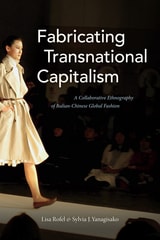
Fabricating Transnational Capitalism
A Collaborative Ethnography of Italian-Chinese Global FashionLisa Rofel and Sylvia J. Yanagisako
Duke University Press, 2018
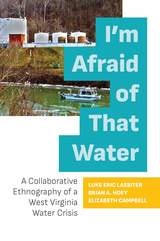
I'm Afraid of That Water
A Collaborative Ethnography of a West Virginia Water CrisisLuke Eric Lassiter
West Virginia University Press, 2020
On January 9, 2014, residents across Charleston, West Virginia, awoke to an unusual licorice smell in the air and a similar taste in the public drinking water. That evening residents were informed the tap water in tens of thousands of homes, hundreds of businesses, and dozens of schools and hospitals—the water made available to as many as 300,000 citizens in a nine-county region—had been contaminated with a chemical used for cleaning crushed coal.
This book tells a particular set of stories about that chemical spill and its aftermath, an unfolding water crisis that would lead to months, even years, of fear and distrust. It is both oral history and collaborative ethnography, jointly conceptualized, researched, and written by people—more than fifty in all—across various positions in academia and local communities. I’m Afraid of That Water foregrounds the ongoing concerns of West Virginians (and people in comparable situations in places like Flint, Michigan) confronted by the problem of contamination, where thresholds for official safety may be crossed, but a genuine return to normality is elusive.
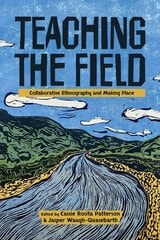
Teaching the Field
Collaborative Ethnography and Making PlaceEdited by Cassie Rosita Patterson and Jasper Waugh-Quasebarth
University of Wisconsin Press, 2027
Field schools are an intensive and crucial part of an education in folklore and other fields that require ethnographic methodologies. Students learn by doing: conducting interviews, documenting customs or activities, and learning how to respectfully collaborate with communities. In the best cases, field schools balance student learning with care for the communities where they take place. In this volume, veteran field school organizers Cassie Rosita Patterson and Jasper Waugh-Quasebarth make space for former students and community members to reflect on a program administered by the Center for Folklore Studies at The Ohio State University since 2017. The perspectives compiled here offer critical insights about the efficacy of collaborative projects, ways to balance needs of various stakeholders, and models for both institutional–community collaboration and pedagogies of equitable engagement.
The Chicago Guide to Collaborative Ethnography
Luke Eric Lassiter
University of Chicago Press, 2005
The Chicago Guide to Collaborative Ethnography presents a historical, theoretical, and practice-oriented road map for this shift from incidental collaboration to a more conscious and explicit collaborative strategy. Luke Eric Lassiter charts the history of collaborative ethnography from its earliest implementation to its contemporary emergence in fields such as feminism, humanistic anthropology, and critical ethnography. On this historical and theoretical base, Lassiter outlines concrete steps for achieving a more deliberate and overt collaborative practice throughout the processes of fieldwork and writing. As a participatory action situated in the ethical commitments between ethnographers and consultants and focused on the co-construction of texts, collaborative ethnography, argues Lassiter, is among the most powerful ways to press ethnographic fieldwork and writing into the service of an applied and public scholarship.
A comprehensive and highly accessible handbook for ethnographers of all stripes, The Chicago Guide to Collaborative Ethnography will become a fixture in the development of a critical practice of anthropology, invaluable to both undergraduates, graduate students, and faculty alike.
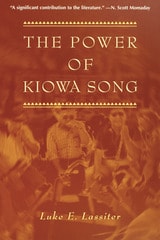
The Power of Kiowa Song
A Collaborative EthnographyLuke E. Lassiter
University of Arizona Press, 1998
Hear the Power of Kiowa Song