Results by title
3 books match the query 'Collaborative Research'

Bridging Scholarship and Activism
Reflections from the Frontlines of Collaborative ResearchBernd Reiter
Michigan State University Press, 2015
CONTENTS:
Introduction, Ulrich Oslender and Bernd Reiter
Part One. The Promises and Pitfalls of Collaborative Research
- Of Academic Embeddedness: Communities of Choice and How to Make Sense of Activism and Research Abroad, Bernd Reiter
- New Shapes of Revolution, Gustavo Esteva
- The Accidental Activist Scholar: A Memoir on Reactive Boundary and Identity Work for Social Change within the Academy, Rob Benford
- Leaving the Field: How to Write about Disappointment and Frustration in Collaborative Research, Ulrich Oslender
- Invisible Heroes, Eshe Lewis
- El Muntuen America, Manuel Zapata Olivella
- Activism as History Making: The Collective and the Personal in Collaborative Research with the Process of Black Communities in Colombia, Arturo Escobar
- Out of Bounds: Negotiating Researcher Positionality in Brazil, Elizabeth Hordge-Freeman
- Between Soapboxes and Shadows: Activism, Theory, and the Politics of Life and Death in Salvador, Bahia, Brazil, Christen A. Smith
- State Violence and the Ethnographic Encounter: Feminist Research and Racial Embodiment, Keisha-Khan Y. Perry
- The Challenges Resulting from Combining Scientific Production and Social-Political Activism in the Brazilian Academy, Fernando Conceição
- The Challenge of Doing Applied/Activist Anti-Racist Anthropology in Revolutionary Cuba, Gayle L. McGarrity
- Conclusion, Ulrich Oslender and Bernd Reiter
- About the Authors
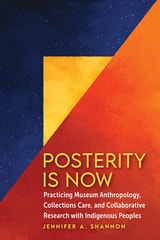
Posterity Is Now
Practicing Museum Anthropology, Collections Care, and Collaborative Research with Indigenous PeoplesJennifer A. Shannon
University of Wyoming Press, 2025
In this handbook based on over twenty years of teaching and practice at the intersection of museums, anthropology, and Indigenous peoples, Jennifer A. Shannon covers both the theoretical (i.e., exploring the idea of objects as kin) and the pragmatic (i.e., guidelines for how to design and budget collaborative projects). She advocates for fundamental change in how anthropological research design and practice are done within and beyond the museum and how leadership and staff view the very purpose of the museum. She also demonstrates how collaborative museum anthropology can be a model for the fields of anthropology, public scholarship, and social science research more broadly.
Posterity Is Now is a starting point, a “companion to practice,” written in accessible language and equally relevant for use in university classrooms, by qualitative researchers, and by practitioners in museums and cultural centers.
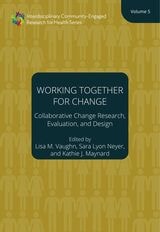
Working Together for Change
Collaborative Change Research, Evaluation, and Design, Volume 5Edited by Lisa M. Vaughn, Sara Neyer, and Kathie Maynard
University of Minnesota Press, 2023
Strategies for engaging key stakeholders—evaluators, researchers, and designers—to discuss frameworks for promoting collaborative change.
Collaborative Change Research, Evaluation, and Design (CCRED) is a framework and collection of participatory practices that engage people and the systems around them to drive community outcomes. This framework emerged out of the recognition that deep participation (or engagement) is frequently missing in collaborative impact approaches. When collaborative change is implemented effectively, community members are viewed as valuable owners and experts instead of being seen as disinterested or unqualified partners.
CCRED is a social action process with dual goals of collective empowerment and the deepening of social knowledge. Executed successfully, CCRED has the potential to increase the rigor, reach, and relevance of research, evaluation, and design translated to meaningful action. Written in an easily accessible, narrative style, Working Together for Change, the fourth volume in the Interdisciplinary Community Engaged Research for Health series edited by Farrah Jacquez and Lela Svedin brings together evaluators, researchers, and designers to describe collaborative change by describing their own work in the space.