Results by title
4 books match the query 'Collage'
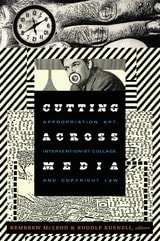
Cutting Across Media
Appropriation Art, Interventionist Collage, and Copyright LawKembrew McLeod and Rudolf Kuenzli, eds.
Duke University Press, 2011
In this collection of essays, leading academics, critics, and artists historicize collage and appropriation tactics that cut across diverse media and genres. They take up issues of appropriation in the popular and the avant-garde, in altered billboards and the work of the renowned painter Chris Ofili, in hip-hop and the compositions of Béla Bartók and Zoltán Kodály, and in audio mash-ups, remixed news broadcasts, pranks, culture jamming, and numerous other cultural forms. The borrowing practices that they consider often run afoul of intellectual property regimes, and many of the contributors address the effects of copyright and trademark law on creativity. Among the contributors are the novelist and essayist Jonathan Lethem, the poet and cultural critic Joshua Clover, the filmmaker Craig Baldwin, the hip-hop historian Jeff Chang, the ’zine-maker and sound collage artist Lloyd Dunn, and Negativland, the infamous collective that was sued in 1991 for sampling U2 in a satirical sound collage. Cutting Across Media is both a serious examination of collage and appropriation practices and a celebration of their transformative political and cultural possibilities.
Contributors. Craig Baldwin, David Banash, Marcus Boon, Jeff Chang, Joshua Clover, Lorraine Morales Cox, Lloyd Dunn, Philo T. Farnsworth, Pierre Joris, Douglas Kahn, Rudolf Kuenzli, Rob Latham, Jonathan Lethem, Carrie McLaren, Kembrew McLeod, Negativland, Davis Schneiderman, David Tetzlaff, Gábor Vályi, Warner Special Products, Eva Hemmungs Wirtén
[more]
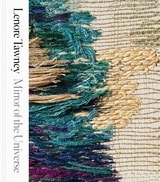
Lenore Tawney
Mirror of the UniverseEdited by Karen Patterson
University of Chicago Press, 2019
Recent years have seen an enormous surge of interest in fiber arts, with works made of thread on display in art museums around the world. But this art form only began to transcend its origins as a humble craft in the late nineteenth and early twentieth centuries, and it wasn’t until the 1950s and 1960s that artists used the fiber arts to build critical practices that challenged the definitions of painting, drawing, and sculpture. One of those artists was Lenore Tawney (1907–2007).
Raised and trained in Chicago before she moved to New York, Tawney had a storied career. She was known for employing an ancient Peruvian gauze weave technique to create a painterly effect that appeared to float in space rather than cling to the wall, as well as for being one of the first artists to blend sculptural techniques with weaving practices and, in the process, pioneered a new direction in fiber art. Despite her prominence on the New York art scene, however, she has only recently begun to receive her due from the greater art world. Accompanying a retrospective at the John Michael Kohler Arts Center, this catalog features a comprehensive biography of Tawney, additional essays on her work, and two hundred full-color illustrations, making it of interest to contemporary artists, art historians, and the growing audience for fiber art.
Copublished with the John Michael Kohler Arts Center.
[more]
Mere and Easy
Collage as a Critical Practice in PedagogyEdited by Jorge Lucero
University of Illinois Press, 2017
Collage making offers everyone from small children to trained artists the ability to express themselves through images. In this new Common Threads collection, Jorge Lucero draws on the archive of the journal Visual Arts Research to present articles focused on the place of collage in fine art and education. Guided by the twinned concepts of mereness --collage's reputation as a trifle--and easiness --the technique's accessibility to all--the authors explore how subversive, debased, and effortless the collage gesture can be. What emerges is in and of itself a collage, one that groups disparate scholarship into a whole that reveals how the technique may serve as a method of scholarship and as a wellspring of vibrant, even radical, pedagogical utility. Contributors: Michael Biggs, Ian Buchanan, Daniela Büchler, Paul Duncum, Charles R. Garoian, Kit Grauer, Anniina Suominen Guyas, Kathleen Keys, Jorge Lucero, Dan Nadaner, Ryan Patton, Janet N. Stevenson, Robert W. Sweeny, and Stuart Thompson.
[more]
The Frame and the Mirror
On Collage and the PostmodernThomas P. Brockelman
Northwestern University Press, 2001
If the postmodern is a collage—as some critics have suggested—or if collage is itself a kernel of the postmodern, what does this mean for our way of understanding the world? The Frame and the Mirror uses this question to probe the distinctive character of the postmodern situation and the philosophical problem of representation. Brockelman’s work is itself a collage of sorts, using juxtapositions of critics and art historical figures to conduct a debate between such figures as Karsten Harries, Gianni Vattimo, Rosalind Krauss, Immanuel Kant, Jean-Francois Lyotard, Slavo Žižek, and Le Corbusier about issues such as truth in art, perspectivism, theatricality, the sublime, psychoanalytic theory, politics, and urbanism.
More than an introduction to the postmodern, The Frame and the Mirror advances our understanding of the contemporary world by relating its features to the peculiar characteristics of collage. Ultimately, Brockelman shows how collage demands that we reinterpret modernity, conceiving of it as suspended between a loss of certainty and a new kind of knowledge about the human condition. In doing so, his work challenges many of the claims made in the name of postmodernism—and offers in their place a new and ironic view of the cultural space in which contemporary and historical events occur.
More than an introduction to the postmodern, The Frame and the Mirror advances our understanding of the contemporary world by relating its features to the peculiar characteristics of collage. Ultimately, Brockelman shows how collage demands that we reinterpret modernity, conceiving of it as suspended between a loss of certainty and a new kind of knowledge about the human condition. In doing so, his work challenges many of the claims made in the name of postmodernism—and offers in their place a new and ironic view of the cultural space in which contemporary and historical events occur.
[more]