Results by title
18 books match the query 'Collections'
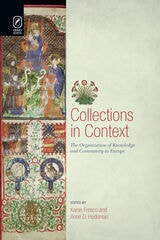
Collections in Context
The Organization of Knowledge and Community in EuropeEdited by Karen Fresco and Anne D. Hedeman
The Ohio State University Press, 2011
The fourteen essays that comprise Collections in Context: The Organization of Knowledge and Community in Europe interrogate questions posed by French, Flemish, English, and Italian collections of all sorts—libraries as a whole, anthologies and miscellanies assembled within a single manuscript or printed book, and even illustrated ivory boxes.
With essays by a wide array of international scholars, Collections in Context demonstrates that the very act of collecting inevitably imposes some kind of relationship among what might otherwise be naively thought of as disparate elements and simultaneously exposes something about the community that created and used the collection. Thus, Collections in Context offers unusual insights into how collecting both produced knowledge and built community in early modern Europe.
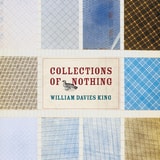
Collections of Nothing
William Davies King
University of Chicago Press, 2008
Nearly everyone collects something, even those who don’t think of themselves as collectors. William Davies King, on the other hand, has devoted decades to collecting nothing—and a lot of it. With Collections of Nothing, he takes a hard look at this habitual hoarding to see what truths it can reveal about the impulse to accumulate.
Part memoir, part reflection on the mania of acquisition, Collections of Nothing begins with the stamp collection that King was given as a boy. In the following years, rather than rarity or pedigree, he found himself searching out the lowly and the lost, the cast-off and the undesired: objects that, merely by gathering and retaining them, he could imbue with meaning, even value. As he relates the story of his burgeoning collections, King also offers a fascinating meditation on the human urge to collect. This wry, funny, even touching appreciation and dissection of the collector’s art as seen through the life of a most unusual specimen will appeal to anyone who has ever felt the unappeasable power of that acquisitive fever.
"What makes this book, bred of a midlife crisis, extraordinary is the way King weaves his autobiography into the account of his collection, deftly demonstrating that the two stories are essentially one. . . . His hard-won self-awareness gives his disclosures an intensity that will likely resonate with all readers, even those whose collections of nothing contain nothing at all."—New Yorker
"King's extraordinary book is a memoir served up on the backs of all things he collects. . . . His story starts out sounding odd and singular—who is this guy?—but by the end, you recognize yourself in a lot of what he does."—Julia Keller, Chicago Tribune
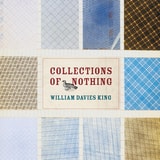
Collections of Nothing
William Davies King
University of Chicago Press, 2008
Nearly everyone collects something, even those who don’t think of themselves as collectors. William Davies King, on the other hand, has devoted decades to collecting nothing—and a lot of it. With Collections of Nothing, he takes a hard look at this habitual hoarding to see what truths it can reveal about the impulse to accumulate.
Part memoir, part reflection on the mania of acquisition, Collections of Nothing begins with the stamp collection that King was given as a boy. In the following years, rather than rarity or pedigree, he found himself searching out the lowly and the lost, the cast-off and the undesired: objects that, merely by gathering and retaining them, he could imbue with meaning, even value. As he relates the story of his burgeoning collections, King also offers a fascinating meditation on the human urge to collect. This wry, funny, even touching appreciation and dissection of the collector’s art as seen through the life of a most unusual specimen will appeal to anyone who has ever felt the unappeasable power of that acquisitive fever.
"What makes this book, bred of a midlife crisis, extraordinary is the way King weaves his autobiography into the account of his collection, deftly demonstrating that the two stories are essentially one. . . . His hard-won self-awareness gives his disclosures an intensity that will likely resonate with all readers, even those whose collections of nothing contain nothing at all."—New Yorker
"King's extraordinary book is a memoir served up on the backs of all things he collects. . . . His story starts out sounding odd and singular—who is this guy?—but by the end, you recognize yourself in a lot of what he does."—Julia Keller, Chicago Tribune
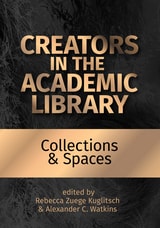
Creators in the Academic Library
Collections and SpacesRebecca Zuege Kuglitsch
Assoc of College & Research Libraries, 2023
In four parts, Creators in the Academic Library: Collections and Spaces explores how academic libraries can build collections, spaces, and communities that serve creators.
- Tailoring Collections for Creators
- Making in the Academic Library
- Creating Experiences in the Library
- Cultivating Creator Communities
Drama in English From the Middle Ages to the Early Twentieth Century
Christopher J. Wheatley
Catholic University of America Press, 2016
Eight Plays for Children
The New Generation Play ProjectEdited by Coleman A. Jennings
University of Texas Press, 1999
The New Generation Play Project was a daring experiment in American children's theatre. Begun in 1989 by a consortium that included the Seattle Children's Theatre, The Children's Theatre Company of Minneapolis, Stage One: The Louisville Children's Theatre, and the Honolulu Theatre for Youth, the NGPP raised half a million dollars to commission major American dramatists to create new works for young people and to produce these plays over a several-year period.
This book provides the full text of the plays produced through the NGPP:
- Constance Congdon, Beauty and the Beast
- Velina Hasu Houston, Hula Heart
- Tina Howe, East of the Sun and West of the Moon
- Len Jenkin, The Invisible Man
- Mark Medoff, Kringle's Window
- Eric Overmyer, Duke Kahanamoku vs. The Surfnappers
- Michael Weller, Dogbrain
- Y York, The Witch of Blackbird Pond
In his introduction, Coleman Jennings describes the work of the NGPP, some of the controversies surrounding its selection of playwrights who do not ordinarily write for young audiences, as well as the playwrights' reactions to the project, and the critical reception of the plays. Suzan Zeder, one of the nation's leading playwrights for family audiences, supplies the foreword.
Goatfoot Milktongue Twinbird
Interviews, Essays, and Notes on Poetry, 1970-76Donald Hall
University of Michigan Press, 1978
Infinite Constellations
An Anthology of Identity, Culture, and Speculative ConjunctionsEdited by Khadijah Queen and K. Ibura
University of Alabama Press, 2023
A galaxy of voices. A universe of belonging.
The innovative fictions in Infinite Constellations showcase the voices and visions of 30 remarkable writers, both new and established, from the global majority: Native American/First Nation writers, South Asian writers, East Asian writers, Black American writers, Latinx writers, and Caribbean and Middle Eastern writers. These are visions both familiar and strange, but always rooted in the mystery of human relationships, the deep honoring of memory, and the rootedness to place and the centering of culture.
The writers in this anthology mirror, instruct, bind and unbind, myth-make and myth-invert, transform and transmute, make us belly-laugh or hum our understanding, gasp or whisper gently, and remember that sometimes we need to holler and fight as we grieve. Any dangers herein, imagined or observed in poem and story, transport us: moving from latent to extant, then unleashed.
This work does not presume; it presents and blossoms, creating a constellation of appearances, a symphony of belonging.
“In collecting this work,” note editors Khadijah Queen and K. Ibura, “we felt humbled by the love threaded throughout the voices speaking to us in stories and poems that vault beyond expectation and settle in our consciousness as an expansion of what’s possible when we tend to one another with intention. We felt lifted, held aloft in these arrangements of language. We hope that as you read each story and poem, you will find the same sense of empowerment and celebration that we know has sustained us over countless generations, and in their beauty and humor and intelligence and complexity, continue to enrich us still.”
CONTRIBUTORS
George Abraham / Kenzie Allen / Shreya lla Anasuya / Thea Anderson / Wendy Chin-Tanner / Alton Melvar M. Depanas / Yohanca Delgado / Jennifer Elise Foerster / Aerik Francis / André O. Hoilette / Brian K. Hudson / K. Ibura / Pedro Iniguez / Ruth Ellen Kocher / Ra’Niqua Lee / Tonya Liburd / Kenji C. Liu / Shalewa Mackall / Lucien Darjeun Meadows / Melanie Merle / Juan J. Morales / Thirii Myo Kyaw Myint / Cindy Juyound Ok / Daniel José Older / Soham Patel / Lynn C. Pitts/ Khadijah Queen / Sheree Renée Thomas / Sarah Sophia Yanni / dg nanouk okpik / shakirah peterson
Lofty Dogmas
Poets on PoeticsDeborah Brown
University of Arkansas Press, 2005
Millionaire Shopping
The Collections of Alfred Morrison, 1821–1897Edited by Caroline Dakers
University College London, 2025
Although his fame has faded with time, Alfred Morrison was one of the most influential and avid collectors and patrons of the arts in Victorian England. Morrison was an obsessive and comprehensive collector, using his extravagant wealth to accumulate old master paintings, autograph manuscripts, coins and medals, imperial Chinese porcelain, and other treasures, and his commissions were equally eclectic. Millionaire Shopping includes contributions by contemporary museum curators, scholars, and dealers in painting, sculpture, and decorative arts, with each chapter dedicated to a particular aspect of Morrison’s collecting and patronage. Extensive illustrations, including many never-before-seen images from private archives, help bring his impressive artistic footprint to life.
Mobile Museums
Collections in CirculationEdited by Felix Driver, Mark Nesbitt, and Caroline Cornish
University College London, 2021
How did the process of the circulation re-examine, inform, and unsettle common assumptions about the way museum collections have evolved over time and space? Mobile Museums presents an argument for the importance of circulation in the study of museum collections, both past and present. It brings together a diverse array of international scholars and curators from a variety of disciplines to consider the mobility of collections, especially in the context of Indigenous community engagement. By foregrounding the question of circulation, the book represents a paradigm shift in the understanding of the history and future uses of museum collections. Taking on a global perspective and addressing a variety of types of collection, including the botanical, ethnographic, economic, and archaeological, the book helps us to understand why the mobility of museum collections was a fundamental aspect of their history—and why it continues to matter today.
Object-Based Learning
Exploring Museums and Collections in EducationThomas Kador
University College London, 2025
This textbook provides an overview of some of the most important approaches to material culture and object analysis to illustrate broader themes and trends in museum studies and pedagogy. Covering diverse topics related to curatorial practice and exhibiting objects, including accessibility, curatorial ethics, colonialism and museums, audience engagement, and histories of collecting, Object-Based Learning weaves together important historical context and theoretical perspectives with practical case studies and exercises. It also includes discussion of timely issues like the role of digital technologies in teaching with objects, the psychosocial role of objects, and the use of collections in health and wellness.
Pushing Boundaries in Southwestern Archaeology
Chronometry, Collections, and ContextsStephen E. Nash
University Press of Colorado, 2022
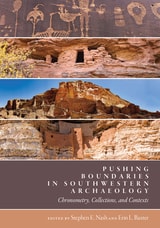
The first of the volume’s four sections examines the status, history, and prospects of Bears Ears National Monument, the broader regulatory and political boundaries that complicate the nature and integrity of the archaeological record, and the cultural contexts and legal stakes of archaeological inquiry. The second section focuses on chronological “big data” in the context of pre-Columbian history and the potential and limits of what can be empirically derived from chronometric analysis of the past. The chapters in the third section advocate for advancing collections-based research, focusing on the vast and often untapped research potential of archives, previously excavated museum collections, and legacy data. The final section examines the permeable boundaries involved in Plains-Pueblo interactions, obvious in the archaeological record but long in need of analysis, interpretation, and explanation.
Contributors: James R. Allison, Erin Baxter, Benjamin A. Bellorado, Katelyn J. Bishop, Eric Blinman, J. Royce Cox, J. Andrew Darling, Kaitlyn E. Davis, William H. Doelle, B. Sunday Eiselt, Leigh Anne Ellison, Josh Ewing, Samantha G. Fladd, Gary M. Feinman, Jeffrey R. Ferguson, Severin Fowles, Willie Grayeyes, Matthew Guebard, Saul L. Hedquist, Greg Hodgins, Lucas Hoedl, John W. Ives, Nicholas Kessler, Terry Knight, Michael W. Lindeman, Hannah V. Mattson, Myles R. Miller, Lindsay Montgomery, Stephen E. Nash, Sarah Oas, Jill Onken, Scott G. Ortman, Danielle J. Riebe, John Ruple, Will G. Russell, Octavius Seowtewa, Deni J. Seymour, James M. Vint, Adam S. Watson

Radical Collections
Re-examining the roots of collections, practices and information professionsEdited by Jordan Landes
University of London Press, 2018
Sappho to Valéry
Poems in TranslationJohn Frederick Nims
University of Arkansas Press, 1990
Revised and enlarged, the second edition of Sappho to Valéry includes both the originals and translations of ninety-eight poems from nine different languages. Nims offers new and lively interpretations of a number of poems that have been translated and others available in no other English translation.
A former editor of Poetry, John Frederick Nims has published several volumes of his own poetry, poetry in translation, and essays on the form.
The Community College Library
Collections and Technical ServicesJanet Pinkley
Assoc of College & Research Libraries, 2025
The Community College Library: Collections and Technical Services highlights the various approaches to collection development and the technical services work being done by community college librarians around the U.S. You’ll find strategies for developing equity-centered collections, data-driven acquisitions, cataloging, systems migrations, zero textbook cost degrees, and more. These programs can serve as a model, providing new and innovative ways to approach this work at your own institutions.
Community college librarians are engaged in meaningful work designing and delivering library programs and services that meet the needs of their diverse populations and support student learning. ACRL’s “The Community College Library” series is meant to lift the voices of community college librarians and highlight their creativity, tenacity, and commitment to students.
The Lost Species
Great Expeditions in the Collections of Natural History MuseumsChristopher Kemp
University of Chicago Press, 2017
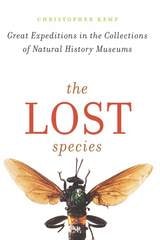
With Kemp as our guide, we go spelunking into museum basements, dig through specimen trays, and inspect the drawers and jars of collections, scientific detectives on the hunt for new species. We discover king crabs from 1906, unidentified tarantulas, mislabeled Himalayan landsnails, an unknown rove beetle originally collected by Darwin, and an overlooked squeaker frog, among other curiosities. In each case, these specimens sat quietly for decades—sometimes longer than a century—within the collections of museums, before sharp-eyed scientists understood they were new. Each year, scientists continue to encounter new species in museum collections—a stark reminder that we have named only a fraction of the world’s biodiversity. Sadly, some specimens have waited so long to be named that they are gone from the wild before they were identified, victims of climate change and habitat loss. As Kemp shows, these stories showcase the enduring importance of these very collections.
The Lost Species vividly tells these stories of discovery—from the latest information on each creature to the people who collected them and the scientists who finally realized what they had unearthed—and will inspire many a museumgoer to want to peek behind the closed doors and rummage through the archives.
Theatre for Youth
Twelve Plays with Mature ThemesEdited by Coleman A. Jennings and Gretta Berghammer
University of Texas Press, 1986
Since the beginning of the theatre-for-youth movement in the United States, the majority of plays written for children have been fairy tales. By the 1960s, however, encouraged by changes in social attitudes toward children, playwrights began to respond to a growing tendency on the parts of both parents and teachers to have children face, rather than avoid, the more difficult truths of existence. Thus children's dramatic literature was opened to new subjects, themes and characters previously considered unsuitable for the young audience.
Theatre for Youth seeks to identify and illustrate this trend by examining twelve plays that deal with mature themes: aging, death and dying, conformity, sexuality, divorce, moral culpability. The plays have been chosen not only for their mature content, but also for their professional integrity, the delicacy with which they handle their subject matter, and their respect for their intended audience.
A foreword by Jed H. Davis, an introduction and summary paragraphs for each play by Jennings and Berghammer, and a lengthy annotated list of suggested plays for further reading or viewing make this volume extremely useful both for directors of children's theatre and for teachers.