Results by title
5 books match the query 'Collective Identity'
Anti-modernism
Radical Revisions of Collective IdentityAhmet Ersoy
Central European University Press, 2014
Dystopias of Infamy
Insult and Collective Identity in Early Modern SpainJavier Irigoyen-García
Bucknell University Press, 2022
Everybody's Autonomy
Connective Reading and Collective IdentityJuliana Spahr
University of Alabama Press, 2001
Contemporary avant garde writing has often been overlooked by those who study literature and identity. Such writing has been perceived as unrelated, as disrespectful of subjectivity. But Everybody's Autonomy instead locates within avant garde literature models of identity that are communal, connective, and racially concerned. Everybody's Autonomy, as it tackles literary criticism's central question of what sort of selves do works create, looks at works that encourage connection, works that present and engage with large, public worlds that are in turn shared with readers. With this intent, it aligns the iconoclastic work of Gertrude Stein with foreign, immigrant Englishes and their accompanying subjectivities. It examines the critique of white individualism and privilege in the work of language writers Lyn Hejinian and Bruce Andrews. It looks at how Harryette Mullen mixes language writing's open text with the distinctivesness of African-American culture to propose a communal, yet still racially conscious identity. And it examines Theresa Hak Kyung Cha's use of broken English and French to unsettle readers' fluencies and assimilating comprehensions, to decolonize reading. Such works, the book argues, well represent and expand changing notions of the public, of everybody.
Everyday Reading
Print Culture and Collective Identity in the Rio de la Plata, 1780-1910William Garrett Acree
Vanderbilt University Press, 2011
Starting in the late nineteenth century, the region of South America known as the Rio de la Plata (containing modern-day Uruguay and Argentina) boasted the highest literacy rates in Latin America. In Everyday Reading, William Acree explores the history, events, and culture that gave rise to the region's remarkable progress. With a specific focus on its print culture, in the form of newspapers, political advertisements and documents, schoolbooks, and even stamps and currency, Acree creates a portrait of a literary culture that permeated every aspect of life.
Everyday Reading argues that the introduction of the printing press into the Rio de la Plata in the 1780s hastened the collapse of Spanish imperial control and played a major role in the transition to independence some thirty years later. After independence, print culture nurtured a new identity and helped sustain the region through the tumult of civil war in the mid-1800s. Acree concludes by examining the role of reading in formal education, which had grown exponentially by the early twentieth century as schoolchildren were taught to fulfill traditional roles in society.
Ultimately, Everyday Reading humanizes literary culture, demonstrating its unrecognized and unexpected influence in everyday lives.
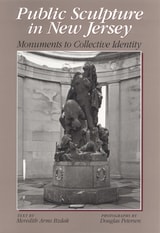
Public Sculpture in New Jersey
Monuments to Collective IdentityBzdak, Meredith Arms
Rutgers University Press, 1999
New Jersey boasts more than 700 public sculptures. When viewed as a group, these works give us great insights about who helped to shape New Jersey, what events we considered significant, and how we hope we will be remembered. Public Sculpture in New Jersey examines 150 years of past and current patterns in the commissioning and placement of outdoor art in the Garden State.
The book contains essays that profile the state’s 100 most significant works as well as the artists who created them, and features nearly 100 magnificent photographs that document these works, capturing the effects of time and the environment on each sculpture. Bzdak and Petersen selected these works for the variety of stories they tell and for their range of artistic expression, from traditional to contemporary, rather than focusing only on the best known or most visible works of public sculpture. By telling the stories behind the sculptures, the book captures New Jersey’s history, especially history that may not be well known but that conveys significant information about how our predecessors lived and the official images they sought to leave behind.