Results by title

4 books match the query 'Collectivism'
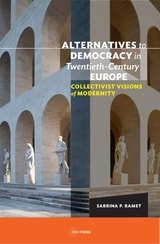
cover of Alternatives to Democracy in Twentieth-Century Europe: Collectivist Visions of Modernity

Alternatives to Democracy in Twentieth-Century Europe

Collectivist Visions of Modernity

Sabrina P. Ramet

Central European University Press, 2019
Alternatives to Democracy in Twentieth-Century Europe examines the historical examples of Soviet Communism, Italian Fascism, German Nazism, and Spanish Anarchism, suggesting that, in spite of their differences, they had some key features in common, in particular their shared hostility to individualism, representative government, laissez faire capitalism, and the decadence they associated with modern culture. But rather than seeking to return to earlier ways of working these movements and regimes sought to design a new future – an alternative future – that would restore the nation to spiritual and political health. The Fascists, for their part, specifically promoted palingenesis, which is to say the spiritual rebirth of the nation. 
The book closes with a long epilogue, in which Ramet defends liberal democracy, highlighting its strengths and advantages. In this chapter, the author identifies five key choke points, which would-be authoritarians typically seek to control, subvert, or instrumentalize: electoral rules, the judiciary, the media, hate speech, and surveillance, and looks at the cases of Viktor Orbán’s Hungary, Jarosław Kaczyński’s Poland, and Donald Trump’s United States.
[more]
cover of Community Without Unity: A Politics of Derridian Extravagance

Community Without Unity

A Politics of Derridian Extravagance

William Corlett

Duke University Press, 1989

Winner of the 1990 Foundations of Political Theory Section of the American Political Science Association "First Book Award"

Now available in paperback with a new preface by the author, this award-winning book breaks new ground by challenging traditional concepts of community in political theory. William Corlett brings the diverse (and sometimes contradictory) work of Foucault and Derrida to bear on the thought of Pocock, Burke, Lincoln, and McIntyre, among others, to move beyond the conventional dichotomy of "individual vs. community," arguing instead that community is best advanced within a politics of difference.

[more]
cover of Postcapitalist Countrysides: From Commoning to Community Wealth Building

Postcapitalist Countrysides

From Commoning to Community Wealth Building

Edited by Nick Gallent, Menelaos Gkartzios, Mark Scott, and Andrew Purves

University College London, 2025

Reimagining rural life beyond capitalism, this volume reviews alternative economic structures that center on sustainability and community wealth-building.

Postcapitalist Countrysides exposes the entrenched inequalities that capitalism has imposed on rural communities and charts a path toward more just and sustainable futures. Built upon case studies from around the world, the book critiques the failures of privatization and market-driven development while showcasing alternative economic models that reclaim land and wealth for the many, not the few.

Through analyses of land reform and community wealth building, contributors depict how local initiatives can reshape rural economies and empower communities when reinforced by structural change. From challenging exploitative land ownership to confronting the encroachment of platform capitalism, this volume engages with urgent global crises while offering tangible strategies for transformation. Postcapitalist Countrysides presents a bold vision for rural life beyond capitalism—one rooted in collective prosperity and resilience.
[more]
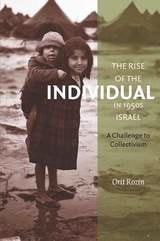
cover of The Rise of the Individual in 1950s Israel: A Challenge to Collectivism

The Rise of the Individual in 1950s Israel

A Challenge to Collectivism

Orit Rozin

Brandeis University Press, 2011

In this sharply argued volume, Orit Rozin reveals the flaws in the conventional account of Israeli society in the 1950s, which portrayed the Israeli public as committed to a collectivist ideology. In fact, major sectors of Israeli society espoused individualism and rejected the state-imposed collectivist ideology. Rozin draws on archival, legal, and media sources to analyze the attitudes of black-market profiteers, politicians and judges, middle-class homemakers, and immigrants living in transit camps and rural settlements. Part of a refreshing trend in recent Israeli historiography to study the voices, emotions, and ideas of ordinary people, Rozin’s book provides an important corrective to much extant scholarly literature on Israel’s early years.
[more]