Results by title

6 books match the query 'College choice'
cover of College Choices: The Economics of Where to Go, When to Go, and How to Pay for It

College Choices

The Economics of Where to Go, When to Go, and How to Pay for It

Edited by Caroline M. Hoxby

University of Chicago Press, 2004

Aspiring college students and their families have many options. A student can attend an in-state or an out-of-state school, a public or private college, a two-year community college program or a four-year university program. Students can attend full-time and have a bachelor of arts degree by the age of twenty-three or mix college and work, progressing toward a degree more slowly. To make matters more complicated, the array of financial aid available is more complex than ever. Students and their families must weigh federal grants, state merit scholarships, college tax credits, and college savings accounts, just to name a few.

In College Choices, Caroline Hoxby and a distinguished group of economists show how students and their families really make college decisions—how they respond to financial aid options, how peer relationships figure in the decision-making process, and even whether they need mentoring to get through the admissions process. Students of all sorts are considered—from poor students, who may struggle with applications and whether to continue on to college, to high aptitude students who are offered "free rides" at elite schools. College Choices utilizes the best methods and latest data to analyze the college decision-making process, while explaining how changes in aid and admissions practices inform those decisions as well.
[more]
cover of Divergent Paths to College: Race, Class, and Inequality in High Schools

Divergent Paths to College

Race, Class, and Inequality in High Schools

Holland, Megan M

Rutgers University Press, 2019
In Divergent Paths to College, Megan M. Holland examines how high schools structure different pathways that lead students to very different college destinations based on race and class. She finds that racial and class inequalities are reproduced through unequal access to key sources of information, even among students in the same school and even in schools with well-established college-going cultures. As the college application process becomes increasingly complex and high-stakes, social capital, or relationships with people who can provide information as well as support and guidance, becomes much more critical. Although much has been written about the college-bound experience, we know less about the role that social capital plays, and specifically how high schools can serve as organizational brokers of social ties. The relationships that high schools cultivate between students and higher education institutions by inviting college admissions officers into their schools to market to students, is a particularly critical, yet unexplored source of college information.
[more]
cover of Overcoming the Odds: The Benefits of Completing College for Unlikely Graduates

Overcoming the Odds

The Benefits of Completing College for Unlikely Graduates

Jennie E. Brand

Russell Sage Foundation, 2023

Each year, millions of high school students consider whether to continue their schooling and attend and complete college. Despite evidence showing that a college degree yields far-reaching benefits, critics of higher education increasingly argue that college “does not pay off” and some students - namely, disadvantaged prospective college goers - would be better served by forgoing higher education. But debates about the value of college often fail to carefully consider what is required to speak knowledgeably about the benefits –what a person’s life might look like had they not completed college, or their college counterfactual. In Overcoming the Odds sociologist Jennie E. Brand reveals the benefits of completing college by comparing life outcomes of college graduates with their college counterfactuals.  
 
Drawing on two cohorts of nationally representative data from the Bureau of Labor Statistics National Longitudinal Surveys program, Brand uses matching and machine learning methods to estimate the effects of college completion across students with varying likelihoods of completing four-year degrees. To illustrate her findings, Brand describes outcomes using matched vignettes of college and non-college graduates. Brand shows that four-year college completion enables graduates to increase wages and household income, while also circumventing unemployment, low-wage work, job instability, poverty, and social assistance. Completing college also increases civic engagement. Most of these benefits are larger for disadvantaged than for more advantaged students, rendering arguments that college has limited benefits for unlikely graduates as flawed. Brand concludes that greater long-term earnings, and less job instability and unemployment, and thus more tax revenue, less reliance on public assistance, and high levels of volunteering indicate that public investment in higher education for students from disadvantaged backgrounds yields far-reaching collective benefits. She asserts that it is better for our society when more people complete college.
 
Overcoming the Odds is an innovative and enlightening exploration of how college can transform lives.


[more]
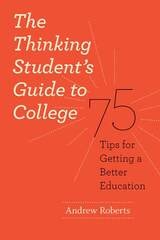
cover of The Thinking Student's Guide to College: 75 Tips for Getting a Better Education

The Thinking Student's Guide to College

75 Tips for Getting a Better Education

Andrew Roberts

University of Chicago Press, 2010

Each fall, thousands of eager freshmen descend on college and university campuses expecting the best education imaginable: inspiring classes taught by top-ranked professors, academic advisors who will guide them to a prestigious job or graduate school, and an environment where learning flourishes outside the classroom as much as it does in lecture halls. Unfortunately, most of these freshmen soon learn that academic life is not what they imagined. Classes are taught by overworked graduate students and adjuncts rather than seasoned faculty members, undergrads receive minimal attention from advisors or administrators, and potentially valuable campus resources remain outside their grasp.

Andrew Roberts’ Thinking Student’s Guide to College helps students take charge of their university experience by providing a blueprint they can follow to achieve their educational goals—whether at public or private schools, large research universities or small liberal arts colleges. An inside look penned by a professor at Northwestern University, this book offers concrete tips on choosing a college, selecting classes, deciding on a major, interacting with faculty, and applying to graduate school. Here, Roberts exposes the secrets of the ivory tower to reveal what motivates professors, where to find loopholes in university bureaucracy, and most importantly, how to get a personalized education. Based on interviews with faculty and cutting-edge educational research, The Thinking Student’s Guide to College is a necessary handbook for students striving to excel academically, creatively, and personally during their undergraduate years.
[more]
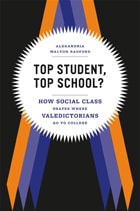
cover of Top Student, Top School?: How Social Class Shapes Where Valedictorians Go to College

Top Student, Top School?

How Social Class Shapes Where Valedictorians Go to College

Alexandria Walton Radford

University of Chicago Press, 2013

Most of us think that valedictorians can write their own ticket. By reaching the top of their class they have proven their merit, so their next logical step should be to attend the nation’s very best universities. Yet in Top Student, Top School?, Alexandria Walton Radford, of American Institutes for Research, reveals that many valedictorians do not enroll in prestigious institutions. Employing an original five-state study that surveyed nine hundred public high school valedictorians, she sets out to determine when and why valedictorians end up at less selective schools, showing that social class makes all the difference.
 
Radford traces valedictorians’ paths to college and presents damning evidence that high schools do not provide sufficient guidance on crucial factors affecting college selection, such as reputation, financial aid, and even the application process itself. Left in a bewildering environment of seemingly similar options, many students depend on their parents for assistance—and this allows social class to rear its head and have a profound impact on where students attend. Simply put, parents from less affluent backgrounds are far less informed about differences in colleges’ quality, the college application process, and financial aid options, which significantly limits their child’s chances of attending a competitive school, even when their child has already managed to become valedictorian.
 
[more]
cover of Unequal Choices: How Social Class Shapes Where High-Achieving Students Apply to College

Unequal Choices

How Social Class Shapes Where High-Achieving Students Apply to College

Yang Va Lor

Rutgers University Press, 2023

High-achieving students from socioeconomically disadvantaged backgrounds are more likely to end up at less selective institutions compared to their socioeconomically advantaged peers with similar academic qualifications. A key reason for this is that few highly able, socioeconomically disadvantaged students apply to selective institutions in the first place. In Unequal Choices, Yang Va Lor examines the college application choices of high-achieving students, looking closely at the ways the larger contexts of family, school, and community influence their decisions. For students today, contexts like high schools and college preparation programs shape the type of colleges that they deem appropriate, while family upbringing and personal experiences influence how far from home students imagine they can apply to college. Additionally, several mechanisms reinforce the reproduction of social inequality, showing how institutions and families of the middle and upper-middle class work to procure advantages by cultivating dispositions among their children for specific types of higher education opportunities.
[more]