Results by title
5 books match the query 'College environment'
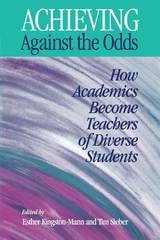
Achieving Against The Odds
edited by Esther Kingston-Mann and Tim Sieber
Temple University Press, 2001
Today's diverse and financially burdened students enter higher education eager to succeed at institutions originally designed for culturally homogenous and predominantly white middle-class populations. They are expected to learn from faculty trained primarily as researchers. Unsurprisingly, student dropout and faculty burnout rates are high, leading some conservatives to demand that higher education purge itself of "unqualified" students and teachers. But, as Achieving Against the Odds demonstrates, new and better solutions emerge once we assume that both faculty and students still possess a mutual potential for learning when they meet in the college classroom.
This collection -- drawing on the experiences of faculty at the University of Massachusetts-Boston -- documents a complex and challenging process of pedagogical transformation. The contributors come from a wide range of disciplines -- American studies, anthropology, Asian American studies, English, ESL, history, language, political science, psychology, sociology, and theology. Like their students, they bring a variety of backgrounds into the classroom -- as people of color, women, gays, working class people, and "foreigners" of one sort or another. Together they have engaged in an exciting struggle to devise pedagogies which respond to the needs and life experiences of their students and to draw each of them into a dialogue with the content and methodology of their disciplines. Courageously airing their own mistakes and weaknesses alongside their breakthroughs, they illuminate for the reader a process of teaching transformation by which discipline-trained scholars discover how to promote the learning of diverse students.
As one reads their essays, one is struck by how much these faculty have benefited from the insights they have gleaned from colleagues as well as students. Through argument and examples, personal revelation and references as well as students. Through argument and examples, personal revelation and references to authority, they draw the reader into their community. This is a book to inspire and enlighten everyone interested in making higher education more truly democratic, inclusive and intellectually challenging for today's students.

Bright College Years
Inside the American College TodayAnne Matthews
University of Chicago Press, 1998
"Matthews writes with sympathy and substantial understanding of the dilemmas colleges face these days."—Tara Fitzpatrick, Chicago Tribune
"A wide-ranging, well-written and lively account of contemporary academia."—Christian Wiman, Dallas Morning News
"Notable Book of the Year." New York Times
"An eye-opening, startling exposé;. . . . Matthews' energetic and well-written report provides a dismal yet concise insider portrait of college life."—Booklist
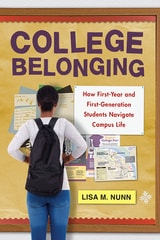
College Belonging
How First-Year and First-Generation Students Navigate Campus LifeLisa M. Nunn
Rutgers University Press, 2021
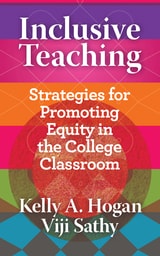
Inclusive Teaching
Strategies for Promoting Equity in the College ClassroomKelly A. Hogan
West Virginia University Press, 2022
Award-winning teachers offer practical tips for addressing inequities in the college classroom and for making all students feel welcome and included.
In a book written by and for college teachers, Kelly Hogan and Viji Sathy provide tips and advice on how to make all students feel welcome and included. They begin with a framework describing why explicit attention to structure enhances inclusiveness in both course design and interactions with and between students. Inclusive Teaching then provides practical ways to include more voices in a series of contexts: when giving instructions for group work and class activities, holding office hours, communicating with students, and more. The authors finish with an opportunity for the reader to reflect on what evidence to include in a teaching dossier that demonstrates inclusive practices.
The work of two highly regarded specialists who have delivered over a hundred workshops on inclusive pedagogy and who contribute frequently to public conversations on the topic, Inclusive Teaching distills state-of-the-art guidance on addressing privilege and implicit bias in the college classroom. It seeks to provide a framework for individuals and communities to ask, Who is being left behind and what can teachers do to add more structure?
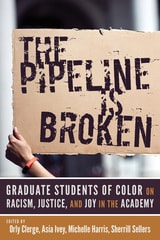
The Pipeline Is Broken
Graduate Students of Color on Racism, Justice, and Joy in the AcademyOrly Clerge
Utah State University Press, 2026
The Pipeline Is Broken explores the reality of racial exclusion and bias in graduate student education, arguing that the insidious effects of structural and institutional racism substantially chip away at the very pipeline of future BIPOC academics—already limited for other racialized reasons.
A series of letters written by graduate students of color, this collection offers a multifaceted account of the challenges, oppositions, microaggressions, and outright discrimination that these students face in higher education settings. Graduate students describe navigating hostile mentoring relationships and unwelcoming campus cultures and peers and laboring for poverty wages to earn their degrees. Yet these letters celebrate joy, community, and agency, offering a more complete and affirming view of graduate student life. Through these brave personal stories, The Pipeline Is Broken asks readers to interrogate what it means to navigate higher education as a person of color and to understand that the reality of faculty of color’s numerical-minority status is a complicated phenomenon whose genesis rests not at the moment of job interview. Rather, these letters show, this status is an intricate manifestation of a process that begins in elementary schools, is reinforced in high schools and colleges, and is part and parcel of the minefield that is graduate education in America.
Essential reading for anyone who cares about racial equity in education, mentorship, leadership development, or student well-being, The Pipeline Is Broken is a guide, a mirror, and a call to action all in one, challenging graduate programs, faculty, and administrators to examine their complicity in maintaining inequitable systems and offering suggestions for building cultures of care.