Results by title
6 books match the query 'Colonial'

Formations of Ritual
Colonial and Anthropological Discourses on the Sinhala YaktovilDavid Scott
University of Minnesota Press, 1994
Formations of Ritual was first published in 1994. Minnesota Archive Editions uses digital technology to make long-unavailable books once again accessible, and are published unaltered from the original University of Minnesota Press editions.
Yaktovil is an elaborate healing ceremony employed by Sinhalas in Sri Lanka to dispel the effects of the eyesight of a pantheon of malevolent supernatural figures known as yakku. Anthropology, traditionally, has articulated this ceremony with the concept metaphor of "demonism." Yet, as David Scott demonstrates in this provocative book, this use of "demonism" reveals more about the discourse of anthropology than it does about the ritual itself. His investigation of yaktovil and yakku within the Sinhala cosmology is also an inquiry into the ways in which anthropology, by ignoring the discursive history of the rituals, religions, and relationships it seeks to describe, tends to reproduce ideological-often, specifically colonial-objects.
To do this, Scott describes the discursive apparatus through which yakku are positioned in the moral universe of Sinhala, traces the appearance of yakku and yaktovil in Western discourse, evaluates the contribution of these figures and this ceremony in anthropology, and attempts to show how the larger anthropology of Buddhism, in which the anthropology of yaktovil is embedded, might be reconfigured. Finally, he offers a rereading of the ritual in terms of the historically selfconscious approach he proposes.The result points to a major rethinking of the historical nature not only of the objects, but also of the concepts through which they are constructed in anthropological discourse.David Scott teaches in the Department of Anthropology at the University of Chicago.
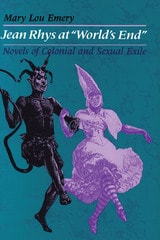
Jean Rhys at "World's End"
Novels of Colonial and Sexual ExileBy Mary Lou Emery
University of Texas Press, 1990
The Caribbean Islands have long been an uneasy meeting place among indigenous peoples, white European colonists, and black slave populations. Tense oppositions in Caribbean culture—colonial vs. native, white vs. black, male conqueror vs. female subject—supply powerful themes and spark complex narrative experiments in the fiction of Dominica-born novelist Jean Rhys. In this pathfinding study, Mary Lou Emery focuses on Rhys's handling of these oppositions, using a Caribbean cultural perspective to replace the mainly European aesthetic, moral, and psychological standards that have served to misread and sometimes devalue Rhys's writing.
Emery considers all five Rhys novels, beginning with Wide Sargasso Sea as the most explicitly Caribbean in its setting, in its participation in the culminating decades of a West Indian literary naissance, and most importantly, in its subversive transformation of European concepts of character. From a sociocultural perspective, she argues persuasively that the earlier novels—Voyage in the Dark, Quartet, After Leaving Mr. Mackenzie, and Good Morning, Midnight—should be read as emergent Caribbean fiction, written in tense dialogue with European modernism. Building on this thesis, she reveals how the apparent passivity, masochism, or silence of Rhys's female protagonists results from their doubly marginalized status as women and as subject peoples. Also, she explores how Rhys's women seek out alternative identities in dreamed of, magically realized, or chosen communities.
These discoveries offer important insights on literary modernism, Caribbean fiction, and the formation of female identity.
Making Words Matter
The Agency of Colonial and Postcolonial LiteratureAmbreen Hai
Ohio University Press, 2009
Why should Salman Rushdie describe his truth telling as an act of swallowing impure “haram” flesh from which the blood has not been drained? Why should Rudyard Kipling cast Kim, the imperial child–agent, as a body/text written upon and damaged by empire? Why should E. M. Forster evoke through the Indian landscape the otherwise unspeakable racial or homosexual body in his writing? In Making Words Matter: The Agency of Colonial and Postcolonial Literature, Ambreen Hai argues that these writers focus self–reflectively on the unstable capacity of words to have material effects and to be censored, and that this central concern with literary agency is embedded in, indeed definitive of, colonial and postcolonial literature.
Making Words Matter contends that the figure of the human body is central to the self–imagining of the text in the world because the body uniquely concretizes three dimensions of agency: it is at once the site of autonomy, instrumentality, and subjection. Hai’s work exemplifies a new trend in postcolonial studies: to combine aesthetics and politics and to offer a historically and theoretically informed mode of interpretation that is sophisticated, lucid, and accessible.
This is the first study to identify and examine the rich convergence of issues and to chart their dynamic. Hai opens up the field of postcolonial literary studies to fresh questions, engaging knowledgeably with earlier scholarship and drawing on interdisciplinary theory to read both well known and lesser–known texts in a new light. It should be of interest internationally to students and scholars in a variety of fields including British, Victorian, modernist, colonial, or postcolonial literary studies, queer or cultural studies, South Asian studies, history, and anthropology.
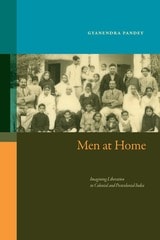
Men at Home
Imagining Liberation in Colonial and Postcolonial IndiaGyanendra Pandey
Duke University Press, 2025
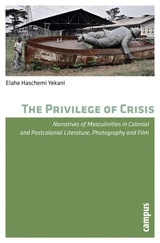
The Privilege of Crisis
Narratives of Masculinities in Colonial and Postcolonial Literature, Photography, and FilmElahe Haschemi Yekani
Campus Verlag, 2011
Despite the understanding of scholars that masculinity, far from being a natural or stable concept, is in reality a social construction, the culture at large continues to privilege an idealized, coherent male point of view. The Privilege of Crisis draws on the work of authors such as H. Rider Haggard, Rudyard Kipling, and Joseph Conrad—as well as contemporary postcolonial writers such as J. M. Coetzee, Hanif Kureishi and Zadie Smith—to show how recurrent references to a "crisis" of masculinity or the decline of masculinity serve largely to demonstrate and support positions of male privilege.
This Happy Land
The Jews of Colonial and Antebellum CharlestonJames William Hagy
University of Alabama Press, 1993