Results by title
3 books match the query 'Colonial Encounters'

Cinema and the Cosmopolitan City
Colonial Encounters in Shanghai, 1900–1930Qiliang He
University of Michigan Press, 2027
In early twentieth-century Shanghai, cinema was more than entertainment—it reshaped the city itself. As movie theaters appealed to city dwellers of all backgrounds, colonial authorities struggled to manage this new public space and introduced new safety rules, censorship, and anti-crime measures. Movie theaters unintentionally brought the unofficial way of racial segregation to an end. Moreover, imported films, though emblematic of Western modernity, paradoxically eroded the myth of Western civilizational superiority. These films revealed social ills in Euro-American societies, exposed Hollywood’s racist depictions of Chinese people, and galvanized anti-imperialist and nationalist sentiments among local audiences.
Cinema and the Cosmopolitan City adopts a “cinema off-screen” approach—stitching together urban history and film studies and foregrounding circulation, consumption, and spatial practice. Qiliang He draws on municipal archives, police records, censorship reports, trade journals, film reviews, and news stories to reconstruct the regulatory regimes imposed by the Shanghai Municipal Council and Shanghai Municipal Police, which was targeting both Bolshevism and “immoral” content. This book reveals how cinema didn’t just reflect modern life—it actively changed urban governance, fueled anticolonial feelings, and linked cosmopolitan culture with rising nationalism in China.
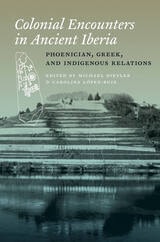
Colonial Encounters in Ancient Iberia
Phoenician, Greek, and Indigenous RelationsEdited by Michael Dietler and Carolina López-Ruiz
University of Chicago Press, 2009
During the first millennium BCE, complex encounters of Phoenician and Greek colonists with natives of the Iberian Peninsula transformed the region and influenced the entire history of the Mediterranean.
One of the first books on these encounters to appear in English, this volume brings together a multinational group of contributors to explore ancient Iberia’s colonies and indigenous societies, as well as the comparative study of colonialism. These scholars—from a range of disciplines including classics, history, anthropology, and archaeology—address such topics as trade and consumption, changing urban landscapes, cultural transformations, and the ways in which these issues played out in the Greek and Phoenician imaginations. Situating ancient Iberia within Mediterranean colonial history and establishing a theoretical framework for approaching encounters between colonists and natives, these studies exemplify the new intellectual vistas opened by the engagement of colonial studies with Iberian history.
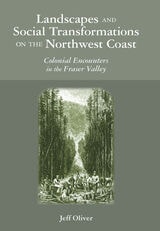
Landscapes and Social Transformations on the Northwest Coast
Colonial Encounters in the Fraser ValleyJeff Oliver
University of Arizona Press, 2010
The Fraser Valley has long been a scene of natural resource appropriation—furs and fish, timber and agriculture—with settlement patterns and land claims centering on the use of these materials. Oliver demonstrates how social change and cultural understanding are tied to the way that people use and remake the landscape. Drawing on ethnographic texts, archaeological evidence, cartography, and historical writing, he has created a deep history of the valley that enables us to view how human entanglements with landscape were creative of a variety of contentious issues. By capturing the multiple dynamics that were operating in the past, Oliver shows us not only how landscape transformations were implicated in constructing different perceptions of place but also how such changes influenced peoples’ understanding of history and identity.
This groundbreaking work examines engagement between people and the environment across a variety of themes, from aboriginal appropriation of nature to colonists’ reworking of physical and conceptual geographies, demonstrating the consequences of these interactions as they permeated various social and cultural spheres. It offers a new lens for viewing a region as it provides fresh insight into such topics as landscape change, perceptions of place, and Indigenous-white relations.