Results by title
2 books match the query 'Colonial Origins'
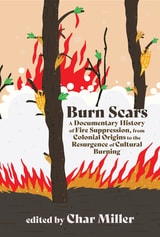
Burn Scars
A Documentary History of Fire Suppression, from Colonial Origins to the Resurgence of Cultural BurningChar Miller
Oregon State University Press, 2024
In Burn Scars, historian Char Miller assembles a collection of primary sources focused on debates over “light burning” (as prescribed or controlled burning was called). These historic documents show that not only was fire suppression controversial, but that it was also driven by explicitly racist and colonial beliefs. Yet the suppression paradigm contained within it the seeds of its destruction: Indigenous people continued to use fire as did non-Indigenous land managers. By the 1920s, scientific evidence was beginning to reveal that fire was essential for regenerating grasslands and forests; by the 1930s even the Forest Service was testing fire’s ecological benefits.
Burn Scars focuses on the burning debates of the early twentieth century, but Miller also provides evidence of a powerful counternarrative emerging from southern non-Indigenous foresters who used fire to revive longleaf pine ecosystems. The volume begins and ends with contributions from Indigenous practitioners discussing the long history and resurgent practice of cultural burning as part of traditional land management.
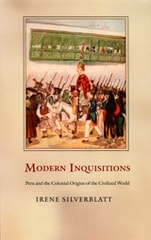
Modern Inquisitions
Peru and the Colonial Origins of the Civilized WorldIrene Silverblatt
Duke University Press, 2004
Drawing on extensive research in Peruvian and Spanish archives, Silverblatt uses church records, evangelizing sermons, and missionary guides to explore how the emerging modern world was built, experienced, and understood by colonists, native peoples, and Inquisition officials: Early missionaries preached about world history and about the races and nations that inhabited the globe; Inquisitors, able bureaucrats, defined who was a legitimate Spaniard as they executed heretics for “reasons of state”; the “stained blood” of Indians, blacks, and descendants of Jews and Moors was said to cause their deficient character; and native Peruvians began to call themselves Indian.
In dialogue with Arendt and other theorists of modernity, Silverblatt shows that the modern world’s underside is tied to its origins in colonialism and to its capacity to rationalize violence. Modern Inquisitions forces the reader to confront the idea that the Inquisition was not only a product of the modern world of the sixteenth and seventeenth centuries, but party to the creation of the civilized world we know today.