Results by title

8 books match the query 'Colonial administrators'
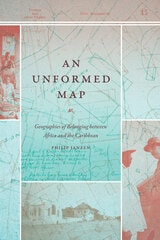
cover of An Unformed Map: Geographies of Belonging between Africa and the Caribbean

An Unformed Map

Geographies of Belonging between Africa and the Caribbean

Philip Janzen

Duke University Press, 2025
In An Unformed Map, Philip Janzen traces the intellectual trajectories of Caribbean people who joined the British and French colonial administrations in Africa between 1890 and 1930. Caribbean administrators grew up in colonial societies, saw themselves as British and French, and tended to look down on Africans. Once in Africa, however, they were doubly marginalized—excluded by Europeans and unwelcome among Africans. This marginalization was then reproduced in colonial archives, where their lives appear only in fragments. Drawing on sources beyond the archives of empire, from dictionaries and language exams to a suitcase full of poems, Janzen considers how Caribbean administrators reckoned with the profound effects of assimilation, racism, and dislocation. As they learned African languages, formed relationships with African intellectuals, and engaged with African cultures and histories, they began to rethink their positions in the British and French empires. They also created new geographies of belonging across the Atlantic, foundations from which others imagined new political horizons. Ultimately, Janzen offers a model for reading across sources and writing history in the face of archival fragmentation.
[more]
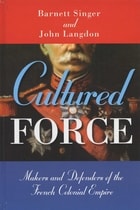
cover of Cultured Force: Makers and Defenders of the French Colonial Empire

Cultured Force

Makers and Defenders of the French Colonial Empire

Barnett Singer and John Langdon

University of Wisconsin Press, 2008
Bridging gaps between intellectual history, biography, and military/colonial history, Barnett Singer and John Langdon provide a challenging, readable interpretation of French imperialism and some of its leading figures from the early modern era through the Fifth Republic.  They ask us to rethink and reevaluate, pulling away from the usual shoal of simplistic condemnation.  In a series of finely-etched biographical studies, and with much detail on both imperial culture and wars (including World War I and II), they offer a balanced, deep, strong portrait of key makers and defenders of the French Empire, one that will surely stimulate much historical work in the field.
[more]
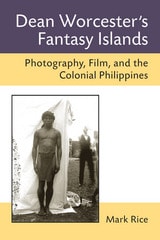
cover of Dean Worcester's Fantasy Islands: Photography, Film, and the Colonial Philippines

Dean Worcester's Fantasy Islands

Photography, Film, and the Colonial Philippines

Mark Rice

University of Michigan Press, 2014

Dean Worcester’s Fantasy Islands brings to life one of the most significant (but under examined) figures in the history of U.S. colonialism in the Philippines. Upon the outbreak of the Spanish-American War, Worcester, a scientist who had traveled twice to the Philippines on zoological expeditions, established himself as one of America’s leading experts on the Philippines. Over a fourteen-year career as a member of the U.S. colonial regime, Worcester devoted much of his time and energy to traveling among and photographing non-Christian minority groups in the Philippines. He amassed an archive of several thousand photographs taken by him or by government photographers. Worcester deployed those photographs in books, magazine articles, and lectures to promote his belief that the United States should maintain control of the Philippines for decades to come. While many historians have examined American colonial photography in the Philippines, this book is the first lengthy treatment of Worcester’s role in shaping American perceptions of the Philippines in the early twentieth century.
[more]
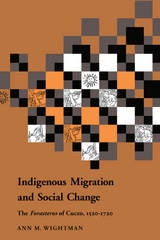
cover of Indigenous Migration and Social Change: The Foresteros of Cuzco, 1570-1720

Indigenous Migration and Social Change

The Foresteros of Cuzco, 1570-1720

Ann M. Wightman

Duke University Press, 1990

Many observers in colonial Spanish America—whether clerical, governmental, or foreign—noted the large numbers of forasteros, or Indians who were not seemingly attached to any locality. These migrants, or “wanderers,” offended the bureaucratic sensibilities of the Spanish administration, as they also frustrated their tax and revenue efforts. Ann M. Wightman’s research on these early “undocumentals” in the Cuzco region of Peru reveals much of importance on Andean society and its adaptation and resistance to Spanish cultural and political hegemony. The book thereby informs our understanding of social change in the colonial period.
Wightman shows that the dismissal of the forasteros as marginalized rural poor is superficial at best, and through laborious and painstaking archival research she presents a clear picture of the transformation of traditional society as the native populations coped with the disruptions of the conquest—and in doing so, reveals the reciprocal adaptations of the colonial power. Her choice of Cuzco is particularly appropriate, as this was a “heartland” region crucial to both the Incan and Spanish empires. The questions addressed by Wightman are of great concern to current Andean ethnohistory, one of the liveliest areas of such research, and are sure to have an important impact.
[more]
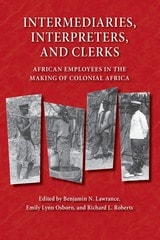
cover of Intermediaries, Interpreters, and Clerks: African Employees in the Making of Colonial Africa

Intermediaries, Interpreters, and Clerks

African Employees in the Making of Colonial Africa

Edited by Benjamin N. Lawrance, Emily Lynn Osborn, and Richard L. Roberts

University of Wisconsin Press, 2006

As a young man in South Africa, Nelson Mandela aspired to be an interpreter or clerk, noting in his autobiography that “a career as a civil servant was a glittering prize for an African.” Africans in the lower echelons of colonial bureaucracy often held positions of little official authority, but in practice these positions were lynchpins of colonial rule. As the primary intermediaries among European colonial officials, African chiefs, and subject populations, these civil servants could manipulate the intersections of power, authority, and knowledge at the center of colonial society.
            By uncovering the role of such men (and a few women) in the construction, function, and legal apparatus of colonial states, the essays in this volume highlight a new perspective. They offer important insights on hegemony, collaboration, and resistance, structures and changes in colonial rule, the role of language and education, the production of knowledge and expertise in colonial settings, and the impact of colonization in dividing African societies by gender, race, status, and class.
[more]
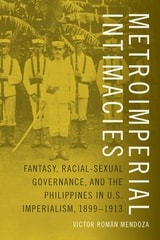
cover of Metroimperial Intimacies: Fantasy, Racial-Sexual Governance, and the Philippines in U.S. Imperialism, 1899-1913

Metroimperial Intimacies

Fantasy, Racial-Sexual Governance, and the Philippines in U.S. Imperialism, 1899-1913

Victor Román Mendoza

Duke University Press, 2015
In Metroimperial Intimacies Victor Román Mendoza combines historical, literary, and archival analysis with queer-of-color critique to show how U.S. imperial incursions into the Philippines enabled the growth of unprecedented social and sexual intimacies between native Philippine and U.S. subjects. The real and imagined intimacies—whether expressed through friendship, love, or eroticism—threatened U.S. gender and sexuality norms. To codify U.S. heteronormative behavior, the colonial government prohibited anything loosely defined as perverse, which along with popular representations of Filipinos, regulated colonial subjects and depicted them as sexually available, diseased, and degenerate. Mendoza analyzes laws, military records, the writing of Philippine students in the United States, and popular representations of Philippine colonial subjects to show how their lives, bodies, and desires became the very battleground for the consolidation of repressive legal, economic, and political institutions and practices of the U.S. colonial state. By highlighting the importance of racial and gendered violence in maintaining control at home and abroad, Mendoza demonstrates that studies of U.S. sexuality must take into account the reach and impact of U.S. imperialism.
 
[more]
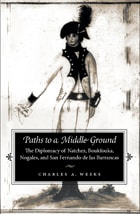
cover of Paths to a Middle Ground: The Diplomacy of Natchez, Boukfouka, Nogales, and San Fernando de las Barrancas, 1791-1795

Paths to a Middle Ground

The Diplomacy of Natchez, Boukfouka, Nogales, and San Fernando de las Barrancas, 1791-1795

Charles A. Weeks

University of Alabama Press, 2005

Spanish imperial attempts to form strong Indian alliances to thwart American expansion in the Mississippi Valley.
 
Charles Weeks explores the diplomacy of Spanish colonial officials in New Orleans and Natchez in order to establish posts on the Mississippi River and Tombigbee rivers in the early 1790s. Another purpose of this diplomacy, urged by Indian leaders and embraced by Spanish officials, was the formation of a regional Indian confederation that would deter American expansion into Indian lands.

Weeks shows how diplomatic relations were established and maintained in the Gulf South between Choctaw, Chickasaw, Creek, and Cherokee chiefs and their Spanish counterparts aided by traders who had become integrated into Indian societies. He explains that despite the absence of a European state system, Indian groups had diplomatic skills that Europeans could understand: full-scale councils or congresses accompanied by elaborate protocol, interpreters, and eloquent metaphorical language.

Paths to a Middle Ground
is both a narrative and primary documents. Key documents from Spanish archival sources serve as a basis for the examination of the political culture and imperial rivalry playing out in North America in the waning years of the 18th century.


[more]
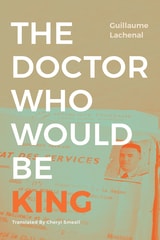
cover of The Doctor Who Would Be King

The Doctor Who Would Be King

Guillaume Lachenal

Duke University Press, 2022

In The Doctor Who Would Be King Guillaume Lachenal tells the extraordinary story of Dr. Jean Joseph David, a French colonial army doctor who governed an entire region of French Cameroon during World War II. Dr. David—whom locals called “emperor”—dreamed of establishing a medical utopia. Through unchecked power, he imagined realizing the colonialist fantasy of emancipating colonized subjects from misery, ignorance, and sickness. Drawing on archives, oral histories, and ethnographic fieldwork, Lachenal traces Dr. David’s earlier attempts at a similar project on a Polynesian island and the ongoing legacies of his failed experiment in Cameroon. Lachenal does not merely recount a Conradian tale of imperial hubris, he brings the past into the present, exploring the memories and remains of Dr. David’s rule to reveal a global history of violence, desire, and failure in which hope for the future gets lost in the tragic comedy of power.
[more]