Results by title

5 books match the query 'Colony'
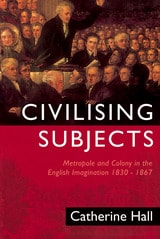
cover of Civilising Subjects: Metropole and Colony in the English Imagination 1830-1867

Civilising Subjects

Metropole and Colony in the English Imagination 1830-1867

Catherine Hall

University of Chicago Press, 2002

How did the English get to be English? In Civilising Subjects, Catherine Hall argues that the idea of empire was at the heart of mid-nineteenth-century British self-imagining, with peoples such as the "Aborigines" in Australia and the "negroes" in Jamaica serving as markers of difference separating "civilised" English from "savage" others.

Hall uses the stories of two groups of Englishmen and -women to explore British self-constructions both in the colonies and at home. In Jamaica, a group of Baptist missionaries hoped to make African-Jamaicans into people like themselves, only to be disappointed when the project proved neither simple nor congenial to the black men and women for whom they hoped to fashion new selves. And in Birmingham, abolitionist enthusiasm dominated the city in the 1830s, but by the 1860s, a harsher racial vocabulary reflected a new perception of the nonwhite subjects of empire as different kinds of men from the "manly citizens" of Birmingham.

This absorbing study of the "racing" of Englishness will be invaluable for imperial and cultural historians.
[more]
cover of Decolonizing the Map: Cartography from Colony to Nation

Decolonizing the Map

Cartography from Colony to Nation

Edited by James R. Akerman

University of Chicago Press, 2017

Almost universally, newly independent states seek to affirm their independence and identity by making the production of new maps and atlases a top priority. For formerly colonized peoples, however, this process neither begins nor ends with independence, and it is rarely straightforward. Mapping their own land is fraught with a fresh set of issues: how to define and administer their territories, develop their national identity, establish their role in the community of nations, and more. The contributors to Decolonizing the Map explore this complicated relationship between mapping and decolonization while engaging with recent theoretical debates about the nature of decolonization itself.
 
These essays, originally delivered as the 2010 Kenneth Nebenzahl, Jr., Lectures in the History of Cartography at the Newberry Library, encompass more than two centuries and three continents—Latin America, Africa, and Asia. Ranging from the late eighteenth century through the mid-twentieth, contributors study topics from mapping and national identity in late colonial Mexico to the enduring complications created by the partition of British India and the racialized organization of space in apartheid and post-apartheid South Africa. A vital contribution to studies of both colonization and cartography, Decolonizing the Map is the first book to systematically and comprehensively examine the engagement of mapping in the long—and clearly unfinished—parallel processes of decolonization and nation building in the modern world.
[more]
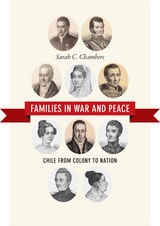
cover of Families in War and Peace: Chile from Colony to Nation

Families in War and Peace

Chile from Colony to Nation

Sarah C. Chambers

Duke University Press, 2015
In Families in War and Peace Sarah C. Chambers places gender analysis and family politics at the center of Chile's struggle for independence and its subsequent state building. Linking the experiences of both prominent and more humble families to Chile's political and legal history, Chambers argues that matters such as marriage, custody, bloodlines, and inheritance were crucial to Chile's transition from colony to nation. She shows how men and women extended their familial roles to mobilize kin networks for political ends, both during and after the Chilean revolution. From the conflict's end in 1823 until the 1850s, the state adopted the rhetoric of paternal responsibility along with patriarchal authority, which became central to the state building process. Chilean authorities, Chambers argues, garnered legitimacy by enacting or enforcing paternalist laws on property restitution, military pensions, and family maintenance allowances, all of which provided for diverse groups of Chileans. By acting as the fathers of the nation, they aimed to reconcile the "greater Chilean family" and form a stable government and society.
[more]
cover of Landscapes of Power and Identity: Comparative Histories in the Sonoran Desert and the Forests of Amazonia from Colony to Republic

Landscapes of Power and Identity

Comparative Histories in the Sonoran Desert and the Forests of Amazonia from Colony to Republic

Cynthia Radding

Duke University Press, 2005

Landscapes of Power and Identity is a groundbreaking comparative history of two colonies on the frontiers of the Spanish empire—the Sonora region of northwestern Mexico and the Chiquitos region of eastern Bolivia’s lowlands—from the late colonial period through the middle of the nineteenth century. An innovative combination of environmental and cultural history, this book reflects Cynthia Radding’s more than two decades of research on Mexico and Bolivia and her consideration of the relationships between human societies and the geographic landscapes they inhabit and create. At first glance, Sonora and Chiquitos are quite different: one a scrub-covered desert, the other a tropical rainforest of the greater Amazonian and Paraguayan river basins. Yet the regions are similar in many ways. Both were located far from the centers of colonial authority, organized into Jesuit missions and linked to the principal mining centers of New Spain and the Andes, and then absorbed into nation-states in the nineteenth century. In each area, the indigenous communities encountered European governors, missionaries, slave hunters, merchants, miners, and ranchers.

Radding’s comparative approach illuminates what happened when similar institutions of imperial governance, commerce, and religion were planted in different physical and cultural environments. She draws on archival documents, published reports by missionaries and travelers, and previous histories as well as ecological studies and ethnographies. She also considers cultural artifacts, including archaeological remains, architecture, liturgical music, and religious dances. Radding demonstrates how colonial encounters were conditioned by both the local landscape and cultural expectations; how the colonizers and colonized understood notions of territory and property; how religion formed the cultural practices and historical memories of the Sonoran and Chiquitano peoples; and how the conflict between the indigenous communities and the surrounding creole societies developed in new directions well into the nineteenth century.
[more]
cover of The Time beneath the Concrete: Palestine between Camp and Colony

The Time beneath the Concrete

Palestine between Camp and Colony

Nasser Abourahme

Duke University Press, 2025

In The Time beneath the Concrete, Nasser Abourahme argues that settler colonialism is always as much an attempt to conquer time as it is to conquer land. Taking as his primary object  Palestinian refugee camps, created in the fallout of the eliminatory violence of Israel’s founding, Abourahme shows how these camps become the primary place where settler colonial attempts to dominate space and time encounter Indigenous refusal. Seen from the camps, Israel becomes a settler colonial project defined by its inability to move past the past—a project stuck at its foundational moment of conquest. At the same time, the Palestinian insistence on return is a refusal to abide by the closure of the past into settler futurity. Palestinian struggle does not just happen in the open time of dispossession; it happens over this time. That struggle, Abourahme demonstrates, is a form of anticolonial refusal that draws its power not from any decisive finality, but precisely from irresolution and keeping time open.
[more]