Results by title
2 books match the query 'Colorado River Delta'
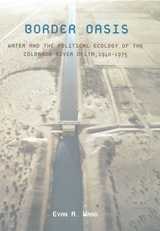
Border Oasis
Water and the Political Ecology of the Colorado River Delta, 1940–1975Evan R. Ward
University of Arizona Press, 2003
The environmental history of the Colorado River delta during the past century is one of the most important—and most neglected—stories of the U.S.-Mexico Borderlands. Thanks to entrepreneurs such as William E. Smythe, the surrounding desert in Arizona, California, Sonora, and Baja California has been transformed into an agricultural oasis, but not without significant ecological, political, economic, and social consequences.
Evan Ward explores the rapid development of this region, examining the ways in which regional politics and international relations created a garden in the Mexicali, Yuma, and Imperial Valleys while simultaneously threatening the life of the Colorado River. Tracing the transformation of the delta by irrigated agribusiness through the twentieth century, he draws on untapped archival resources from both sides of the border to offer a new look at one of the world's most contested landscapes.
Border Oasis tells how two very different nations developed the delta into an agricultural oasis at enormous environmental cost. Focusing on the years 1940 to 1975—including the disastrous salinity crisis of the 1960s and 1970s—it combines Mexican, Native American, and U.S. perspectives to demonstrate that the political and diplomatic influences on the delta played as much a part in the region's transformation as did irrigation. Ward reveals how mistrust among political and economic participants has been fueled by conflict between national and local officials on both sides of the border, by Mexican nationalism, and by a mutual recognition that water is the critical ingredient for regional economic development.
With overemphasis on development in both nations leading to an ecological breaking point, Ward demonstrates that conflicting interests have made sound binational management of the delta nearly impossible. By weaving together all of these threads that have produced the fabric of today's lower Colorado, his study shows that the environmental history of the delta must be understood as a whole, not from the standpoint of only one of many competing interests.
[more]
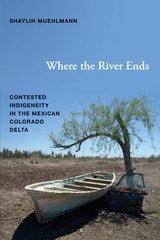
Where the River Ends
Contested Indigeneity in the Mexican Colorado DeltaShaylih Muehlmann
Duke University Press, 2013
Living in the northwest of Mexico, the Cucapá people have relied on fishing as a means of subsistence for generations, but in the last several decades, that practice has been curtailed by water scarcity and government restrictions. The Colorado River once met the Gulf of California near the village where Shaylih Muehlmann conducted ethnographic research, but now, as a result of a treaty, 90 percent of the water from the Colorado is diverted before it reaches Mexico. The remaining water is increasingly directed to the manufacturing industry in Tijuana and Mexicali. Since 1993, the Mexican government has denied the Cucapá people fishing rights on environmental grounds. While the Cucapá have continued to fish in the Gulf of California, federal inspectors and the Mexican military are pressuring them to stop. The government maintains that the Cucapá are not sufficiently "indigenous" to warrant preferred fishing rights. Like many indigenous people in Mexico, most Cucapá people no longer speak their indigenous language; they are highly integrated into nonindigenous social networks. Where the River Ends is a moving look at how the Cucapá people have experienced and responded to the diversion of the Colorado River and the Mexican state's attempts to regulate the environmental crisis that followed.
[more]