Results by title
4 books match the query 'Colorado Springs (Colo.)'

Modernism at Mid-Century
The Architecture of the United States Air Force AcademyEdited by Robert Bruegmann
University of Chicago Press, 1994
The contributors to this volume (Jory Johnson, Robert Nauman, Sheri Olson, James Russell, and Kristen Schaffer) and editor Robert Bruegmann chronicle the complex history of the planning, design, and construction of the Air Force Academy. As the most conspicuous commission of the American military at the height of the Cold War, the design of the Academy generated intense popular interest and was a lightning rod for conflicting values in postwar society. The design, by architects Skidmore, Owings & Merrill, has been hailed as the final triumph of the International Style and as a monument to military bureaucracy.

Newport In Rockies
Life & Good Times OfMarshall Sprague
Ohio University Press, 1988
In the town's early years, rich easterners and Englishmen came seeking adventure, romance, and gentility. But when gold was discovered at nearby Cripple Creek in 1900, Colorado Springs became an instant boom town. A second major boom came several decades later, when local boosters persuaded the Army to choose Colorado Springs as the site for Fort Carson, a training center for 30,000 troops. Other military projects followed, including Peterson Field, Ent Air Force Base, the underground North American Air Defense Command Combat Operations Center, and in 1954, the U.S. Air Force Academy. More recent projects, discussed in a new final chapter, include the Olympic Training Center and the Olympic Hall of Fame, as well as high-tech industries and advances in culture, education, and recreation.
As the city sprawls eastward onto the prairie, it bears little resemblance to General Palmer's 1871 village. Yet the general's dream of a quality town in a quality environment has continued to inspire generations of administrators and boosters who have made Colorado Springs a model of urban prosperity.
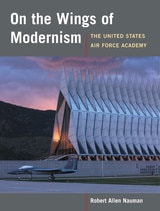
On the Wings of Modernism
The United States Air Force AcademyRobert Allen Nauman
University of Illinois Press, 2003
The United States Air Force Academy stands as one of the most extensive architectural projects of the cold war era. Key to a full understanding of American modernism, the project was also a volatile battleground involving competing ideas about aesthetics and politics. Arguing that the academy's production was squarely grounded in bureaucratic and political processes, Robert Allen Nauman demonstrates that selection of both the site and the design firm was the result of political maneuverings involving U.S. military leadership.
In the academy’s iconic design, myths and metaphors of flight and the American West were interwoven with those of modernism, both to justify the plan and to free it from any lingering socialist or European associations. Skidmore, Owings, and Merrill’s first public exhibition of plans and models for the project was designed by the former Bauhaus master Herbert Bayer, and it incorporated photographs of the Colorado Springs site by Ansel Adams and William Garnett. Using previously unexplored resources of the U.S. Air Force Academy, SOM, and the Air Force Academy Construction Agency, Nauman uncovered materials such as negatives of Adams’s original photographs of the sites. He also conducted extensive interviews with SOM’s project director for the academy, Walter Netsch, in tracing the complete history of the academy's construction, from its earliest conception to eventual completion.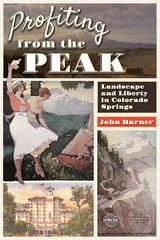
Profiting from the Peak
Landscape and Liberty in Colorado SpringsJohn Harner
University Press of Colorado, 2021
Colorado Springs, Colorado, has long profited from Pikes Peak and built an urban infrastructure to sustain that relationship. In Profiting from the Peak, geographer John Harner surveys the events and socioeconomic conditions that formed the city, analyzing the built landscape to offer insight into the origins of its urban forms and spatial layout, focusing particularly on historic downtown architecture and public spaces. He examines the cultural values that have come to define the city, showing how military and other institutions, tourism, political and economic conditions, cultural movements, key individual actors, and administrative policies have created a singular urban personality.
Capital accumulation has been a defining theme of Colorado Springs from its very beginning, with enormous profits generated from regional industrialization, railroads, land sales, water appropriation, and extraction of coal and gold. These conditions and its setting in the Rocky Mountain West formed a libertarian-oriented, limited governance philosophy.