Results by title
3 books match the query 'Coltman, Derek'

From Myth to Fiction
The Saga of HadingusGeorges Dumézil
University of Chicago Press, 1973
In this work the distinguished religious historian Georges Dumézil considers how the early mythology of a people can be creatively transposed into the epic of their origin or the "history" of their kings, or the source of their fiction. The Saga of Hadingus, written by a twelfth-century Danish "historian," Saxo-Grammaticus, provides an extraordinarily interesting instance of this kind of transposition. By comparing this work to a myth as it was handed down to Saxo, Professor Dumézil demonstrates how the saga can be seen as a literary structure derived from the religious structure of the myth.
As Professor Dumézil and others have shown, some Indo-European peoples, after their conversion to Christianity, have reordered an earlier mythology to constitute the epic of their origins. For instance, Celtic mythology became history in one case and a source of fiction in another; and from the two texts, Welsh and Irish, by comparison one can reconstruct the original myth.
The Scandinavian nations provide a unique case, for here the pre-Christian texts are still read and have preserved much of the area's mythology in its original form. In addition, we have the work of Saxo and other known writers who composed and signed human transpositions of this mythology purporting to be history. This permits Professor Dumézil to make observations of a rare kind, for knowing something of the author's personality facilitates an understanding of the process of transposition itself.
Professor Dumézil shows how Saxo began by wanting only to tell the story of Denmark and its rulers as nobly as he could—and then later on to extend that narrative back in time. This led him to the only extant Scandinavian literature—that centered on Iceland—that he reordered and reinterpreted to the greater glory of Denmark.
In order to provide a content for the reign of the third king of the Danish Skoldunger dynasty, Hadingus, Saxo simply reworked a Scandinavian account of the career of the god Njördr. In this light Professor Dumézil reads The Saga of Hadingus as a fascinating substitution of a psychological and completely personal narrative for a story of purely social value.
This book contains six appendixes including two that consider the relationship between myth and folklore. They complement Professor Dumézil's careful exegeses and imaginative scholarship to make this the most important, specialized work on Scandinavian mythology available in English.
[more]
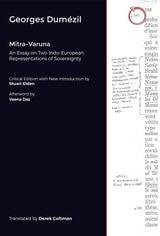
Mitra-Varuna
An Essay on Two Indo-European Representations of SovereigntyGeorges Dumézil
HAU, 2023
A classic text that develops one prong of Dumézil’s tripartite hypothesis of Indo-European tribes: the sacred sovereign.
Georges Dumézil’s fascination with the myths and histories of India, Rome, Scandinavia, and the Celts yielded an idea that became his most influential scholarly legacy: the tripartite hypothesis, which divides Indo-European societal functions into three classes: the sacred sovereign, the warrior, and the producer. Mitra-Varuna, originally published in 1940, concentrates on the first function, that of sovereignty. Dumézil identifies two types of rulers, the first judicial and worldly, the second divine and supernatural. These figures, both priestly, are oppositional but complementary. The title nods to these roles, referring to the gods Mitra, a rational mediator, and Varuna, an awesome religious figure.
Stuart Elden’s critical edition, based on the 1988 English translation by Derek Coltman, identifies variations between the first and second French editions and completes—and in places corrects—Dumézil’s references. The editor’s detailed introduction situates Mitra-Varuna within Dumézil’s career, outlines how his treatment of its themes developed over time, and relates the book to the political controversy around his ideas. Two new appendices contain passages that did not appear in the second French edition.
[more]
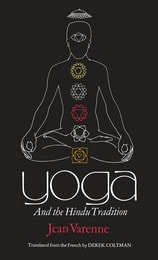
Yoga and the Hindu Tradition
Jean Varenne
University of Chicago Press, 1977
A popular and critical success when it first appeared in France, Yoga and the Hindu Tradition has freed Yoga from the common misconceptions of the recent Yoga vogue. Jean Varenne, the distinguished French Orientalist, presents the theory of classical Yoga, in all its richness, as a method—a concrete way to reach the Absolute through spiritual exercises—which makes possible the transition from existence to essence.
This excellent translation, including line drawings and charts, a glossary of technical terms, and a complete translation of the Yoga Darshana Upanishad, begins with a brief description of the metaphysical and religious history on which Yoga is based. Varenne discusses the theoretical conception of Yoga as the search for liberating knowledge, concluding with a brief indication of the physical practices and extra Yogic themes such as Kundalini and Tantrism. It is the author's hope that "those who read [this book] will come to realize that it is in fact dishonest to reduce Yoga to some sort of physical training, or to just an occult doctrine; it is a 'world view' a Weltanschauung that comprehends reality in its totality."
"The straightforward, well-organized presentation makes the book itself a microcosm of what Varenne singles out as a dominant feature of classical Hindu thought—a bringing of the complex and multitudinous into a unity."—Judith Guttman, Yoga Journal
[more]