Results by title
3 books match the query 'Comanche Indians'
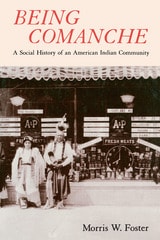
Being Comanche
The Social History of an American Indian CommunityMorris W. Foster
University of Arizona Press, 1991
Comanches have engaged Euro-Americans' curiosity for three centuries. Their relations with Spanish, French, and Anglo-Americans on the southern Plains have become a highly resonant part of the mythology of the American West. Yet we know relatively little about the community that Comanches have shared and continue to construct in southwestern Oklahoma. Morris W. Foster has written the first study of Comanches' history that identifies continuities in their intracommunity organization from the initial period of European contact to the present day. Those continuities are based on shared participation in public social occasions such as powwows, peyote gatherings, and church meetings Foster explains how these occasions are used to regulate social organization and how they have been modified by Comanches to adapt them to changing political and economic relations with Euro-Americans. Using a model of community derived from sociolinguistics, Foster argues that Comanches have remained a distinctive people by organizing their face-to-face relations with one another in ways that maintain Comanche-Comanche lines of communication and regulate a shared sense of appropriate behavior. His book offers readers a significant reinterpretation of traditional anthropological and historical views of Comanche social organization.
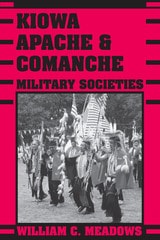
Kiowa, Apache, and Comanche Military Societies
Enduring Veterans, 1800 to the PresentBy William C. Meadows
University of Texas Press, 1999
A CHOICE Outstanding Academic Book
For many Plains Indians, being a warrior and veteran has long been the traditional pathway to male honor and status. Men and boys formed military societies to celebrate victories in war, to perform community service, and to prepare young men for their role as warriors and hunters. By preserving cultural forms contained in song, dance, ritual, language, kinship, economics, naming, and other semireligious ceremonies, these societies have played an important role in maintaining Plains Indian culture from the pre-reservation era until today.
In this book, Williams C. Meadows presents an in-depth ethnohistorical survey of Kiowa, Apache, and Comanche military societies, drawn from extensive interviews with tribal elders and military society members, unpublished archival sources, and linguistic data. He examines their structure, functions, rituals, and martial symbols, showing how they fit within larger tribal organizations. And he explores how military societies, like powwows, have become a distinct public format for cultural and ethnic continuity.
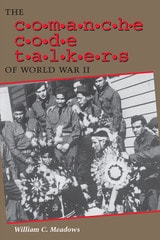
The Comanche Code Talkers of World War II
By William C. Meadows
University of Texas Press, 2003
Among the allied troops that came ashore in Normandy on D-Day, June 6, 1944, were thirteen Comanches in the 4th Infantry Division, 4th Signal Company. Under German fire they laid communications lines and began sending messages in a form never before heard in Europe—coded Comanche. For the rest of World War II, the Comanche Code Talkers played a vital role in transmitting orders and messages in a code that was never broken by the Germans.
This book tells the full story of the Comanche Code Talkers for the first time. Drawing on interviews with all surviving members of the unit, their original training officer, and fellow soldiers, as well as military records and news accounts, William C. Meadows follows the group from their recruitment and training to their active duty in World War II and on through their postwar lives up to the present. He also provides the first comparison of Native American code talking programs, comparing the Comanche Code Talkers with their better-known Navajo counterparts in the Pacific and with other Native Americans who used their languages, coded or not, for secret communication. Meadows sets this history in a larger discussion of the development of Native American code talking in World Wars I and II, identifying two distinct forms of Native American code talking, examining the attitudes of the American military toward Native American code talkers, and assessing the complex cultural factors that led Comanche and other Native Americans to serve their country in this way.