Results by title
121 books match the query 'Comic books, strips, etc' and 8 start with a

Alice in Sussex
Mahler after Lewis Carroll & H. C. ArtmannNicolas Mahler
Seagull Books, 2022
Alice is back in Wonderland. Here she meets the White Rabbit, who leads her down into his rabbit hole in search of an illustrated edition of H. C. Artmann’s Frankenstein in Sussex. Over the course of the novel, Alice repeatedly runs into the Rabbit, who quotes freely from other literary works by the likes of Herman Melville and E. M. Cioran.
Unlike in Lewis Carroll’s classic, Alice is not traveling the Wonderland we know. Rather, in Nicolas Mahler’s whimsical graphic novel retelling, she is in a house deep beneath the ground. On subsequent floors, she encounters the famous creations of Lewis Carroll: the Hookah-Smoking Caterpillar, the Cheshire Cat, the Mock Turtle, and many others. One after the other, these creatures address the terrors of childhood and youth. It is only when Alice reaches the ground floor of the house that we arrive at the inevitable climax: face to face with Frankenstein’s Monster.
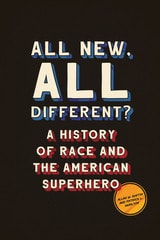
All New, All Different?
A History of Race and the American SuperheroBy Allan W. Austin and Patrick L. Hamilton
University of Texas Press, 2019
Winner, John G. Cawelti Award for the Best Textbook/Primer, Popular Culture Association/American Culture Association, 2019
MPCA/ACA Book Award, Midwest Popular Culture Association / Midwest American Culture Association, 2020
Taking a multifaceted approach to attitudes toward race through popular culture and the American superhero, All New, All Different? explores a topic that until now has only received more discrete examination. Considering Marvel, DC, and lesser-known texts and heroes, this illuminating work charts eighty years of evolution in the portrayal of race in comics as well as in film and on television.
Beginning with World War II, the authors trace the vexed depictions in early superhero stories, considering both Asian villains and nonwhite sidekicks. While the emergence of Black Panther, Black Lightning, Luke Cage, Storm, and other heroes in the 1960s and 1970s reflected a cultural revolution, the book reveals how nonwhite superheroes nonetheless remained grounded in outdated assumptions. Multiculturalism encouraged further diversity, with 1980s superteams, the minority-run company Milestone’s new characters in the 1990s, and the arrival of Ms. Marvel, a Pakistani-American heroine, and a new Latinx Spider-Man in the 2000s. Concluding with a discussion of contemporary efforts to make both a profit and a positive impact on society, All New, All Different? enriches our understanding of the complex issues of racial representation in American popular culture.
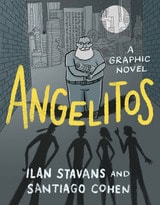
Angelitos
A Graphic NovelIlan Stavans and Santiago Cohen
The Ohio State University Press, 2018
Though Angelitos: A Graphic Novel is a fictional retelling of a desperate time, it draws on autobiographical elements to tell the real-life story of Alejandro García Durán de Lara, popularly known as Padre Chinchachoma, a complicated figure revered by some and reviled by others.
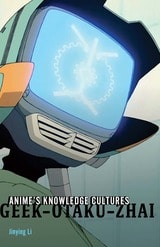
Anime's Knowledge Cultures
Geek, Otaku, ZhaiJinying Li
University of Minnesota Press, 2024
Unlocking the technosocial implications of global geek cultures
Why has anime, a “low-tech” medium from last century, suddenly become the cultural “new cool” in the information age? Through the lens of anime and its transnational fandom, Jinying Li explores the meanings and logics of “geekdom” as one of the most significant sociocultural groups of our time. In Anime’s Knowledge Cultures, Li shifts the center of global geography in knowledge culture from the computer boys in Silicon Valley to the anime fandom in East Asia.
Drawing from film studies, animation studies, media theories, fan studies, and area studies, she provides broad cultural and theoretical explanations of anime’s appeal to a new body of tech-savvy knowledge workers and consumers commonly known as geeks, otaku, or zhai. Examining the forms, techniques, and aesthetics of anime, as well as the organization, practices, and sensibilities of its fandom, Anime’s Knowledge Cultures is at once a theorization of anime as a media environment as well as a historical and cultural study of transnational geekdom as a knowledge culture. Li analyzes anime culture beyond the national and subcultural frameworks of Japan or Japanese otaku, instead theorizing anime’s transnational, transmedial network as the epitome of the postindustrial knowledge culture of global geekdom.
By interrogating the connection between the anime boom and global geekdom, Li reshapes how we understand the meanings and significance of anime culture in relation to changing social and technological environments.
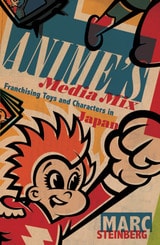
Anime’s Media Mix
Franchising Toys and Characters in JapanMarc Steinberg
University of Minnesota Press, 2012
In Anime’s Media Mix, Marc Steinberg convincingly shows that anime is far more than a style of Japanese animation. Beyond its immediate form of cartooning, anime is also a unique mode of cultural production and consumption that led to the phenomenon that is today called “media mix” in Japan and “convergence” in the West.
According to Steinberg, both anime and the media mix were ignited on January 1, 1963, when Astro Boy hit Japanese TV screens for the first time. Sponsored by a chocolate manufacturer with savvy marketing skills, Astro Boy quickly became a cultural icon in Japan. He was the poster boy (or, in his case, “sticker boy”) both for Meiji Seika’s chocolates and for what could happen when a goggle-eyed cartoon child fell into the eager clutches of creative marketers. It was only a short step, Steinberg makes clear, from Astro Boy to Pokémon and beyond.
Steinberg traces the cultural genealogy that spawned Astro Boy to the transformations of Japanese media culture that followed—and forward to the even more profound developments in global capitalism supported by the circulation of characters like Doraemon, Hello Kitty, and Suzumiya Haruhi. He details how convergence was sparked by anime, with its astoundingly broad merchandising of images and its franchising across media and commodities. He also explains, for the first time, how the rise of anime cannot be understood properly—historically, economically, and culturally—without grasping the integral role that the media mix played from the start. Engaging with film, animation, and media studies, as well as analyses of consumer culture and theories of capitalism, Steinberg offers the first sustained study of the Japanese mode of convergence that informs global media practices to this day.
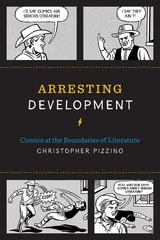
Arresting Development
Comics at the Boundaries of LiteratureBy Christopher Pizzino
University of Texas Press, 2016
Mainstream narratives of the graphic novel’s development describe the form’s “coming of age,” its maturation from pulp infancy to literary adulthood. In Arresting Development, Christopher Pizzino questions these established narratives, arguing that the medium’s history of censorship and marginalization endures in the minds of its present-day readers and, crucially, its authors. Comics and their writers remain burdened by the stigma of literary illegitimacy and the struggles for status that marked their earlier history.
Many graphic novelists are intensely aware of both the medium’s troubled past and their own tenuous status in contemporary culture. Arresting Development presents case studies of four key works—Frank Miller’s Batman: The Dark Knight Returns, Alison Bechdel’s Fun Home, Charles Burns’s Black Hole, and Gilbert Hernandez’s Love and Rockets—exploring how their authors engage the problem of comics’ cultural standing. Pizzino illuminates the separation of high and low culture, art and pulp, and sophisticated appreciation and vulgar consumption as continual influences that determine the limits of literature, the status of readers, and the value of the very act of reading.
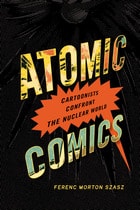
Atomic Comics
Cartoonists Confront the Nuclear WorldFerenc Morton Szasz
University of Nevada Press, 2013
The advent of the Atomic Age challenged purveyors of popular culture to explain to the general public the complex scientific and social issues of atomic power. Atomic Comics examines how comic books, comic strips, and other cartoon media represented the Atomic Age from the early 1920s to the present. Through the exploits of superhero figures such as Atomic Man and Spiderman, as well as an array of nuclear adversaries and atomic-themed adventures, the public acquired a new scientific vocabulary and discovered the major controversies surrounding nuclear science. Ferenc Morton Szasz’s thoughtful analysis of the themes, content, and imagery of scores of comics that appeared largely in the United States and Japan offers a fascinating perspective on the way popular culture shaped American comprehension of the fissioned atom for more than three generations.
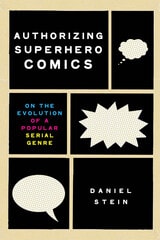
Authorizing Superhero Comics
On the Evolution of a Popular Serial GenreDaniel Stein
The Ohio State University Press, 2021