Results by title

3 books match the query 'Commercial treaties'
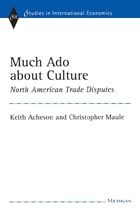
cover of Much Ado about Culture: North American Trade Disputes

Much Ado about Culture

North American Trade Disputes

Keith Acheson and Christopher Maule

University of Michigan Press, 2001
In Canada, the audio-visual and print industries are referred to as the cultural industries, whereas the United States calls them the entertainment industries. These language distinctions are accompanied by different domestic policies and political discourses. The United States has relatively open policies toward these activities, while Canada has adopted an inward-looking approach. Failure to integrate cultural industries into NAFTA and WTO has led to trade disputes between Canada and the United States over copyrights, television licensing, violence in media, and discriminatory magazine policy, indicating the need for an agreed-upon process for settling cultural trade disputes.
Much Ado about Culture explores the differing sets of policies--cultural nationalism versus the open option--and the resulting conflicts in the context of technological developments as well as international agreements dealing with trade, investment, copyright, and labor movements. The Canadian cultural industries are examined, from film and television production and distribution to broadcasting, publishing, and sound recording. Several areas of recent conflict, such as Sports Illustrated, Country Music Television, and Borders Books, highlight the types of policies disputed, the process followed, and the conclusions reached. Finally, the authors propose an alternative approach to constraining national cultural policies by international agreement that would allow the gains from openness to be realized while serving legitimate cultural concerns.
Authored by the acknowledged experts on trade disputes in the cultural arena, this book will be essential reading for international economists, policymakers, and lawyers interested in the cultural industries.
Keith Acheson and Christopher Maule are Professors of Economics, Carleton University, Ontario.
[more]
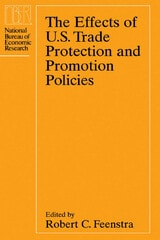
cover of The Effects of U.S. Trade Protection and Promotion Policies

The Effects of U.S. Trade Protection and Promotion Policies

Edited by Robert C. Feenstra

University of Chicago Press, 1997

Economists disagree on whether recent U.S. trade policies are harmful or helpful, but they all agree that there is a new trend toward focusing on results-oriented policies in specific markets and with particular trading partners. These twelve essays by leading international economists explore crucial issues in U.S. trade policy today. Topics examined include the markets for automobile and automobile parts in the United States and Japan, the U.S. response to "unfair" trading practices such as dumping, and the effects of industry- and country-specific policies. Examples include high-technology and agricultural industries and off-shore assembly in U.S. border cities.

The volume concludes that some policies can act to both protect imports and promote exports, that the threat of protectionist policies can often have effects that are as pronounced as their implementation, and that regulatory policy has as great an impact on trade and investment patterns as does trade policy itself. It will be of crucial interest to international trade economists, policy specialists, and political scientists.
[more]
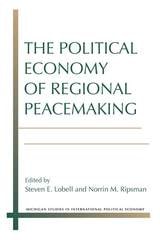
cover of The Political Economy of Regional Peacemaking

The Political Economy of Regional Peacemaking

Edited by Steven E. Lobell and Norrin M. Ripsman

University of Michigan Press, 2016

In The Political Economy of Regional Peacemaking, scholars examine the efficacy of trade agreements, economic sanctions, and other strategies of economic statecraft for the promotion of peace both between rival states and across conflict-ridden regions more generally. In the introduction, Steven E. Lobell and Norrin M. Ripsman pose five central questions: (1) What types of economic statecraft, including incentives and sanctions, can interested parties employ? (2) Who are the appropriate targets in the rival states—state leaders, economic and social elites, or society as whole? (3) When should specific economic instruments be used to promote peace—prior to negotiations, during negotiations, after signature of the treaty, or during implementation of the treaty? (4) What are the limits and risks of economic statecraft and economic interdependence? (5) How can economic statecraft be used to move from a bilateral peace agreement to regional peace?

The chapters that follow are grouped in three sections, corresponding to the three stages of peacemaking: reduction or management of regional conflict; peacemaking or progress toward a peace treaty; and maintenance of bilateral peace and the regionalization of the peace settlement. In each chapter, the contributors consider the five key questions from a variety of methodological, historical, cultural, and empirical perspectives, drawing data from the Pacific, the Middle East, Europe, Asia, and Latin America. The conclusion expands on several themes found in the chapters and proposes an agenda for future research.

[more]