Results by title

11 books match the query 'Common'

cover of A Common Law for Europe

A Common Law for Europe

Barbara Pasa

Central European University Press, 2005
An essential guide for lawmakers, scholars, and students of law, this work takes on the formidable task of providing a detailed overview of the harmonization of law in the European Union. Skillfully researched, the authors seek to approach this topic with an eye to the recent enlargement process. In highlighting the most recent actions of the European Court of Justice and the Court of First Instance, the book seeks to analyze the future strengths and pitfalls of EU Common Law. Court rulings are quoted at length, and work in conjunction with text inserts in providing a format that breaks down complex information. This open style of the book gives researchers the ability to quickly locate useful information and cite statements from EU institutions. In outlining the sources and institutions of Community Law, and the challenges in harmonizing national and supra-national law-books, 'A Common Law for Europe' has done a tremendous service for academics and future leaders of the European Union.
[more]
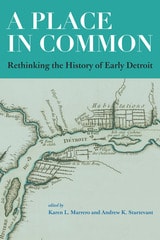
cover of A Place in Common: Rethinking the History of Early Detroit

A Place in Common

Rethinking the History of Early Detroit

Karen L. Marrero

Michigan State University Press, 2025

At the turn of the eighteenth century, Indigenous nations designated Detroit as a “common bowl” and a crucial nexus where they shared resources, made compromises, and coexisted. As the century unfolded, Detroit continued as a polyglot community in the face of expanding Euro-American settlement. The region became a highly charged space where the rituals of political negotiation grew in importance alongside a constant threat of violence. British political and economic systems continued to operate long after the end of the American Revolution, creating a shared cultural border at the end of the eighteenth century that would endure even as the American Empire reestablished rule on the north side of the river. Both Anishinaabe and Wyandot people set aside land for future occupation of their people, re-creating another transnational space in the region. A hundred years later, issues of race, economic development, political partisanship, and overlapping national claims continued to resonate as the city commemorated and mythologized its origins. This book considers how larger watershed occasions impacted the Detroit region and how, in turn, the unique particularities of local custom impacted regional and national trade and politics and the very nature of how the city continues to view its past.
[more]
cover of A Student-Friendly Guide to Move from Civil Law to U.S. Common Law

A Student-Friendly Guide to Move from Civil Law to U.S. Common Law

Nancy Daspit and Kirsten Schaetzel

University of Michigan Press, 2025

A Student-Friendly Guide to Move from Civil Law to U.S. Common Law provides an overview of the differences in the study and practice of law for international LLM students trying to transition from their home country’s civil law legal system to the U.S. common law system. The vast majority of countries in the world are civil code jurisdictions that rely almost solely on statutes (codes) to define their laws. However, common law countries—such as the US, Canada, and Great Britain—have multiple sources of law, including constitutions, statutes, regulations, and cases decided by the courts. These court cases have the same force of law as the other sources within their respective jurisdictions, and thus the resulting decisions must be followed in future cases, unless otherwise nullified.

To help students who may feel overwhelmed adjusting to a new approach to legal education, this book focuses on these key differences between civil law and common law jurisdictions. It defines and demonstrates the application of key concepts with examples, illustrations, and exercises. While relatively brief, it provides numerous references to the other texts and sources for students wanting or needing more depth for some of the topics. The book also includes numerous examples illustrating the differences, with an emphasis on common law examples, of key documents and processes used in the practice of law. Further, it includes student-focused exercises and questions on the analytical and rhetorical skills needed for a successful law practice, whether the student will continue in a common law jurisdiction or merely needs to understand the common law for continued practice in their civil law jurisdiction.

Within this book, students will find
  • a brief historical background regarding the development of the common law system; 
  • a description of the US government structure, with an emphasis on the judicial branch; 
  • key rhetorical and analytical differences between civil law and common law; 
  • numerous examples of differences between the two systems, with an emphasis on common law requirements; 
  • and exercises for practice with key concepts and terminology.
[more]
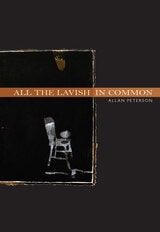
cover of All the Lavish in Common

All the Lavish in Common

Allan Peterson

University of Massachusetts Press, 2006

These poems remind us that we are all in the thick of things, the rich and complicated givens. Moving fluently from subjects as diverse as the surface of Europa to a tiny spider in a tear of wallpaper, from Pythagoras at Tyre to the wings of a dragonfly, they are in love with the world and the deep seriousness of living. Often lavish themselves, they reflect that fact that the author is a visual artist as well as a poet of insightful and sustained imagination.
[more]
cover of Dear Colleague: Common And Uncommon Observations

Dear Colleague

Common And Uncommon Observations

Yi-Fu Tuan

University of Minnesota Press, 2002
A long-awaited collection of highlights from a scholar's renowned letters. "Maybe the most influential scholar you've never heard of" was how a feature article in The Chronicle of Higher Education recently described Yi-Fu Tuan, a widely traveled Chinese-American geographer whose letters to his friends and colleagues, distilling observations, ideas, and experiences, have carried his insights, and his reputation, far beyond his chosen field. Culling the most characteristic thoughts and compelling moments from these prized letters, Dear Colleague at long last gives readers near and far the opportunity to share what Tuan's correspondents have already enjoyed-and to discover the pleasures of the underlined passages in a book of life at once edifying, entertaining, and exemplary. Reflecting on personal encounters and impersonal forces, Tuan conducts us along a path that leads from nature to human nature, through society and culture, geography and history, morality and religion, life and death. By turns playful and aphoristic, these essays hold revelations both humorous and harrowing. Whether browsed for their considerable incidental pleasures or perused in depth from beginning to end, they afford their reader the rare interior knowledge of another human being and his world, and an even rarer glimpse of the connections between sensation and intellect that lie at the very heart of the humanistic enterprise. Imparting the insights of a revered scholar, revealing the tensions-and contradictions-that exist between life and thought, remarking on ideas from other thinkers, and expanding on perennial matters of morality and meaning, religion and ritual, pleasure and pain, Dear Colleague maps Tuan's own humanity in a lucid, elegant, and memorable way. Yi-Fu Tuan is professor emeritus in the Department of Geography at the University of Wisconsin. He is widely considered the founder of human geography, and is the author of many books, including Cosmos and Hearth (1996) and Space and Place (new edition, 2001), published by the University of Minnesota Press. He is also the author of books on desert landforms, China, the history of ideas, and an autobiography, Who Am I? (1999).
[more]
cover of Making Sense in Common: A Reading of Whitehead in Times of Collapse

Making Sense in Common

A Reading of Whitehead in Times of Collapse

Isabelle Stengers

University of Minnesota Press, 2023

A leading philosopher seeks to recover “common sense” as a meeting place to reconcile science and philosophy

With her previous books on Alfred North Whitehead, Isabelle Stengers not only secured a reputation as one of the premier philosophers of our times but also inspired a rethinking of critical theory, political thought, and radical philosophy across a range of disciplines. Here, Stengers unveils what might well be seen as her definitive reading of Whitehead.

Making Sense in Common will be greeted eagerly by the growing group of scholars who use Stengers’s work on Whitehead as a model for how to think with conceptual precision through diverse domains of inquiry: environmentalism and ecology, animal studies, media and technology studies, the history and philosophy of science, feminism, and capitalism. On the other hand, the significance of this new book extends beyond Whitehead. Instead, it lies in Stengers’s recovery of the idea of “common sense” as a meeting place—a commons—where opposed ideas of science and humanistic inquiry can engage one another and help to move society forward. Her reconciliation of science and philosophy is especially urgent today—when climate disaster looms all around us, when the values of what we thought of as civilization and modernity are discredited, and when expertise of any kind is under attack.
[more]
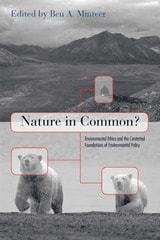
cover of Nature in Common?: Environmental Ethics and the Contested Foundations of Environmental Policy

Nature in Common?

Environmental Ethics and the Contested Foundations of Environmental Policy

Ben A. Minteer

Temple University Press, 2009

This important book brings together leading environmental thinkers to debate a central conflict within environmental philosophy: Should we appreciate nature mainly for its ability to advance our interests or should we respect it as having a good of its own, apart from any contribution to human well being? Specifically, the fourteen essays collected here discuss the "convergence hypothesis" put forth by Bryan Norton—a controversial thesis in environmental ethics about the policy implications of moral arguments for environmental protection. Historically influential essays are joined with newly commissioned essays to provide the first sustained attempt to reconcile two long-opposed positions. Norton himself offers the book's closing essay.

This seminal volume contains contributions from some of the most respected scholars in the field, including Donald Brown, J. Baird Callicott, Andrew Light, Holmes Rolston III, Laura Westra, and many others. Although Nature in Common? will be especially useful for students and professionals studying environmental ethics and philosophy, it will engage any reader who is concerned about the philosophies underlying contemporary environmental policies.
[more]
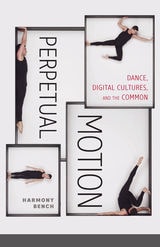
cover of Perpetual Motion: Dance, Digital Cultures, and the Common

Perpetual Motion

Dance, Digital Cultures, and the Common

Harmony Bench

University of Minnesota Press, 2020

A new exploration of how digital media assert the relevance of dance in a wired world

How has the Internet changed dance? Dance performances can now be seen anywhere, can be looped endlessly at user whim, and can integrate crowds in unprecedented ways. Dance practices are evolving to explore these new possibilities. In Perpetual Motion, Harmony Bench argues that dance is a vital part of civil society and a means for building participation and community. She looks at how, after 9/11, it became a crucial way of recuperating the common character of public spaces. She explores how crowdsourcing dance contributes to the project of performing a common world, as well as the social relationships forged when we look at dance as a gift in the era of globalization. Throughout, she asks how dance brings people together in digital spaces and what dance’s digital travels might mean for how we experience and express community. 

From original research on dance today to political economies of digital media to the philosophy of dance, Perpetual Motion provides an ambitious, invigorating look at a commonly shared practice.
[more]
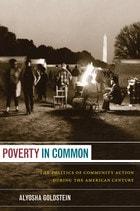
cover of Poverty in Common: The Politics of Community Action during the American Century

Poverty in Common

The Politics of Community Action during the American Century

Alyosha Goldstein

Duke University Press, 2012

After the Second World War, the idea that local community action was indispensable for the alleviation of poverty was broadly embraced by US policymakers, social scientists, international development specialists, and grassroots activists. Governmental efforts to mobilize community action in the name of democracy served as a volatile condition of possibility for poor people and dispossessed groups negotiating the tension between calls for self-help and demands for self-determination in the era of the Cold War and global decolonization. In Poverty in Common, Alyosha Goldstein suggests new ways to think about the relationship among liberalism, government, and inequality in the United States. He does so by analyzing historical dynamics including Progressive-era reform as a precursor to community development during the Cold War, the ways that the language of "underdevelopment" articulated ideas about poverty and foreignness, the use of poverty as a crucible of interest group politics, and radical groups' critical reframing of community action in anticolonial terms. During the mid-twentieth century, approaches to poverty in the United States were linked to the racialized and gendered negotiation of boundaries—between the foreign and the domestic, empire and nation, violence and order, and dependency and autonomy.
[more]
cover of The Common

The Common

Gail Mazur

University of Chicago Press, 1995

At the heart of Gail Mazur's The Common is the refusal to simplify what is paradoxical in our world and a recognition of the tensions in our own divided nature. These unflinching poems create a place where wisdom and foolishness, fear and courage, rage and pity, love and diffidence, naturally co-exist.

Desire, ambition, devotion, and devastating loss are all subjects for Mazur's clear-eyed poems, which resonate with the contradictions between the body's yearning and the mind's acknowledgment of the consequences of our choices. In a poetry driven by unrelenting questioning, Mazur tries, in Rilke's worlds, "to love the questions themselves."
[more]
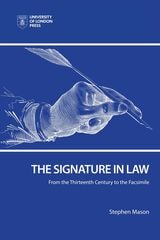
cover of The Signature in Law: From the Thirteenth Century to the Facsimile

The Signature in Law

From the Thirteenth Century to the Facsimile

Stephen Mason

University of London Press, 2022

This book considers the judicial development of the signature—its definition, purpose, and legal functions.

Since the thirteenth century, the signature has been used to demonstrate proof of intent. This book puts the concept of the signature into a broad legal context, setting out the purposes and functions of a signature. Drawing on cases from common law jurisdictions across the world, this book demonstrates that judges expanded the meaning of the signature as technologies developed and were used in unanticipated ways.

Following an overview of the historical methods used to demonstrate proof of intent and authentication, the book considers the judicial response to the variations in form that signatures have been subject to over the past two hundred years, from initials, partial signatures, and fingerprints to rubber stamps and typewriting. Past judicial decision-making not only demonstrates the flexibility of the form a signature can take but also confirms that judges had the flexibility of mind to accept the first forms of electronic signature (telex, facsimile transmission) without the aid of special legislation. In this way, the signature is a prime example of the inherent flexibility of the English common law.
[more]