Results by title
6 books match the query 'Communication, International'
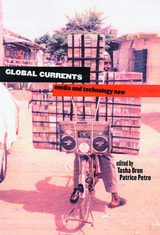
Global Currents
Media and Technology NowOren, Tasha G
Rutgers University Press, 2004
Rhetoric about media technology tends to fall into two extreme categories: unequivocal celebration or blanket condemnation. This is particularly true in debate over the clash of values when first world media infiltrate third world audiences.
Bringing together the best new work on contemporary media practices, technologies, and policies, the essayists in Global Currents argue that neither of these extreme views accurately represents the role of media technology today. New ways of thinking about film, television, music, and the internet demonstrate that it is not only media technologies that affect the cultures into which they are introduced—it is just as likely that the receiving culture will change the media.
Topics covered in the volume include copyright law and surveillance technology, cyber activism in the African Diaspora, transnational monopolies and local television industries, the marketing and consumption of “global music,” “click politics” and the war on Afghanistan, the techno-politics of distance education, artificial intelligence and global legal institutions, and traveling and “squatting” in digital space. Balanced between major theoretical positions and original field research, the selections address the political and cultural meanings that surround and configure new technologies.
Hybridity
The Cultural Logic Of GlobalizationMarwan Kraidy
Temple University Press, 2005
Internationalizing "International Communication"
Chin-Chuan Lee, editor
University of Michigan Press, 2015

The Alchemy of English
The Spread, Functions, and Models of Non-native EnglishesBraj Kachru
University of Illinois Press, 1990
of an entire field, rather than merely the fruitful exploration of a topic.
. . . [Kachru] is to be congratulated for having taken us as far as he
already has and for doing so in so stimulating and so productive a fashion."
-- World Englishes
"A potent addition to theoretical, sociolinguistic, attitudinal
and methodological explorations vis-à-vis the spread and functions
of, and innovations in, English from the viewpoint of a non-Western scholar."
-- The Language Teacher
Winner of the Joint First Prize, Duke of Edinburgh English Language
Book Competition of the English-Speaking Union of the Commonwealth, 1987
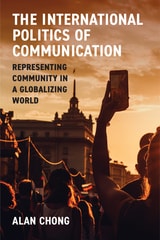
The International Politics of Communication
Representing Community in a Globalizing WorldAlan Chong
University of Michigan Press, 2025
The International Politics of Communication examines this informational dimension of international politics, investigating how information is generated, conveyed through channels, and directed specifically at audiences. While citizens are often portrayed as faithfully loyal supporters and beneficiaries of the modern nation-state—a fiction supported by passports, identification papers, and other notarized credentials—they are subject to the pulls of loyalty from transnational tribal affiliations, mythological and historical narratives of ethnicity, as well as the transcendental claims of religion and philosophy. Increasingly, social media also enchants non-state individuals, providing new virtual communities as the center of loyalties rather than national affiliations. By reinterpreting taken-for-granted concepts in journalism, media, political economy, nationalism, development, and propaganda as information politics, this book prepares serious-minded scholars, citizens, politicians, and social activists everywhere to understand the power plays in international communication and use alternatives to begin transforming power relations.

The Undersea Network
Nicole Starosielski
Duke University Press, 2015