Results by title

23 books match the query 'Communication and culture'
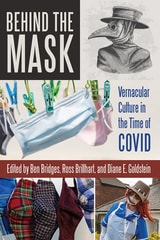
cover of Behind the Mask: Vernacular Culture in the Time of COVID

Behind the Mask

Vernacular Culture in the Time of COVID

Ben Bridges

Utah State University Press, 2023

Vernacular responses have been crucial for communities seeking creative ways to cope with the coronavirus pandemic. With most people locked down and separated from the normal ebb and flow of life for an extended period of time, COVID-19 inspired community and creativity, adaptation and flexibility, traditional knowledge, resistance, and dynamism. Removing people from assumed norms and daily lives, the pandemic provided a moment of insight into the nature of vernacular culture as it was used, abused, celebrated, critiqued, and discarded. In Behind the Mask, contributors from the USA, the UK, and Scandinavia emphasize the choices that individual people and communities made during the COVID pandemic, prioritizing the everyday lives of people enduring this health crisis.
 
Despite vernacular’s potential nod to dominant or external culture, it is the strong connection to the local that grounds the vernacular within the experiential context that it occupies. Exploring the nature and shape of vernacular responses to the ongoing public health crisis, Behind the Mask documents processes that are otherwise likely to be forgotten. Including different ethnographic presents, contributors capture moments during the pandemic rather than upon reflection, making the work important to students and scholars of folklore and ethnology, as well as general readers interested in the COVID pandemic.
 
[more]
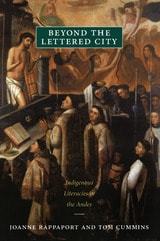
cover of Beyond the Lettered City: Indigenous Literacies in the Andes

Beyond the Lettered City

Indigenous Literacies in the Andes

Joanne Rappaport and Tom Cummins

Duke University Press, 2012
In Beyond the Lettered City, the anthropologist Joanne Rappaport and the art historian Tom Cummins examine the colonial imposition of alphabetic and visual literacy on indigenous groups in the northern Andes. They consider how the Andean peoples received, maintained, and subverted the conventions of Spanish literacy, often combining them with their own traditions. Indigenous Andean communities neither used narrative pictorial representation nor had alphabetic or hieroglyphic literacy before the arrival of the Spaniards. To absorb the conventions of Spanish literacy, they had to engage with European symbolic systems. Doing so altered their worldviews and everyday lives, making alphabetic and visual literacy prime tools of colonial domination. Rappaport and Cummins advocate a broad understanding of literacy, including not only reading and writing, but also interpretations of the spoken word, paintings, wax seals, gestures, and urban design. By analyzing secular and religious notarial manuals and dictionaries, urban architecture, religious images, catechisms and sermons, and the vast corpus of administrative documents produced by the colonial authorities and indigenous scribes, they expand Ángel Rama’s concept of the lettered city to encompass many of those who previously would have been considered the least literate.
[more]
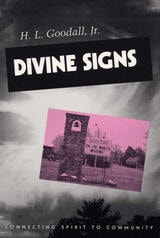
cover of Divine Signs: Connecting Spirit to Community

Divine Signs

Connecting Spirit to Community

H. L. Goodall, Jr.

Southern Illinois University Press, 1996

Divine Signs is the concluding volume of the ethnographic trilogy about the communicative tensions in everyday American cultural life H. L. Goodall, Jr., began with Casing a Promised Land and continued with Living in the Rock n Roll Mystery.

In this final work, the terms for understanding these tensions are found in a historical and mythological drama featuring Power (as the embodiment of the modern), Other (as the embodiment of the postmodern), and Spirit (as the unifying power capable of connecting disparate selves to dangerously fragmented communities). For this study, the localized site of interpretation is in and around Pickens and Oconee Counties, South Carolina, where every day street signs, business advertisements on billboards, signs that announce church themes, Internet postings, and other forms of public communication that invite private meanings are read as rhetorical invitations to participate in these myths and mysteries.

Using themes discoverable in such public forms of communication, Goodall deconstructs a variety of communal experiences—from annual community celebrations to weekly therapy sessions in local beauty salons to the fall audience rituals of Clemson University football games—to gain a deeper appreciation of the unifying symbolic orders that enrich the interpretive possibilities of our lives and that serve as signs of our deeply spiritual connections to each other and to the planet.

In the last sections of the book, the interplays of Power, Other, and Spirit are read into and against a wide variety of everyday interpretive contexts, from Rush Limbaugh and talk radio to narratives about angels and stories about the transformative powers of spiritual practices in organizations. Goodall then asks the important question: Where are the themes of this mythological drama leading us? In the stunning conclusion, Goodall creates communicative, cultural, and spiritual challenges for us all.
[more]
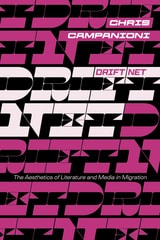
cover of Drift Net: The Aesthetics of Literature and Media in Migration

Drift Net

The Aesthetics of Literature and Media in Migration

Chris Campanioni

Lever Press, 2025

Today’s aesthetic strategies to compose content and identity across digital media are neither new nor exclusively digital, but emerged from migration. In Drift Net: The Aesthetics of Literature and Media in Migration, Chris Campanioni theorizes an aesthetics of transmedia as a framework for civic activism, while showing how migrants have forecasted and reshaped new media practices and norms, producing a political subjectivity that resists subjectification. As borders, global inequality, racism, and xenophobia proliferate, migrants continue to enact the possibilities of something else, beyond being spoken about and spoken for. 

Through a model Campanioni calls a “migratory text,” Drift Net advances a theory of literature and art born in translation that calls into question established theories of world literature, national literatures, literary periodization, and translation itself. Through an analysis of works born in translation and produced in passage, detention, and exile, Campanioni utilizes this model to read creatively across a wide range of social and political formations, from the experience of his parents' exiles to alternative housing initiatives and asylum reform efforts throughout Europe, including the largest LGBT+ refugee center in the world. Drawing on a mixed methodology of qualitative interviews with asylum applicants and shelter directors, textual analysis, and autoethnographic narrative, Drift Net traces literary developments alongside contemporary social and political interventions. This approach proposes interventions on the organizational levels of asylum, integration, public housing, and membership. It also marks the ways migrant creators have reformulated subjectivity through the same genres and modes that have contributed to their devaluation as minoritized subjects. 

Drift Net both deepens and broadens our conceptualization of migrant literature, and recovers an understanding and application of transmedia that predates digital cultures. Campanioni offers a wide-ranging study of texts including Edward Said and Jean Mohr’s After the Last Sky: Palestinian Lives, Edgar Garcia’s Skins of Columbus, Anna Seghers’s Transit, Francis Ponge’s Soap, Walid Raad’s The Atlas Group, Klára Hosnedlová’s embroidered paintings, Reem Karssli and Caroline Williams’s Now is the Time To Say Nothing, Cornelia Schleime’s paper prints, and more. Drift Net formulates the “migratory” as a site of artistic production, resistance, and possibility, where theory is not an end but the beginning of tools and practices that might help researchers, instructors, and organizers to develop their strategies.
[more]
cover of Ethnography as Commentary: Writing from the Virtual Archive

Ethnography as Commentary

Writing from the Virtual Archive

Johannes Fabian

Duke University Press, 2008

The Internet allows ethnographers to deposit the textual materials on which they base their writing in virtual archives. Electronically archived fieldwork documents can be accessed at any time by the writer, his or her readers, and the people studied. Johannes Fabian, a leading theorist of anthropological practice, argues that virtual archives have the potential to shift the emphasis in ethnographic writing from the monograph to commentary. In this insightful study, he returns to the recording of a conversation he had with a ritual healer in the Congolese town of Lubumbashi more than three decades ago. Fabian’s transcript and translation of the exchange have been deposited on a website (Language and Popular Culture in Africa), and in Ethnography as Commentary he provides a model of writing in the presence of a virtual archive.

In his commentary, Fabian reconstructs his meeting with the healer Kahenga Mukonkwa Michel, in which the two discussed the ritual that Kahenga performed to protect Fabian’s home from burglary. Fabian reflects on the expectations and terminology that shape his description of Kahenga’s ritual and meditates on how ethnographic texts are made, considering the settings, the participants, the technologies, and the linguistic medium that influence the transcription and translation of a recording and thus fashion ethnographic knowledge. Turning more directly to Kahenga—as a practitioner, a person, and an ethnographic subject—and to the questions posed to him, Fabian reconsiders questions of ethnic identity, politics, and religion. While Fabian hopes that emerging anthropologists will share their fieldwork through virtual archives, he does not suggest that traditional ethnography will disappear. It will become part of a broader project facilitated by new media.
[more]
cover of Gestures of Concern

Gestures of Concern

Chris Ingraham

Duke University Press, 2020
In Gestures of Concern Chris Ingraham shows that while gestures such as sending a “Get Well” card may not be instrumentally effective, they do exert an intrinsically affective force on a field of social relations. From liking, sharing, posting, or swiping to watching a TED Talk or wearing an “I Voted” sticker, such gestures operate as much through affective registers as they do through overt symbolic action. Ingraham demonstrates that gestures of concern are central to establishing the necessary conditions for larger social or political change because they give the everyday aesthetic and rhetorical practices of public life the capacity to attain some socially legible momentum. Rather than supporting the notion that vociferous public communication is the best means for political and social change, Ingraham advances the idea that concerned gestures can help to build the affective communities that orient us to one another with an imaginable future in mind. Ultimately, he shows how acts that many may consider trivial or banal are integral to establishing those background conditions capable of fostering more inclusive social or political change.
[more]
cover of Global Indigenous Media: Cultures, Poetics, and Politics

Global Indigenous Media

Cultures, Poetics, and Politics

Pamela Wilson and Michelle Stewart, eds.

Duke University Press, 2008

In this exciting interdisciplinary collection, scholars, activists, and media producers explore the emergence of Indigenous media: forms of media expression conceptualized, produced, and created by Indigenous peoples around the globe. Whether discussing Maori cinema in New Zealand or activist community radio in Colombia, the contributors describe how native peoples use both traditional and new media to combat discrimination, advocate for resources and rights, and preserve their cultures, languages, and aesthetic traditions. By representing themselves in a variety of media, Indigenous peoples are also challenging misleading mainstream and official state narratives, forging international solidarity movements, and bringing human rights violations to international attention.

Global Indigenous Media addresses Indigenous self-representation across many media forms, including feature film, documentary, animation, video art, television and radio, the Internet, digital archiving, and journalism. The volume’s sixteen essays reflect the dynamism of Indigenous media-making around the world. One contributor examines animated films for children produced by Indigenous-owned companies in the United States and Canada. Another explains how Indigenous media producers in Burma (Myanmar) work with NGOs and outsiders against the country’s brutal regime. Still another considers how the Ticuna Indians of Brazil are positioning themselves in relation to the international community as they collaborate in creating a CD-ROM about Ticuna knowledge and rituals. In the volume’s closing essay, Faye Ginsburg points out some of the problematic assumptions about globalization, media, and culture underlying the term “digital age” and claims that the age has arrived. Together the essays reveal the crucial role of Indigenous media in contemporary media at every level: local, regional, national, and international.

Contributors: Lisa Brooten, Kathleen Buddle, Cache Collective, Michael Christie, Amalia Córdova,
Galina Diatchkova, Priscila Faulhaber, Louis Forline, Jennifer Gauthier, Faye Ginsburg, Alexandra Halkin, Joanna Hearne, Ruth McElroy, Mario A. Murillo, Sari Pietikäinen, Juan Francisco Salazar,
Laurel Smith, Michelle Stewart, Pamela Wilson

[more]
cover of Hush: Media and Sonic Self-Control

Hush

Media and Sonic Self-Control

Mack Hagood

Duke University Press, 2019
For almost sixty years, media technologies have promised users the ability to create sonic safe spaces for themselves—from bedside white noise machines to Beats by Dre's “Hear What You Want” ad campaign, in which Colin Kaepernick's headphones protect him from taunting crowds. In Hush, Mack Hagood draws evidence from noise-canceling headphones, tinnitus maskers, LPs that play ocean sounds, nature-sound mobile apps, and in-ear smart technologies to argue the true purpose of media is not information transmission, but rather the control of how we engage our environment. These devices, which Hagood calls orphic media, give users the freedom to remain unaffected in the changeable and distracting spaces of contemporary capitalism and reveal how racial, gendered, ableist, and class ideologies shape our desire to block unwanted sounds. In a noisy world of haters, trolls, and information overload, guarded listening can be a necessity for self-care, but Hagood argues our efforts to shield ourselves can also decrease our tolerance for sonic and social difference. Challenging our self-defeating attempts to be free of one another, he rethinks media theory, sound studies, and the very definition of media.
[more]
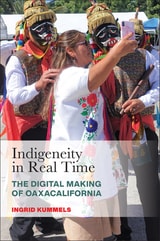
cover of Indigeneity in Real Time: The Digital Making of Oaxacalifornia

Indigeneity in Real Time

The Digital Making of Oaxacalifornia

Ingrid Kummels

Rutgers University Press, 2023
Long before the COVID-19 crisis, Mexican Indigenous peoples were faced with organizing their lives from afar, between villages in the Oaxacan Sierra Norte and the urban districts of Los Angeles, as a result of unauthorized migration and the restrictive border between Mexico and the United States. By launching cutting-edge Internet radio stations and multimedia platforms and engaging as community influencers, Zapotec and Ayuujk peoples paved their own paths to a transnational lifeway during the Trump era. This meant adapting digital technology to their needs, setting up their own infrastructure, and designing new digital formats for re-organizing community life in all its facets—including illness, death and mourning, collective celebrations, sport tournaments, and political meetings—across vast distances. Author Ingrid Kummels shows how mediamakers and users in the Sierra Norte villages and in Los Angeles created a transborder media space and aligned time regimes. By networking from multiple places, they put into practice a communal way of life called Comunalidad and an indigenized American Dream—in real time.
 
[more]
cover of James Carey: A Critical Reader

James Carey

A Critical Reader

Eve Stryker Munson

University of Minnesota Press, 1997

An essential guide to the thought of a central figure in media studies .

James Carey-scholar, media critic, and teacher of journalists-almost single-handedly established the importance of defining a cultural perspective when analyzing communications. Interspersing Carey’s major essays with articles exploring his central themes and their importance, this collection provides a critical introduction to the work of this significant figure.

Long before the “interpretive turn” became the fashion in the humanities and sociology, Carey was busily studying and combining the ideas of an impressive array of philosophers, sociologists, historians, and anthropologists, including John Dewey, Clifford Geertz, Raymond Williams, Thomas Kuhn, Max Weber, C. Wright Mills, Richard Rorty, Jürgen Habermas, Harold Innis, and Lewis Mumford. In James Carey: A Critical Reader, seven scholars who have been influenced by him consider his work and how it has affected the development of media studies. Carey has demonstrated that mass communications serve a complex function in society, with one central question reflecting his concerns: How does one make democracy work in a vast country that spans a continent? In his view, symbols, language, and those who create them are reality-creating, rather than reality-reflecting. Carey has examined the roles the media and the academy have played in creating and maintaining a public sphere, as well as the ways technology helps or hinders that project. Carey’s themes range from the strains on democracy and drawbacks of technology to the critique of journalism and the politics of academe. Contributors: G. Stuart Adam, Carleton U, Canada; James Carey, Columbia U; Carolyn Marvin, U of Pennsylvania; John Pauly, St. Louis U; Jay Rosen, New York U; Michael Schudson, U of California, San Diego.
[more]
cover of Key Concepts in Critical Cultural Studies

Key Concepts in Critical Cultural Studies

Edited by Linda Steiner and Clifford Christians

University of Illinois Press, 2010
This volume brings together sixteen essays on key and intersecting topics in critical cultural studies from major scholars in the field. Taking into account the vicissitudes of political, social, and cultural issues, the contributors engage deeply with the evolving understanding of critical concepts such as history, community, culture, identity, politics, ethics, globalization, and technology. The essays address the extent to which these concepts have been useful to scholars, policy makers, and citizens, as well as the ways they must be rethought and reconsidered if they are to continue to be viable. Each essay considers what is known and understood about these concepts. The essays give particular attention to how relevant ideas, themes, and terms were developed, elaborated, and deployed in the work of James W. Carey, the "founding father" of cultural studies in the United States. The contributors map how these important concepts, including Carey's own work with them, have evolved over time and how these concepts intersect. The result is a coherent volume that redefines the still-emerging field of critical cultural studies. Contributors are Stuart Allan, Jack Zeljko Bratich, Clifford Christians, Norman Denzin, Mark Fackler, Robert Fortner, Lawrence Grossberg, Joli Jensen, Steve Jones, John Nerone, Lana Rakow, Quentin J. Schultze, Linda Steiner, Angharad N. Valdivia, Catherine Warren, Frederick Wasser, and Barbie Zelizer.
[more]
cover of Living in the Rock N Roll Mystery: Reading Context, Self, and Others as Clues

Living in the Rock N Roll Mystery

Reading Context, Self, and Others as Clues

H. L. Goodall, Jr.

Southern Illinois University Press, 1991

Mystery, rather than “problem,” provides the con­text that the cultural ethnographer best uses to ap­proach the experience of both the living and the writ­ing of culture. In this work, H. L. Goodall, Jr., continues his discussion of the cultural ethnographer as detective through an investigation of what he calls the “rock n roll mystery.”

Using Bakhtin’s notion of “Carnival,” Goodall posi­tions rock n roll as an important aspect of the American cultural experience using its lyrics and rhythm as a force of resistance to the dominant bureaucratic order. He argues that interpretive eth­nography, where sentences use rhythms and emo­tions along with words to construct a work, parallels rock n roll in its creation of multiple voices strug­gling for creative and interpretive presence and space in the text. As there is no privileged text in the social life of rock n roll, there is no privileged voice in the writing of interpretive ethnography. It is, instead, a reading and writing method within the field of communication and the field of cultural studies that challenges the “existing wisdom.”

Goodall invites the reader to join him in the role of the detective who confronts, enters, and then participates in the mysteries of living. Through the use of his interpretive method, Goodall is able to move under the skin of experience to disclose the relationship among self, other(s), and context, an understanding only achieved by “going beneath the often cosmetic surfaces of cultural traffic to where symbols mingle with the driven stuff of life.” Be­cause the “stuff of life” is laid out on the pages of this book, Goodall’s text is as compelling as a good novel and in some ways more intimate.
[more]
cover of Out of Sync: Ventriloquism in Popular Media from Vinyl to TikTok

Out of Sync

Ventriloquism in Popular Media from Vinyl to TikTok

Sarah Rebecca Kessler

Duke University Press, 2026
Ventriloquism, or the art of “throwing the voice,” has outdated and even unsettling connotations to many, associated with vaudeville and the nefarious talking dolls of so many horror movies. Despite this, ventriloquism remains a popular performance art, filling theaters and concert venues with audiences eager to hear puppets voice what humans, in an increasingly polarized present, want to say but feel they can’t. In Out of Sync, Sarah Rebecca Kessler explores ventriloquism’s persistence in, and relevance to, the contemporary moment, examining performances by recent and current practitioners such as Richard Sandfield, Nina Conti, Jeff Dunham, and Terry Fator while also tracing ventriloquism’s travels across media including vinyl records, documentary films, music videos, and social media platforms such as TikTok. Kessler argues that ventriloquism and its many remediations amplify a cultural politics of synchronization that positions not just sounds and images, but voices and bodies, as more and less out of sync along the lines of race, gender, and sexuality. Looking closely at the art and its outgrowths, Out of Sync gives insight into the operations of race, gender, and sexuality as distinctly audiovisual processes.
[more]
cover of Paper Knowledge: Toward a Media History of Documents

Paper Knowledge

Toward a Media History of Documents

Lisa Gitelman

Duke University Press, 2014
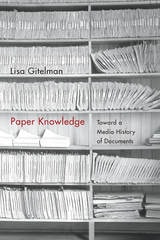
Paper Knowledge is a remarkable book about the mundane: the library card, the promissory note, the movie ticket, the PDF (Portable Document Format). It is a media history of the document. Drawing examples from the 1870s, the 1930s, the 1960s, and today, Lisa Gitelman thinks across the media that the document form has come to inhabit over the last 150 years, including letterpress printing, typing and carbon paper, mimeograph, microfilm, offset printing, photocopying, and scanning. Whether examining late nineteenth century commercial, or "job" printing, or the Xerox machine and the role of reproduction in our understanding of the document, Gitelman reveals a keen eye for vernacular uses of technology. She tells nuanced, anecdote-filled stories of the waning of old technologies and the emergence of new. Along the way, she discusses documentary matters such as the relation between twentieth-century technological innovation and the management of paper, and the interdependence of computer programming and documentation. Paper Knowledge is destined to set a new agenda for media studies.
[more]
cover of Promiscuous Knowledge: Information, Image, and Other Truth Games in History

Promiscuous Knowledge

Information, Image, and Other Truth Games in History

Kenneth Cmiel and John Durham Peters

University of Chicago Press, 2020
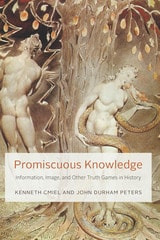
Sergey Brin, a cofounder of Google, once compared the perfect search engine to “the mind of God.” As the modern face of promiscuous knowledge, however, Google’s divine omniscience traffics in news, maps, weather, and porn indifferently. This book, begun by the late Kenneth Cmiel and completed by his close friend John Durham Peters, provides a genealogy of the information age from its early origins up to the reign of Google. It examines how we think about fact, image, and knowledge, centering on the different ways that claims of truth are complicated when they pass to a larger public. To explore these ideas, Cmiel and Peters focus on three main periods—the late nineteenth century, 1925 to 1945, and 1975 to 2000, with constant reference to the present. Cmiel’s original text examines the growing gulf between politics and aesthetics in postmodern architecture, the distancing of images from everyday life in magical realist cinema, the waning support for national betterment through taxation, and the inability of a single presentational strategy to contain the social whole. Peters brings Cmiel’s study into the present moment, providing the backstory to current controversies about the slipperiness of facts in a digital age.  A hybrid work from two innovative thinkers, Promiscuous Knowledge enlightens our understanding of the internet and the profuse visual culture of our time.
[more]
cover of Rhetoric, Through Everyday Things

Rhetoric, Through Everyday Things

Edited by Scot Barnett and Casey Boyle

University of Alabama Press, 2016

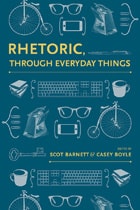
A fascinating addition to rhetoric scholarship, Rhetoric, Through Everyday Things expands the scope of rhetorical situations beyond the familiar humanist triad of speaker-audience-purpose to an inclusive study of inanimate objects.
 
The fifteen essays in Rhetoric, Through Everyday Things persuasively overturn the stubborn assumption that objects are passive tools in the hands of objective human agents. Rhetoric has proved that forms of communication such as digital images, advertising, and political satires do much more than simply lie dormant, and Rhetoric, Through Everyday Things shows that objects themselves also move, circulate, and produce opportunities for new rhetorical publics and new rhetorical actions. Objects are not simply inert tools but are themselves vibrant agents of measurable power.
 
Organizing the work of leading and emerging rhetoric scholars into four broad categories, the collection explores the role of objects in rhetorical theory, histories of rhetoric, visual rhetoric, literacy studies, rhetoric of science and technology, computers and writing, and composition theory and pedagogy. A rich variety of case studies about objects such as women’s bicycles in the nineteenth century, the QWERTY keyboard, and little free libraries ground this study in fascinating, real-life examples and build on human-centered approaches to rhetoric to consider how material elements—human and nonhuman alike—interact persuasively in rhetorical situations.
 
Taken together, Rhetoric, Through Everyday Things argues that the field of rhetoric’s recent attention to material objects should go further than simply open a new line of inquiry. To maximize the interdisciplinary turn to things, rhetoricians must seize the opportunity to reimagine and perhaps resolve rhetoric’s historically problematic relationship to physical reality and ontology. By tapping the rich resource of inanimate agents such as "fish, political posters, plants, and dragonflies,” rhetoricians can more fully grasp the rhetorical implications at stake in such issues.
[more]
cover of Technoculture

Technoculture

Constance Penley

University of Minnesota Press, 1991

[more]
cover of The Dialogic Emergence of Culture

The Dialogic Emergence of Culture

Dennis Tedlock and Bruce Mannheim

University of Illinois Press, 1995

 Major figures in contemporary anthropology present a dialogic critique
        of ethnography. Moving beyond sociolinguistics and performance theory,
        and inspired by Bakhtin and by their own field experiences, the contributors
        revise notions of where culture actually resides. This pioneering effort
        integrates a concern for linguistic processes with interpretive approaches
        to culture.
      Culture and ethnography are located in social interaction. The collection
        contains dialogues that trace the entire course of ethnographic interpretation,
        from field research to publication. The authors explore an anthropology
        that actively acknowledges the dialogical nature of its own production.
        Chapters strike a balance between theory and practice and will also be
        of interest in cultural studies, literary criticism, linguistics, and
        philosophy.
      CONTRIBUTORS: Deborah Tannen, John Attinasi, Paul Friedrich, Billie
        Jean Isbell, Allan F. Burns, Jane H. Hill, Ruth Behar, Jean DeBernardi,
        R. P. McDermott, Henry Tylbor, Alton L. Becker, Bruce Mannheim, Dennis
        Tedlock
 
[more]
cover of The Educated Eye: Visual Culture and Pedagogy in the Life Sciences

The Educated Eye

Visual Culture and Pedagogy in the Life Sciences

Edited by Nancy Anderson

Dartmouth College Press, 2012

The creation and processing of visual representations in the life sciences is a critical but often overlooked aspect of scientific pedagogy. The Educated Eye follows the nineteenth-century embrace of the visible in new spectatoria, or demonstration halls, through the twentieth-century cinematic explorations of microscopic realms and simulations of surgery in virtual reality. With essays on Doc Edgerton’s stroboscopic techniques that froze time and Eames’s visualization of scale in Powers of Ten, among others, contributors ask how we are taught to see the unseen.
[more]
cover of The House of My Sojourn: Rhetoric, Women, and the Question of Authority

The House of My Sojourn

Rhetoric, Women, and the Question of Authority

Jane S. Sutton

University of Alabama Press, 2010


Employing the trope of architecture, Jane Sutton envisions the relationship between women and rhetoric as a house: a structure erected in ancient Greece by men that, historically, has made room for women but has also denied them the authority and agency to speak from within. Sutton’s central argument is that all attempts to include women in rhetoric exclude them from meaningful authority in due course, and this exclusion has been built into the foundations of rhetoric.

Drawing on personal experience, the spatial tropes of ancient Greek architecture, and the study of women who attained significant places in the house of rhetoric, Sutton highlights a number of decisive turns where women were able to increase their rhetorical access but were not able to achieve full authority, among them the work of Frances Wright, Lucy Stone, and suffragists Mott, Anthony, and Stanton; a visit to the 1893 World’s Columbian Exposition in Chicago, where the busts that became the Portrait Monument were displayed in the Woman’s Building (a sideshow, in essence); and a study of working-class women employed as telephone operators in New York in 1919.

With all the undeniable successes—socially, politically, and financially— of modern women, it appears that women are now populating the house of rhetoric as never before. But getting in the house and having public authority once inside are not the same thing. Sutton argues that women “can only act as far as the house permits.” Sojourn calls for a fundamental change in the very foundations of rhetoric.
[more]
cover of The Right to Look: A Counterhistory of Visuality

The Right to Look

A Counterhistory of Visuality

Nicholas Mirzoeff

Duke University Press, 2011
In The Right to Look, Nicholas Mirzoeff develops a comparative decolonial framework for visual culture studies, the field that he helped to create and shape. Casting modernity as an ongoing contest between visuality and countervisuality, or “the right to look,” he explains how visuality sutures authority to power and renders the association natural. An early-nineteenth-century concept, meaning the visualization of history, visuality has been central to the legitimization of Western hegemony. Mirzoeff identifies three “complexes of visuality”—plantation slavery, imperialism, and the present-day military-industrial complex—and explains how, within each, power is made to seem self-evident through techniques of classification, separation, and aestheticization. At the same time, he shows how each complex of visuality has been countered—by the enslaved, the colonized, and opponents of war, all of whom assert autonomy from authority by claiming the right to look. Encompassing the Caribbean plantation and the Haitian revolution, anticolonialism in the South Pacific, antifascism in Italy and Algeria, and the contemporary global counterinsurgency, The Right to Look is a work of astonishing geographic, temporal, and conceptual reach.
[more]
cover of The Voice and Its Doubles: Media and Music in Northern Australia

The Voice and Its Doubles

Media and Music in Northern Australia

Daniel Fisher

Duke University Press, 2016
Beginning in the early 1980s Aboriginal Australians found in music, radio, and filmic media a means to make themselves heard across the country and to insert themselves into the center of Australian political life. In The Voice and Its Doubles Daniel Fisher analyzes the great success of this endeavor, asking what is at stake in the sounds of such media for Aboriginal Australians. Drawing on long-term ethnographic research in northern Australia, Fisher describes the close proximity of musical media, shifting forms of governmental intervention, and those public expressions of intimacy and kinship that suffuse Aboriginal Australian social life. Today’s Aboriginal media include genres of country music and hip-hop; radio requests and broadcast speech; visual graphs of a digital audio timeline; as well as the statistical media of audience research and the discursive and numerical figures of state audits and cultural policy formation. In each of these diverse instances the mediatized voice has become a site for overlapping and at times discordant forms of political, expressive, and institutional creativity. 
 
 
[more]
cover of Transmedia Geographies: Decoloniality, Democratization, Cultural Citizenship, and Media Convergence

Transmedia Geographies

Decoloniality, Democratization, Cultural Citizenship, and Media Convergence

Kevin Glynn

Rutgers University Press, 2025

Looking at the US, New Zealand, and Central America, this book considers how cultural politics has been deeply reworked in our contemporary media environment. The authors analyze how rampant technological convergence has allowed stories to spill across media platforms as well as geographical borders and how those stories reemerge as transmediated events.    

The authors explore the cultural politics that have developed within this new media environment by moving across the mediated landscapes of the first, third, and fourth (Indigenous people’s) worlds, which are deeply intertwined and interconnected under contemporary conditions of neoliberal globalization and emergent regimes of authoritarian postdemocracy. The book attends both to the platforms and digital networks of the new media environment and to the cultural forms and practices that have constituted television as the dominant medium of communication throughout the second half of the twentieth century. In the new media environment, transmediation works on behalf not only of those corporate megaconglomerates that have become all too familiar to media consumers around the world but also of many communities that have previously been excluded from access to the means of electronic textual production and circulation. For the latter, grassroots transmediation has become an important technique for the production of cultural citizenship.
 
[more]