Results by title
2 books match the query 'Communism and Judaism'
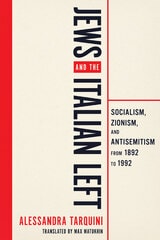
Jews and the Italian Left
Socialism, Zionism, and Antisemitism from 1892 to 1992Alessandra Tarquini, Translated by Max Matukhin
University of Wisconsin Press, 2026
Alessandra Tarquini, an expert on Italian Fascism, untangles the complicated relationship between the Italian left and Jews since the late nineteenth century. Due largely to indifference, and sometimes to antisemitism, Italian leftists consistently overlooked Jews in their visions for a collectivist future. Yet, from the birth of the Socialist Party in 1892 until 1992, when the heirs of the Marxist tradition dispersed or set out on a new path, questions continually arose in revolutionary efforts to remake the Italian state: Should Jews be seen as oppressed, and therefore welcome to participate in the struggle that would lead to the advent of a new civilization? Or might they hinder the realization of socialism because of their attachment to a religious identity?
Tarquini’s research fills an important lacuna by analyzing the antisemitism of twentieth-century socialist movements. Crucially, however, Tarquini makes important distinctions between antisemitism on the Italian left and right, and identifies the relationship between leftism and antisemitism as a distinct formation.
Tarquini’s research fills an important lacuna by analyzing the antisemitism of twentieth-century socialist movements. Crucially, however, Tarquini makes important distinctions between antisemitism on the Italian left and right, and identifies the relationship between leftism and antisemitism as a distinct formation.
[more]
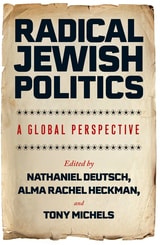
Radical Jewish Politics
A Global PerspectiveNathaniel Deutsch
Rutgers University Press, 2026
For the first time, this volume centers the rich but little known history of radical Jewish politics in the Middle East and North Africa and puts it into conversation with developments in the Americas, South Africa, Soviet Asia, and Europe. Jews were attracted to radical politics in the nineteenth and twentieth centuries to transform the societies they lived in but also out of a deep desire to belong. Somewhat paradoxically, then, radical politics held out the enticing possibility of normalization for Jews, even as it frequently resulted in their further alienation or persecution. In some cases, Jewish radicals sought recognition and autonomy as Jews; in others, Jews labored to be accepted as full-fledged citizens of their home countries; in still others, they tried to escape Jewishness altogether. Jewish experiences of modernity, colonialism, race, nationalism, emancipation, war, and migration, serve as the connective tissue that binds together radical Jewish politics from Baghdad to Buenos Aires.
[more]