Results by title
11 books match the query 'Community activists'
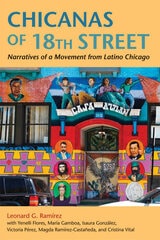
Chicanas of 18th Street
Narratives of a Movement from Latino ChicagoLeonard G. Ramirez
University of Illinois Press, 2011
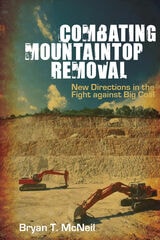
Combating Mountaintop Removal
New Directions in the Fight against Big CoalBryan T. McNeil
University of Illinois Press, 2012
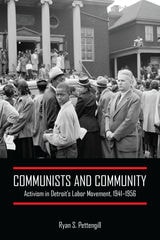
Communists and Community
Activism in Detroit's Labor Movement, 1941-1956Ryan S. Pettengill
Temple University Press, 2020
Communists and Community seeks to reframe the traditional chronology of the Communist Party in the United States as a means to better understand the change that occurred in community activism in the mid-twentieth century. Ryan Pettengill argues that Popular Front activism continued to flourish throughout the war years and into the postwar period. In Detroit, where there was a critical mass of heavy industry, Communist Party activists mobilized support for civil rights and affordable housing, brought attention to police brutality, sought protection for the foreign-born, and led a movement for world peace.
Communists and Community demonstrates that the Communist Party created a social space where activists became effective advocates for the socioeconomic betterment of a multiracial work force. Pettengill uses Detroit as a case study to examine how communist activists and their sympathizers maintained a community to enhance the quality of life for the city’s working class. He investigates the long-term effects of organized labor’s decision to force communists out of the unions and abandon community-based activism. Communists and Community recounts how leftists helped workers, people of color, and other under-represented groups became part of the mainstream citizenry in America.
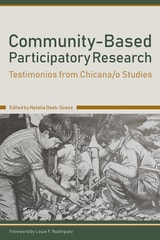
Community-Based Participatory Research
Testimonios from Chicana/o StudiesEdited by Natalia Deeb-Sossa; Foreword by Louie F. Rodriguez
University of Arizona Press, 2019
The testimonies tell of projects that stem from community demands for truly collaborative research addressing locally identified issues and promoting community social change. Contributors share their personal experiences in conducting CBPR, focusing on the complexities of implementing this method and how it may create sustainable change and community empowerment. Along with a retrospective analysis of how CBPR has been at the center of the Chicana/o Movement and Chicana/o studies, the book includes a discussion of consejos y advertencias (advice and warnings).
The most knowledgeable people on community issues are the very members of the communities themselves. Recognizing a need to identify the experiences and voices (testimonios) of communities of color, activist-scholars showcase how to incorporate the perspectives of the true experts: the poor, women, farmworkers, students, activists, elders, and immigrants.

Dance with the Bear
The Joe Rosenblatt StoryNorman Rosenblatt
University of Utah Press, 2013
The “Little Hoover Commission” was modeled after the 1947 initiative of President Harry Truman, who created the Commission on Organization of the Executive Branch of Government to recommend administrative changes and appointed former president Herbert Hoover to chair it. Rosenblatt, a perceptive and outspoken figure, brought a much-needed dose of urgency and pragmatism to the Utah process and formulated a number of far-reaching suggestions to the legislature—many of which were adopted and still exist to this day. His work with the commission coupled with his later role on the San Francisco Federal Reserve Board did much to modernize Utah. Rosenblatt’s legacy as a perpetual champion of the community is further exemplified by his role as cultural conduit between Salt Lake’s Jewish community and the leaders of the Church of Jesus Christ of Latter-day Saints.
This readable work will serve as an integral addition to Utah business and political history, enriching the library of anyone looking for an engaging story of a remarkable and transformative figure.
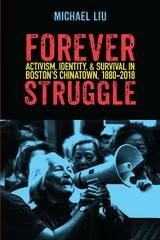
Forever Struggle
Activism, Identity, and Survival in Boston's Chinatown, 1880–2018Michael Liu
University of Massachusetts Press, 2020
In writing about Boston Chinatown's long history, Michael Liu, a lifelong activist and scholar of the community, charts its journey and efforts for survival—from its emergence during a time of immigration and deep xenophobia to the highway construction and urban renewal projects that threatened the neighborhood after World War II to its more recent efforts to keep commercial developers at bay. At the ground level, Liu depicts its people, organizations, internal battles, and varied and complex strategies against land-taking by outside institutions and public authorities. The documented courage, resilience, and ingenuity of this low-income immigrant neighborhood of color have earned it a place amongst our urban narratives. Chinatown has much to teach us about neighborhood agency, the power of organizing, and the prospects of such neighborhoods in rapidly growing and changing cities.

From the Skin
Defending Indigenous Nations Using Theory and PraxisEdited by J. Jeffery Clark and Elise Boxer; Foreword by Nick Estes
University of Arizona Press, 2023
In this volume, contributors demonstrate the real-world application of Indigenous theory to the work they do in their own communities and how this work is driven by urgency, responsibility, and justice—work that is from the skin.
In From the Skin, contributors reflect on and describe how they apply the theories and concepts of Indigenous studies to their communities, programs, and organizations, and the ways the discipline has informed and influenced the same. They show the ways these efforts advance disciplinary theories, methodologies, and praxes. Chapters cover topics including librarianship, health programs, community organizing, knowledge recovery, youth programming, and gendered violence. Through their examples, the contributors show how they negotiate their peoples’ knowledge systems with knowledge produced in Indigenous studies programs, demonstrating how they understand the relationship between their people, their nations, and academia.
Editors J. Jeffery Clark and Elise Boxer propose and develop the term practitioner-theorist to describe how the contributors theorize and practice knowledge within and between their nations and academia. Because they live and exist in their community, these practitioner-theorists always consider how their thinking and actions benefit their people and nations. The practitioner-theorists of this volume envision and labor toward decolonial futures where Indigenous peoples and nations exist on their own terms.
Contributors
Randi Lynn Boucher-Giago
Elise Boxer
Shawn Brigman
J. Jeffery Clark
Nick Estes
Eric Hardy
Shalene Joseph
Jennifer Marley
Brittani R. Orona
Alexander Soto
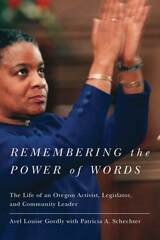
Remembering the Power of Words
The Life of an Oregon Activist, Legislator, and Community LeaderAvel Louise Gordly
Oregon State University Press, 2011
Remembering the Power of Words recounts the personal and professional journey of Avel Gordly, the first African-American woman elected to the Oregon State Senate.
The book is a brave and honest telling of Gordly’s life. She shares the challenges and struggles she faced growing up black in Portland in the 1950s and 1960s, as well as her determination to attend college, the dedication to activism that took her from Portland to Africa, and her eventual decision to run for a seat in the state legislature.
That words have power is a constant undercurrent in Gordly’s account and a truth she learned early in life. “Growing up, finding my own voice,” she writes, “was tied up with denying my voice or having it forcefully rejected and in all of that the memory of my father is very strong. To this day—and I am today a very experienced public speaker—preparation to speak takes a great deal of energy.” That this memoir has its origins as an oral history is fitting since Gordly has used her voice, out loud, to teach and inspire others for so many years.
Important as a biographical account of one significant Oregonian’s story, the book also contributes “broader narratives touching on Black history (and Oregon’s place within it), and most particularly the politics associated with being an African American woman,” according to series editor Melody Rose.
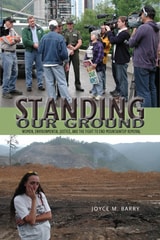
Standing Our Ground
Women, Environmental Justice, and the Fight to End Mountaintop RemovalJoyce M. Barry
Ohio University Press, 2012
Standing Our Ground: Women, Environmental Justice, and the Fight to End Mountaintop Removal examines women’s efforts to end mountaintop removal coal mining in West Virginia. Mountaintop removal coal mining, which involves demolishing the tops of hills and mountains to provide access to coal seams, is one of the most significant environmental threats in Appalachia, where it is most commonly practiced.
The Appalachian women featured in Barry’s book have firsthand experience with the negative impacts of Big Coal in West Virginia. Through their work in organizations such as the Coal River Mountain Watch and the Ohio Valley Environmental Coalition, they fight to save their mountain communities by promoting the development of alternative energy resources. Barry’s engaging and original work reveals how women’s tireless organizing efforts have made mountaintop removal a global political and environmental issue and laid the groundwork for a robust environmental justice movement in central Appalachia.
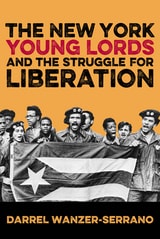
The New York Young Lords and the Struggle for Liberation
Darrel Wanzer-Serrano
Temple University Press, 2015
In The New York Young Lords and the Struggle for Liberation, Darrel Wanzer-Serrano details the numerous community initiatives that advanced decolonial sensibilities in El Barrio and beyond. Using archival research and interviews, he crafts an engaging account of the Young Lords’ discourse and activism. He rescues the organization from historical obscurity and makes an argument for its continued relevance, enriching and informing contemporary discussions about Latino/a politics.
The Newark Frontier
Community Action in the Great SocietyMark Krasovic
University of Chicago Press, 2016
The Newark Frontier shows how, during the Great Society, urban liberalism adapted and grew, defining itself less by centralized programs and ideals than by administrative innovation and the small-scale, personal interactions generated by community action programs, investigative commissions, and police-community relations projects. Paying particular attention to the fine-grained experiences of Newark residents, Krasovic reveals that this liberalism was rooted in an ethic of experimentation and local knowledge. He illustrates this with stories of innovation within government offices, the dynamic encounters between local activists and state agencies, and the unlikely alliances among nominal enemies. Krasovic makes clear that postwar liberalism’s eventual fate had as much to do with the experiments waged in Newark as it did with the violence that rocked the city in the summer of 1967.