Results by title
7 books match the query 'Community in literature'

As American as Mom, Baseball, and Apple Pie
Constructing Community in Contemporary American Horror FictionLinda J. Holland-Toll
University of Wisconsin Press, 2001
Faulkner’s Marginal Couple
Invisible, Outlaw, and Unspeakable CommunitiesBy John N. Duvall
University of Texas Press, 1990
Is William Faulkner’s fiction built on a fundamental dichotomy of outcast individual versus the healthy agrarian community? The New Critics of the 1930s advanced this view, and it has shaped much Faulkner criticism. However, in Faulkner’s Marginal Couple, John Duvall posits the existence of another possibility, alternative communities formed by “deviant” couples. These couples, who violate “normal” gender roles and behaviors, challenge the either/or view of Faulkner’s world.
The study treats in detail the novels Light in August, The Wild Palms, Sanctuary, Pylon, and Absalom, Absalom!, as well as several of Faulkner’s short stories. In discussing each work, Duvall challenges the traditional view that Faulkner created active men who follow a code of honor and passive women who are close to nature. Instead, he charts the many instances of men who are nurturing and passive and women who are strong and sexually active. These alternative couples undermine a common view of Faulkner as an upholder of Southern patriarchal values, thus countering the argument that Faulkner’s fiction is essentially misogynist.
This new approach, drawing on semiotics, feminism, and Marxism, makes Faulkner more accessible to readers interested in ideological analysis. It also stresses the intertextual connections between Faulkner’s Yoknapatawpha and non-Yoknapatawpha fiction. Perhaps most importantly, it uncovers what the New Criticism concealed, namely, that Faulkner’s fiction traces the full androgynous spectrum of the human condition.
Literary Circles and Cultural Communities in Renaissance England
Edited by Claude J. Summers & Ted-Larry Pebworth
University of Missouri Press, 2001
Although the literary circle is widely recognized as a significant feature of Renaissance literary culture, it has received remarkably little examination. In this collection of essays, the authors attempt to explain literary circles and cultural communities in Renaissance England by exploring both actual and imaginary ways in which they were conceived and the various needs they fulfilled. The book also pays considerable attention to larger theoretical issues relating to literary circles.
The essayists raise important questions about the extent to which literary circles were actual constructs or fictional creations. Whether illuminating or limiting, the circle metaphor itself can be extended or reformulated. Some of the authors discuss how particular circles actually operated, and some question the very concept of the literary circle. Literary Circles and Cultural Communities in Renaissance England will be an important addition to seventeenth-century studies.
New Visions of Community in Contemporary American Fiction
Tan, Kingsolver, Castillo, MorrisonMagali Cornier Michael
University of Iowa Press, 2006
Reading the Middle Generation Anew
Culture, Community, and Form in Twentieth-Century American PoetryEric Haralson
University of Iowa Press, 2006
In addition to having worked during the broad middle of the last century, these poets constitute the center of twentieth-century American poetry in the larger sense, refuting invidious connotations of “middle” as coming after the great moderns and being superseded by a proliferating postmodern experimentation. This middle generation mediates the so-called American century and its prodigious body of poetry, even as it complicates historical and aesthetic categorizations.
Taking diverse formal and thematic angles on these poets—deconstructionist, biographical-historical, and more formalist accounts—this book re-examines their between-ness and ambivalence: their various positionings and repositionings in aesthetic, political, and personal matters. The essays study the interplay between these writers and such shifting formations as religious discourse, consumerism, militarism and war, the ideology of America as “nature’s nation,” and U.S. race relations and ethnic conflicts. Reading the Middle Generation Anew also shows the legacy of the middle generation, the ways in which their lives and writings continue to be a shaping force in American poetry. This fresh and invigorating collection will be of great interest to literary scholars and poets.
Women's Life-Writing
Finding Voice, Building CommunityLinda S. Coleman
University of Wisconsin Press, 1997
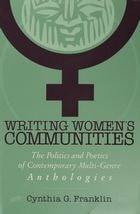
Writing Women's Communities
The Politics and Poetics of Contemporary Multi-Genre AnthologiesCynthia G. Franklin
University of Wisconsin Press, 1997
Beginning in the 1980s, a number of popular and influential anthologies organized around themes of shared identity—Nice Jewish Girls, This Bridge Called My Back, Home Girls, and others—have brought together women’s fiction and poetry with journal entries, personal narratives, and transcribed conversations. These groundbreaking multi-genre anthologies, Cynthia G. Franklin demonstrates, have played a crucial role in shaping current literary studies, in defining cultural and political movements, and in building connections between academic and other communities.
Exploring intersections and alliances across the often competing categories of race, class, gender, and sexuality, Writing Women’s Communities contributes to current public debates about multiculturalism, feminism, identity politics, the academy as a site of political activism, and the relationship between literature and politics.