Results by title

6 books match the query 'Community mental health services'
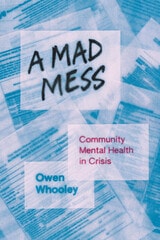
cover of A Mad Mess: Community Mental Health in Crisis

A Mad Mess

Community Mental Health in Crisis

Owen Whooley

University of Chicago Press, 2026

A sobering assessment of the systematic failures of mental health work.

The United States is in the midst of a mental health crisis that cannot be ignored. Its effects are visible in overcrowded emergency rooms, homeless encampments, and frequent encounters between police and people with serious mental illness. And yet, our attempts to support people with mental illness—from medical care to housing support to basic hygiene—seem to never take meaningful hold despite the tireless work of professionals who attempt to help people bring together the pieces of a life. The problem is not in any individual effort though; it’s in the many ways these programs fail to work together. For those with serious mental illness, and those who work to ameliorate it, there is no system. There is only mess. 

In A Mad Mess, sociologist Owen Whooley uncovers the exasperating barriers, bureaucratic mismatches, and threadbare resources that have made a mess of what should be a supportive system. Set in Albuquerque, New Mexico—a city whose struggles echo those of communities nationwide—the book reveals the challenges mental health workers face daily, from tedious paperwork to occasional violence. Whooley follows workers across local outpatient service organizations, specialized police mental health units, and a psychiatric emergency department. Despite mostly good intentions and sometimes heroic efforts, he shows why this important work so often ends in failure. 

Written with deep sympathy and unflinching honesty, A Mad Mess reveals how the lack of a cohesive mental health system obstructs critical care and places roadblocks before front-line mental health workers at every turn. Most critically, for those who suffer from severe mental illness, these setbacks are a constant reminder that the institutions charged with helping them have left them on their own.

[more]
cover of Between Families and Institutions: Mental Health and Biopolitical Paternalism in Contemporary China

Between Families and Institutions

Mental Health and Biopolitical Paternalism in Contemporary China

Zhiying Ma

Duke University Press, 2025

In contemporary China, people diagnosed with serious mental illnesses have long been placed under the guardianship of close relatives who decide on their hospitalization and treatment. Despite attempts at reforms to ensure patient rights, the 2013 Mental Health Law reinforced the family’s rights and responsibilities. In Between Families and Institutions, Zhiying Ma examines how ideological, institutional, and technological processes shape families’ complicated involvement in psychiatric care. Drawing on extensive ethnographic fieldwork in psychiatric hospitals, community mental health teams, social work centers, and family support groups as well as interviews with policymakers and activists, Ma maps the workings of what she calls “biopolitical paternalism”—a mode of governance that sees vulnerable individuals as sources of risk, frames risk management as the state’s paternalistic intervention, and shifts responsibilities for care and management onto families. Ma outlines the ethical tensions, intimate vulnerabilities in households, and health disparities across the population that biopolitical paternalism produces. By exploring these implications, Ma demonstrates the myriad ways biopower enables, inhibits, and transforms medical care in China.
[more]
cover of Faith and Mental Health: Religious Resources for Healing

Faith and Mental Health

Religious Resources for Healing

Harold G. Koenig

Templeton Press, 2005

Dr. Harold Koenig opens a window on mental health, providing an unprecedented source of practical information about the relationship between religion and mental health. He examines how Christianity and other world religions deliver mental health services today, and he makes recommendations, based on research, expertise, and experience, for new programs to meet local needs.

Meticulously researched and documented, Faith and Mental Health includes

  • Research on the relationship between religion and positive emotions, psychiatric illnesses, and severe and persistent mental disorders
  • Ways in which religion has influenced mental health historically, and how now and in the future it can be involved with mental health
  • A comprehensive description and categorization of Christian and non-Christian faith-based organizations that provide mental health resources
  • Resources for religious professionals and faith communities on how to design effective programs

Presenting a combination of the history and current research of mental health and religion along with a thorough examination of faith-based organizations operating in the field, this book is a one-of-a-kind resource for the healthcare community; its valuable research and insights will benefit medical and religious professionals, and anyone concerned with the future of mental health care.
[more]
cover of MMPI-2 Correlates for Outpatient Community Mental Health Settings

MMPI-2 Correlates for Outpatient Community Mental Health Settings

John R. Graham

University of Minnesota Press, 1999

The first major collection of outpatient data on the MMPI-2, the most widely used personality assessment test in the world. With the introduction of managed care to mental health treatment, patients increasingly are seen and treated in outpatient settings. Although the MMPI-2 and its predecessor, the MMPI, have long been used for outpatient assessment, the bulk of research on the test has been performed at inpatient psychiatric hospitals. This volume presents the first extensive set of correlates for the MMPI-2 in outpatient settings, demonstrating the relationship of MMPI-2 scores to clinically relevant behavior. Reporting the results of a large-scale research project on the use of the MMPI-2 in community mental health centers, this study provides clinically useful information concerning the interpretation of MMPI-2 scores and code types. Because the research found that the correlates in outpatient mental health settings are essentially the same as those in other settings, this book will be a standard reference for all clinicians who use the MMPI-2, regardless of where they work. "A well-written, well-organized presentation. The literature is extensively reviewed, both in terms of prototypic studies reporting MMPI interpretive correlates, as well as those performed by one or more of the authors using the MMPI-2. This comprehensive literature review and the knowledge base of the authors are quite laudable." Linda Nelson "This timely book presents extremely important data for the clinical and research communities. It is unusually comprehensive and thorough, representing what is probably the best effort to date at providing external correlates of MMPI-2 scales." David Berry John R. Graham, Yossef S. Ben-Porath, and John L. McNulty are in the Department of Psychology at Kent State University. Graham is professor and chair, Ben-Porath is associate professor, and McNulty is a postdoctoral fellow.
[more]
cover of Managing Madness in the Community: The Challenge of Contemporary Mental Health Care

Managing Madness in the Community

The Challenge of Contemporary Mental Health Care

Kerry Michael Dobransky

Rutgers University Press, 0

 While mental illness and mental health care are increasingly recognized and accepted in today’s society, awareness of the most severely mentally ill—as well as those who care for them—is still dominated by stereotypes.  Managing Madness in the Community dispels the myth.  Readers will see how treatment options often depend on the social status, race, and gender of both clients and carers; how ideas in the field of mental health care—conflicting priorities and approaches—actually affect what happens on the ground; and how, amid the competing demands of clients and families, government agencies, bureaucrats and advocates, the fragmented American mental health system really works—or doesn’t.

In the wake of movies like One Flew Over the Cuckoo’s Nest and Shutter Island, most people picture the severely or chronically mentally ill being treated in cold, remote, and forbidding facilities.  But the reality is very different.  Today the majority of deeply troubled mental patients get treatment in nonprofit community organizations.  And it is to two such organizations in the Midwest that this study looks for answers.  Drawing upon a wealth of unique evidence—fifteen months of ethnographic observations, 91 interviews with clients and workers, and a range of documents—Managing Madness in the Community lays bare the sometimes disturbing nature and effects of our overly complex and disconnected mental health system.

Kerry Michael Dobransky examines the practical strategies organizations and their clients use to manage the often-conflicting demands of a host of constituencies, laws, and regulations.  Bringing to light the challenges confronting patients and staff of the community-based institutions that bear the brunt of caring for the mentally ill, his book provides a useful broad framework that will help researchers and policymakers understand the key forces influencing the mental health services system today.

[more]
cover of Ties That Enable: Community Solidarity for People Living with Serious Mental Health Problems

Ties That Enable

Community Solidarity for People Living with Serious Mental Health Problems

Teresa L. Scheid

Rutgers University Press, 2021

Ties that Enable is written for students, providers, and advocates seeking to understand how best to improve mental health care – be it for themselves, their loved ones, their clients, or for the wider community. The authors integrate their knowledge of mental health care as researchers, teachers, and advocates and rely on the experiences of people living with severe mental health problems to help understand the sources of community solidarity. Communities are the primary source of social solidarity, and given the diversity of communities, solutions to the problems faced by individuals living with severe mental health problems must start with community level initiatives. “Ties that Enable” examines the role of a faith-based community group in providing a sense of place and belonging as well as reinforcing a valued social identity. The authors argue that mental health reform efforts need to move beyond a focus on individual recovery to more complex understandings of the meaning of community care. In addition, mental health care needs to move from a medical model to a social model which sees the roots of mental illness and recovery as lying in society, not the individual. It is our society’s inability to provide inclusive supportive environments which restrict the ability of individuals to recover. This book provides insights into how communities and system level reforms can promote justice and the higher ideals we aspire to as a society.
[more]