Results by title
7 books match the query 'Community power'
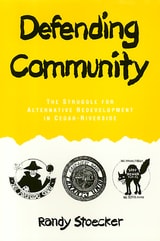
Defending Community
The Struggle for Alternative Redevelopment in Cedar-RiversideRandy Stoecker
Temple University Press, 1994
Randy Stoecker's intimate biography of Cedar-Riverside, nationally known for a period as "the Haight-Ashbury of the Mid-West," contains important lessons about the conflicts between the needs of capitalism and the needs of community. While attending graduate school at the University of Minnesota, the author moved to Cedar-Riverside, a Minneapolis neighborhood known for its determination to enact values of peace, justice, wholeness, participation, and community in its truest sense. There he experienced first-hand the clashes between a radical community and state-backed urban developers.
His narrative tells the story of a community that overcame the odds against its own survival. Slated for total demolition, the neighborhood was saved by a powerful grass-roots movement. Citizens stopped a state-capital coalition from entombing the community in concrete and went on to create one of the largest community controlled urban redevelopment projects in the country After more than twenty years of struggle, Cedar-Riverside continues to experience citizen-controlled urban redevelopment on its own terms, setting an example for other communities, urban planners, and policymakers.
In the series Conflicts in Urban and Regional Development, edited by John R. Logan and Todd Swanstrom.

Duval County Tejanos
An Epic narrative of Liberty and DemocracyAlfredo Cardenas
University of North Texas Press, 2024
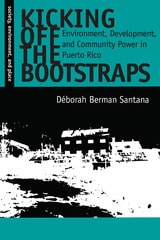
Kicking Off the Bootstraps
Environment, Development, and Community Power in Puerto RicoDéborah Berman Santana
University of Arizona Press, 1996
Kicking Off the Bootstraps is a powerful case history of such an effort. It describes a grassroots activist movement that emerged in the Puerto Rican community of Salinas to counter the poverty and economic dependence experienced by its citizens in the wake of "Operation Bootstrap," a post-World War II industrial development program. Déborah Berman Santana examines the efforts of the community to develop its own economic strategy based primarily on environmentally and socially responsible uses of local natural and human resources.
Berman Santana shows how local activists are seeking to empower the Salinas community to make decisions concerning economic development. She evaluates present-day efforts to develop positive alternatives, examining the motivations of the activists, the nature of their projects, their efforts to mobilize the community, their dealings with government and other organizations, and the obstacles they face. In a closing chapter, she addresses the potential roles of community leaders, outside activists, local businesses, and government in actualizing these alternatives.
A testimony to one community's efforts to determine its own future, Kicking Off the Bootstraps deals with real issues such as control over productive resources, quality of life, and environmental health. It also extends an examination of community-directed activism to an exploration of policy implications for sustainable development. While this concept is often too vague to be applied to real strategies, the Salinas experience provides a clear idea of what sustainable development can—and should—mean in actual practice.
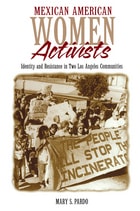
Mexican American Women Activists
Mary Pardo
Temple University Press, 1998
By focusing on women in two contiguous but very different communities -- the working-class, inner-city neighborhood of Boyle Heights in Eastside Los Angeles and the racially mixed middle-class suburb of Monterey Park -- Pardo is able to bring class as ell as gender and ethnic concerns to bear on her analysis in ways that shed light on the complexity of mobilizing for urban change.
Unlike many studies, the stories told here focus on women's strengths rather than on their problems. We follow the process by which these women empowered themselves by using their own definitions of social justice and their own convictions about the importance of traditional roles. Rather than becoming political participants in spite of their family responsibilities, women in both neighborhoods seem to have been more powerful because they had responsibilities, social networks, and daily routines separate from the men in their communities.
Pardo asserts that the decline of real wages and the growing income gap means that unforunately most women will no longer be able to focus their energies on unpaid community work. She reflects on the consequences of this change for women's political involvement, as well as on the politics of writing about women and politics.
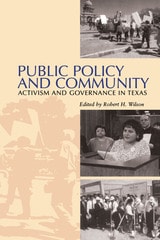
Public Policy and Community
Activism and Governance in TexasEdited by Robert H. Wilson
University of Texas Press, 1997
The decentralization of public policy from the federal government to state and local governments offers increased opportunities for ordinary citizens to participate directly in public policymaking. Yet these opportunities may not be equally shared. Due to a variety of factors, low-income citizens have long been denied a meaningful role in the public life and governance of our country.
By contrast, the essays in this volume explore how low-income citizens have successfully affected public policy. The book is built around six case studies, all from Texas, that cover education finance and reform, local infrastructure provision, environmental protection, and indigent health care.
This research illuminates several issues of national importance, including how communities gain standing and recognition for themselves and their issues, how policy agendas are defined, how communities mobilize technical and institutional resources, and how they form coalitions and alliances to accomplish their goals.
Race and Authority in Urban Politics
David J. Greenstone
Russell Sage Foundation, 1974
Race and Authority in Urban Politics
Community Relations and the War on PovertyDavid Greenstone and Paul E. Peterson
University of Chicago Press, 1976
In a series of lively chapters, Greenstone and Peterson show how the coalitions that formed around the community action question developed not out of electoral or organizational interests alone but were strongly influenced by prevailing conceptions of the nature of authority in America. The book stresses the way in which both machine and reform structures affected the ability of minority groups to organize effectively and to form alliances in urban politics. It considers the wide-ranging critiques made of the Community Action Program by conservative, liberal, and radical analysts and finds that all of them fail to appreciate the significance and intensity of the racial cleavage in American politics.