Results by title
5 books match the query 'Comparative Analysis'
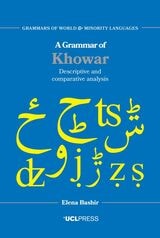
A Grammar of Khowar
Descriptive and Comparative AnalysisElena Bashir
University College London, 2025
Grammar of Khowar is the first comprehensive English-language study of Khowar, a unique Indo-Aryan language spoken in northern Pakistan. Drawing on over thirty years of field research, Elena Bashir provides a detailed snapshot of the language at a critical moment in its evolution, as increasing cultural and economic pressures accelerate linguistic change.
The book presents Khowar’s phonology, morphology, and syntax, alongside an in-depth analysis of how its grammatical structures shape the way speakers conceptualize the world. Rife with original example sentences—many sourced from oral texts recorded in multiple villages—this work preserves linguistic data that might otherwise be lost. A special appendix includes a thirty-page sample text in Khowar’s Perso-Arabic script, followed by a romanized transcription and English translation, offering an invaluable resource for scholars.
A critical contribution to South Asian linguistics, this book underscores the urgency of studying and preserving endangered mountain languages before they fade from use.
Coalition Politics and Cabinet Decision Making
A Comparative Analysis of Foreign Policy ChoicesJuliet Kaarbo
University of Michigan Press, 2013
Every day, coalition cabinets make policy decisions critical to international politics. Juliet Kaarbo examines the dynamics of these multiparty cabinets in parliamentary democracies in order to assess both the quality of coalition decision making and the degree to which coalitions tend to favor peaceful or military solutions. Are coalition cabinets so riddled by conflict that they cannot make foreign policy effectively, or do the multiple voices represented in the cabinet create more legitimate and imaginative responses to the international system? Do political and institutional constraints inherent to coalition cabinets lead to nonaggressive policies? Or do institutional and political forces precipitate more belligerent behavior?
Employing theory from security studies and political psychology as well as a combination of quantitative cross-national analyses and twelve qualitative comparative case studies of foreign policy made by coalition cabinets in Japan, the Netherlands, and Turkey, Kaarbo identifies the factors that generate highly aggressive policies, inconsistency, and other policy outcomes. Her findings have implications not merely for foreign policy but for all types of decision making and policy-making by coalition governments.
Leadership in Committee
A Comparative Analysis of Leadership Behavior in the U.S. SenateC. Lawrence Evans
University of Michigan Press, 2001
How does the leadership of a Senate committee influence the outcome of bills? In Leadership in Committee C. Lawrence Evans delves into the behavior of legislative leaders and the effects of what they do, how their tactics vary, and why. Using evidence gleaned from personal interviews with a large number of U.S. senators and Senate staff, the author compares the leadership styles of eight committee chairs and ranking minority members in the U.S. Senate. The result is a significant contribution to the literature on American politics, the first book-length, comparative analysis of legislative leadership behavior in the modern Senate.
". . . .this book is highly recommended reading for those interested in both legislative politics and political leadership. . . .Leadership in Committee establishes Evans as one of the handful of political scientists who have done justice to the subtleties of politics in the modern Senate."
---Randall Strahan, Journal of Politics
"Larry Evans has significantly influenced my own work over the years, and Leadership in Committee is one reason why. It is a model of great scholarship, the best work on committee leadership ever written. It has the discriminatory sense of context that appears only when the author truly knows his subject. It is theoretical without being reductionist or vacuously abstract. Its principal claims are general yet sufficiently concrete to be testable, and Evans provides systematic, comparative evidence to support (or qualify) each of them. Larger issues of agenda-setting, institutional structure, partisanship, anticipated reactions, participation, committee-floor bargaining, and strategic action of various kinds receive thoughtful and insightful examination. And the book is simply a terrific read. Too long in coming, the publication of Leadership in Committee in paperback ought to spark a well-deserved revival of interest in this work."
---Richard L. Hall, University of Michigan
The Gendered Executive
A Comparative Analysis of Presidents, Prime Ministers, and Chief ExecutivesJanet M. Martin
Temple University Press, 2016
Excluded from the ranks of elite executive decision-makers for generations, women are now exercising power as chiefs of government and chiefs of state. As of April 2016, 112 women in 73 countries have served as presidents or prime ministers.
The Gendered Executive is a critical examination of national executives, focusing on matters of identity, representation, and power. The editors and contributors to this volume address the impact of female executives through political mobilization and participation, policy- and decision-making, and institutional change. Other topics include party nomination processes, the intersectionality of race and gender, and women-centered U.S. foreign policy in southern Africa. In addition, case studies from Chile, India, Portugal, and the United States are presented, as are cross-national comparisons of women leaders in Latin America.
The Gendered Executive will enhance our understanding of the complexity of gender in and comparative analyses of executive politics.
Contributors include: Amy C. Alexander, Sheetal Chhabria, Georgia Duerst-Lahti, Maria C. Escobar-Lemmon, Cory Charles Gooding, Lilly Goren, Karen M. Hult, Farida Jalalzai, Daniela F. Melo, Catherine Reyes-Housholder, Ariella R. Rotramel, Leslie A. Schwindt-Bayer, Michelle M. Taylor-Robinson, and the editors
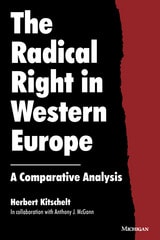
The Radical Right in Western Europe
A Comparative AnalysisHerbert Kitschelt
University of Michigan Press, 1996