Results by title
2 books match the query 'Comparative industrial relations'

Globalisation and Industrial Relations
The Pharmaceutical Industry in Germany and the United KingdomLuitpold Rampeltshammer
Campus Verlag, 2008
Although many books have been written about the economic impact of globalization on Europe, none has focused exclusively on the pharmaceutical industry. To fill this gap in scholarship, Globalization and Industrial Relations offers a full account of how open markets have affected drug companies, their employees, and consumers alike.
Using the examples of Germany and the United Kingdom as case studies, this volume uses a careful theoretical background and broad empirical analysis to evaluate the current state of industrial relations in the pharmaceutical industry. Globalisation and Industrial Relations addresses how companies in the pharmaceutical industry deal with the challenges from globalization in respect to collective bargaining and workplace representation. A complete analysis of industrial relations in the drug manufacturing industry in a changing world, this volume also forecasts different trajectories for the systems of industrial relations in Germany and the United Kingdom.
[more]
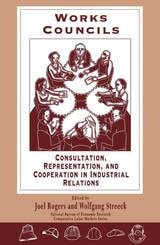
Works Councils
Consultation, Representation, and Cooperation in Industrial RelationsEdited by Joel Rogers and Wolfgang Streeck
University of Chicago Press, 1995
As the influence of labor unions declines in many industrialized nations, particularly the United States, the influence of workers has decreased. Because of the need for greater involvement of workers in changing production systems, as well as frustration with existing structures of workplace regulation, the search has begun for new ways of providing a voice for workers outside the traditional collective bargaining relationship.
Works councils—institutionalized bodies for representative communication between an employer and employees in a single workplace—are rare in the Anglo-American world, but are well-established in other industrialized countries. The contributors to this volume survey the history, structure, and functions of works councils in the Netherlands, Germany, France, Spain, Sweden, Italy, Poland, Canada, and the United States. Special attention is paid to the relations between works councils and unions and collective bargaining, works councils and management, and the role and interest of governments in works councils. On the basis of extensive comparative data from other Western countries, the book demonstrates powerfully that well-designed works councils may be more effective than labor unions at solving management-labor problems.
Works councils—institutionalized bodies for representative communication between an employer and employees in a single workplace—are rare in the Anglo-American world, but are well-established in other industrialized countries. The contributors to this volume survey the history, structure, and functions of works councils in the Netherlands, Germany, France, Spain, Sweden, Italy, Poland, Canada, and the United States. Special attention is paid to the relations between works councils and unions and collective bargaining, works councils and management, and the role and interest of governments in works councils. On the basis of extensive comparative data from other Western countries, the book demonstrates powerfully that well-designed works councils may be more effective than labor unions at solving management-labor problems.
[more]