Results by title
7 books match the query 'Comparative method'
Apples and Oranges
Explorations In, On, and With ComparisonBruce Lincoln
University of Chicago Press, 2018
Comparison is an indispensable intellectual operation that plays a crucial role in the formation of knowledge. Yet comparison often leads us to forego attention to nuance, detail, and context, perhaps leaving us bereft of an ethical obligation to take things correspondingly as they are. Examining the practice of comparison across the study of history, language, religion, and culture, distinguished scholar of religion Bruce Lincoln argues in Apples and Oranges for a comparatism of a more modest sort.
Lincoln presents critiques of recent attempts at grand comparison, and enlists numerous theoretical examples of how a more modest, cautious, and discriminating form of comparison might work and what it can accomplish. He does this through studies of shamans, werewolves, human sacrifices, apocalyptic prophecies, sacred kings, and surveys of materials as diverse and wide-ranging as Beowulf, Herodotus’s account of the Scythians, the Native American Ghost Dance, and the Spanish Civil War.
Ultimately, Lincoln argues that concentrating one's focus on a relatively small number of items that the researcher can compare closely, offering equal attention to relations of similarity and difference, not only grants dignity to all parties considered, it yields more reliable and more interesting—if less grandiose—results. Giving equal attention to the social, historical, and political contexts and subtexts of religious and literary texts also allows scholars not just to assess their content, but also to understand the forces, problems, and circumstances that motivated and shaped them.
[more]
On Baltic Slovenia and Adriatic Lithuania
A Qualitative Comparative Analysis of Patterns in Post-Communist TransformationZenonas Norkus
Central European University Press, 2012
A unique application of social science software to generate typology and ranklist of transition models of twenty-nine countries in Europe and Asia, ranging from Estonia to Vietnam, Norkus provides a highly innovative internationally comparative causal analysis of the variation in political and economic outcomes after the first decade of post-communist transformations, using multi-value Qualitative Comparative Analysis and Tosmana programme. The analysis includes a critical revision of received dichotomies (e.g. on gradualism versus “shock therapy”), and contributes to current debates on the varieties of post-communist capitalism.This conceptual framework is applied in national case studies, searching for reasons behind successes and failures, with special consideration given to the possibility of alternatives to the Lithuanian way, and the challenges of populism in this country’s politics.
[more]
The Comparative Method of Language Acquisition Research
Clifton Pye
University of Chicago Press, 2017
The Mayan family of languages is ancient and unique. With their distinctive relational nouns, positionals, and complex grammatical voices, they are quite alien to English and have never been shown to be genetically related to other New World tongues. These qualities, Clifton Pye shows, afford a particular opportunity for linguistic insight. Both an overview of lessons Pye has gleaned from more than thirty years of studying how children learn Mayan languages as well as a strong case for a novel method of researching crosslinguistic language acquisition more broadly, this book demonstrates the value of a close, granular analysis of a small language lineage for untangling the complexities of first language acquisition.
Pye here applies the comparative method to three Mayan languages—K’iche’, Mam, and Ch’ol—showing how differences in the use of verbs are connected to differences in the subject markers and pronouns used by children and adults. His holistic approach allows him to observe how small differences between the languages lead to significant differences in the structure of the children’s lexicon and grammar, and to learn why that is so. More than this, he expects that such careful scrutiny of related languages’ variable solutions to specific problems will yield new insights into how children acquire complex grammars. Studying such an array of related languages, he argues, is a necessary condition for understanding how any particular language is used; studying languages in isolation, comparing them only to one’s native tongue, is merely collecting linguistic curiosities.
Pye here applies the comparative method to three Mayan languages—K’iche’, Mam, and Ch’ol—showing how differences in the use of verbs are connected to differences in the subject markers and pronouns used by children and adults. His holistic approach allows him to observe how small differences between the languages lead to significant differences in the structure of the children’s lexicon and grammar, and to learn why that is so. More than this, he expects that such careful scrutiny of related languages’ variable solutions to specific problems will yield new insights into how children acquire complex grammars. Studying such an array of related languages, he argues, is a necessary condition for understanding how any particular language is used; studying languages in isolation, comparing them only to one’s native tongue, is merely collecting linguistic curiosities.
[more]
The Idea of Indian Literature
Gender, Genre, and Comparative MethodPreetha Mani
Northwestern University Press, 2022
Winner of the 2023 Aldo and Jeanne Scaglione Prize for South Asian Studies
Indian literature is not a corpus of texts or literary concepts from India, argues Preetha Mani, but a provocation that seeks to resolve the relationship between language and literature, written in as well as against English. Examining canonical Hindi and Tamil short stories from the crucial decades surrounding decolonization, Mani contends that Indian literature must be understood as indeterminate, propositional, and reflective of changing dynamics between local, regional, national, and global readerships. In The Idea of Indian Literature, she explores the paradox that a single canon can be written in multiple languages, each with their own evolving relationships to one another and to English.
Hindi, representing national aspirations, and Tamil, epitomizing the secessionist propensities of the region, are conventionally viewed as poles of the multilingual continuum within Indian literature. Mani shows, however, that during the twentieth century, these literatures were coconstitutive of one another and of the idea of Indian literature itself. The writers discussed here—from short-story forefathers Premchand and Pudumaippittan to women trailblazers Mannu Bhandari and R. Chudamani—imagined a pan-Indian literature based on literary, rather than linguistic, norms, even as their aims were profoundly shaped by discussions of belonging unique to regional identity. Tracing representations of gender and the uses of genre in the shifting thematic and aesthetic practices of short vernacular prose writing, the book offers a view of the Indian literary landscape as itself a field for comparative literature.
[more]
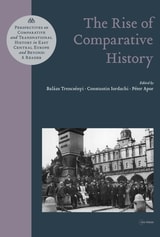
The Rise of Comparative History
Balázs Trencsényi
Central European University Press, 2021
This book—the first of a three-volume overview of comparative and transnational historiography in Europe—focuses on the complex engagement of various comparative methodological approaches with different transnational and supranational frameworks. It considers scales from universal history to meso-regional (i.e. Balkans, Central Europe, etc.) perspectives. In the form of a reader, it displays 18 historical studies written between 1900 and 1943. The collection starts with the French and German methodological discussions around the turn of the twentieth century, stemming from the effort to integrate history with other emerging social sciences on a comparative methodological basis. The volume then turns to the question of structural and institutional comparisons, revisiting various historiographical ventures that tried to sketch out a broader (regional or European-level) interpretative framework to assess the legal systems, patterns of agrarian production, and the common ethnographic and sociocultural features.
In the third part, a number of texts are presented, which put forward a supra-national research framework as an antidote to national exclusivism. While in Western Europe the most obvious such framework was pan-European, in East Central Europe the agenda of comparison was linked usually to a meso-regional framework.
The studies are accompanied by short contextual introductions including biographical information on the respective authors.
[more]

The Value of Comparison
Peter van der Veer
Duke University Press, 2016
In The Value of Comparison Peter van der Veer makes a compelling case for using comparative approaches in the study of society and for the need to resist the simplified civilization narratives popular in public discourse and some social theory. He takes the quantitative social sciences and the broad social theories they rely on to task for their inability to question Western cultural presuppositions, demonstrating that anthropology's comparative approach provides a better means to understand societies. This capacity stems from anthropology's engagement with diversity, its fragmentary approach to studying social life, and its ability to translate difference between cultures. Through essays on topics as varied as iconoclasm, urban poverty, Muslim immigration, and social exclusion van der Veer highlights the ways that studying the particular and the unique allows for gaining a deeper knowledge of the whole without resorting to simple generalizations that elide and marginalize difference.
[more]
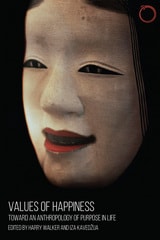
Values of Happiness
Toward an Anthropology of Purpose in LifeEdited by Iza Kavedžija and Harry Walker
HAU, 2016
How people conceive of happiness reveals much about who they are and the values they hold dear. Drawing on ethnographic insights from diverse field sites around the world, this book offers a unique window onto the ways in which people grapple with fundamental questions about how to live and what it means to be human. Developing a distinctly anthropological approach concerned less with gauging how happy people are than with how happiness figures as an idea, mood, and motive in everyday life, the book explores how people strive to live well within challenging or even hostile circumstances.
The contributors explore how happiness intersects with dominant social values as well as an array of aims and aspirations that are potentially conflicting, demonstrating that not every kind of happiness is seen as a worthwhile aim or evaluated in positive moral terms. In tracing this link between different conceptions of happiness and their evaluations, the book engages some of the most fundamental questions concerning human happiness: What is it and how is it achieved? Is happiness everywhere a paramount value or aim in life? How does it relate to other ideas of the good? What role does happiness play in orienting peoples’ desires and life choices? Taking these questions seriously, the book draws together considerations of meaning, values, and affect, while recognizing the diversity of human ends.
The contributors explore how happiness intersects with dominant social values as well as an array of aims and aspirations that are potentially conflicting, demonstrating that not every kind of happiness is seen as a worthwhile aim or evaluated in positive moral terms. In tracing this link between different conceptions of happiness and their evaluations, the book engages some of the most fundamental questions concerning human happiness: What is it and how is it achieved? Is happiness everywhere a paramount value or aim in life? How does it relate to other ideas of the good? What role does happiness play in orienting peoples’ desires and life choices? Taking these questions seriously, the book draws together considerations of meaning, values, and affect, while recognizing the diversity of human ends.
[more]