Results by title
12 books match the query 'Complexity'

Alternative Pathways to Complexity
A Collection of Essays on Architecture, Economics, Power, and Cross-Cultural AnalysisLane F. Fargher
University Press of Colorado, 2016
A group of highly distinguished scholars takes up important issues, theories, and methods stemming from the nascent body of research on comparative archaeology to showcase and apply important theories of households, power, and how the development of complex societies can be extended and refined. Drawing on the archaeological, ethnohistorical, and ethnographic records, the chapters in this volume contain critical investigations on the role of collective action, economics, and corporate cognitive codes in structuring complex societies.
Alternative Pathways to Complexity is an important addition to theoretical development and empirical research on Mesoamerica, the Old World, and cross-cultural studies. The theoretical implications addressed in the chapters will have broad appeal for scholars grappling with alternative pathways to complexity in other regions as well as those addressing diverse cross-cultural research.
Contributors: Sarah B. Barber, Cynthia L. Bedell, Christopher S. Beekman, Frances F. Berdan, Tim Earle, Carol R. Ember, Gary M. Feinman, Arthur A. Joyce, Stephen A. Kowalewski, Lisa J. LeCount, Linda M. Nicholas, Peter N. Peregrine, Peter Robertshaw, Barbara L. Stark, T. L. Thurston, Deborah Winslow, Rita Wright
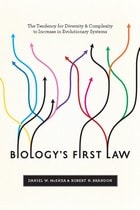
Biology's First Law
The Tendency for Diversity and Complexity to Increase in Evolutionary SystemsDaniel W. McShea and Robert N. Brandon
University of Chicago Press, 2010
Life on earth is characterized by three striking phenomena that demand explanation: adaptation—the marvelous fit between organism and environment; diversity—the great variety of organisms; and complexity—the enormous intricacy of their internal structure. Natural selection explains adaptation. But what explains diversity and complexity? Daniel W. McShea and Robert N. Brandon argue that there exists in evolution a spontaneous tendency toward increased diversity and complexity, one that acts whether natural selection is present or not. They call this tendency a biological law—the Zero-Force Evolutionary Law, or ZFEL. This law unifies the principles and data of biology under a single framework and invites a reconceptualization of the field of the same sort that Newton’s First Law brought to physics.
Biology’s First Law shows how the ZFEL can be applied to the study of diversity and complexity and examines its wider implications for biology. Intended for evolutionary biologists, paleontologists, and other scientists studying complex systems, and written in a concise and engaging format that speaks to students and interdisciplinary practitioners alike, this book will also find an appreciative audience in the philosophy of science.
Complexity
Life at the Edge of ChaosRoger Lewin
University of Chicago Press, 2000
"[Complexity] is that curious mix of complication and organization that we find throughout the natural and human worlds: the workings of a cell, the structure of the brain, the behavior of the stock market, the shifts of political power. . . . It is time science . . . thinks about meaning as well as counting information. . . . This is the core of the complexity manifesto. Read it, think about it . . . but don't ignore it."—Ian Stewart, Nature
This second edition has been brought up to date with an essay entitled "On the Edge in the Business World" and an interview with John Holland, author of Emergence: From Chaos to Order.

Joyce, Chaos, and Complexity
Thomas Jackson Rice
University of Illinois Press, 1997
Placing Joyce in his cultural context, Rice first traces the influence of Euclidean and non-Euclidean geometries on Dubliners and A Portrait of the Artist as a Young Man. He then demonstrates that, when later innovations in science transformed entire worldviews, Joyce recognized conventional literary modes of representation as offering only arbitrary constructions of this reality. Joyce responded in Ulysses by experimenting with perspective, embedding design, and affirming the existence of reality. Rice contends that Ulysses presages the multiple tensions of chaos theory; likewise, chaos theory can serve as a model for understanding Ulysses. In Finnegans Wake Joyce consummates his vision and anticipates the theories of complexity science through a dynamic approximation of reality.
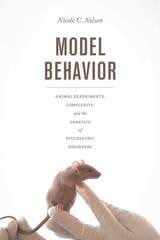
Model Behavior
Animal Experiments, Complexity, and the Genetics of Psychiatric DisordersNicole C. Nelson
University of Chicago Press, 2018
Behavior genetics is a particularly challenging field for making a clear-cut case that mouse experiments work, because researchers believe that both the phenomena they are studying and the animal models they are using are complex. These assumptions of complexity change the nature of what laboratory work produces. Whereas historical and ethnographic studies traditionally portray the laboratory as a place where scientists control, simplify, and stabilize nature in the service of producing durable facts, the laboratory that emerges from Nelson’s extensive interviews and fieldwork is a place where stable findings are always just out of reach. The ongoing work of managing precarious experimental systems means that researchers learn as much—if not more—about the impact of the environment on behavior as they do about genetics. Model Behavior offers a compelling portrait of life in a twenty-first-century laboratory, where partial, provisional answers to complex scientific questions are increasingly the norm.
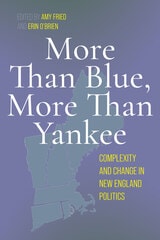
More Than Blue, More Than Yankee
Complexity and Change in New England PoliticsEdited by Amy Fried and Erin O’Brien
University of Massachusetts Press, 2024
New England politics can, at first blush, appear monochromatic. After all, only one member of the entire region’s delegation to the US Congress is a Republican, and citizens have elected few Republicans to the US House or Senate in the last decade. But this has not always been the case. In 1948, only two states in the region–Rhode Island and Connecticut–had Democratic senators. Yet a closer examination of the region today reveals fascinating political variation. Liberal policies, greater diversity, and engaged political movements are reshaping stereotypical Yankee tendencies of close-fisted government, whiteness, and laconic discourse.
This collection of new essays captures both the political history and contemporary moment in this region and exposes the surprisingly varied political landscape. It examines historical shifts, regional developments, and the politics of its states to argue that New England has been and continues to be an important part of the national political puzzle, from demonstrating democratic principles in early America to producing major contemporary figures such as Elizabeth Warren, Ayanna Pressley, and Susan Collins. The political shifts at work in New England mirror the South’s transformation, but have received much less attention. This volume corrects that omission by profiling political movements and candidates, political rhetoric from activists to pundits, and demographics and voting in each state as well as the region as a whole.
In addition to material by the editors, this important collection includes contributions from Rachael V. Cobb, Jerold Duquette, Christopher J. Galdieri, Jane JaKyung Han, Douglas B. Harris, Luis Jiménez, Scott McLean, James Melcher, Maureen Moakley, Paul Petterson, and Dante J. Scala.
Recent Developments in Southeastern Archaeology
From Colonization to ComplexityDavid G. Anderson
University Press of Colorado, 2012
Revisiting McKeithen Weeden Island
Complexity, Ritual, and PotteryPrudence M. Rice
University of Alabama Press, 2024
Reassesses the ancient Indigenous McKeithen site in northern Florida in light of new data, analyses, and theories
Revisiting McKeithen Weeden Island further illuminates an Indigenous Late Woodland (ca. AD 200–900) mound-and-village community in northern Florida that was first excavated in the late 1970s. Since then, some artifacts received additional analyses, and the topic of prechiefdom societies has been broadly reconsidered in anthropology and archaeology. These developments allow new perspectives on McKeithen’s history and significance.
Prudence M. Rice, a Mayanist who began her career at the University of Florida, revisits what is known about McKeithen and recontextualizes the 1970s excavations. Weeden Island and McKeithen are best known through mortuary mounds and mortuary ritual, mainly involving unusual pottery bird effigies. Rice discusses current theoretical trends in studies of ritual and belief systems and their relation to mound-building at McKeithen in early stages of developing societal complexity.
Revisiting McKeithen Weeden Island serves as a masterful example of an esteemed archaeologist advancing the field through rethought and updated interpretations of the site and its significance, primarily through its pottery. Rice’s case study ultimately also fosters understanding of later Mississippian society and other civilizations around the world at this time period. Archaeologists, anthropologists, and social historians as well as students and avocational readers will welcome Rice’s insight.
Simplicity and Complexity
Pondering Literature, Science, and PaintingFloyd Merrell
University of Michigan Press, 1998

The Complexity of Evil
Perpetration and GenocideTimothy Williams
Rutgers University Press, 2021
Download the open access ebook here.
The Moment of Complexity
Emerging Network CultureMark C. Taylor
University of Chicago Press, 2001
The science of complexity accounts for that inscrutable mix of chaos and order that governs our natural world. Complexity explains how networks emerge and function, how species organize into ecosystems, how stars form into galaxies, and how just a few sequences of DNA can account for so many different life forms. Recently, the idea of complexity has taken the worlds of business and politics by storm. The concept is used to account for phenomena as varied as the behavior of the stock market, the response of voting populations, and the effects of risk management. Even Disney has used complexity theory to manage crowd control at its theme parks.
Given the startling development of new information technologies, we now live in a moment of unprecedented complexity, an era in which change occurs faster than our ability to comprehend it. With The Moment of Complexity, Mark C. Taylor offers a timely map for this unfamiliar terrain opening in our midst, unfolding an original philosophy through a remarkable synthesis of science and culture. According to Taylor, complexity is not just a breakthrough scientific concept, but the defining quality of the post-Cold War era. The flux of digital currents swirling around us, he argues, has created a new network culture with its own distinctive logic and dynamic.
Drawing on resources from information theory and evolutionary biology, Taylor explains the operation of complex adaptive systems in social and cultural processes and captures a whole new zeitgeist in the making. To appreciate the significance of our emerging network culture, he claims, we need not only to understand contemporary scientific and technological transformations, but also to explore the subtle influences of art, architecture, philosophy, religion, and higher education. The Moment of Complexity, then, is a remarkable work of cultural analysis on a scale rarely seen today. To follow its trajectory is to learn how we arrived at this critical moment in our culture, and to know where we might head in the twenty-first century.
Unsimple Truths
Science, Complexity, and PolicySandra D. Mitchell
University of Chicago Press, 2009
The world is complex, but acknowledging its complexity requires an appreciation for the many roles context plays in shaping natural phenomena. In Unsimple Truths, Sandra Mitchell argues that the long-standing scientific and philosophical deference to reductive explanations founded on simple universal laws, linear causal models, and predict-and-act strategies fails to accommodate the kinds of knowledge that many contemporary sciences are providing about the world. She advocates, instead, for a new understanding that represents the rich, variegated, interdependent fabric of many levels and kinds of explanation that are integrated with one another to ground effective prediction and action.
Mitchell draws from diverse fields including psychiatry, social insect biology, and studies of climate change to defend “integrative pluralism”—a theory of scientific practices that makes sense of how many natural and social sciences represent the multi-level, multi-component, dynamic structures they study. She explains how we must, in light of the now-acknowledged complexity and contingency of biological and social systems, revise how we conceptualize the world, how we investigate the world, and how we act in the world. Ultimately Unsimple Truths argues that the very idea of what should count as legitimate science itself should change.