Results by title
4 books match the query 'Composition (Art)'
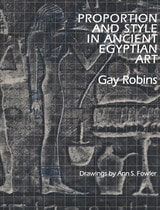
Proportion and Style in Ancient Egyptian Art
By Gay Robins
University of Texas Press, 1993
The painted and relief-cut walls of ancient Egyptian tombs and temples record an amazing continuity of customs and beliefs over nearly 3,000 years. Even the artistic style of the scenes seems unchanging, but this appearance is deceptive. In this work, Gay Robins offers convincing evidence, based on a study of Egyptian usage of grid systems and proportions, that innovation and stylistic variation played a significant role in ancient Egyptian art.
Robins thoroughly explores the squared grid systems used by the ancient artists to proportion standing, sitting, and kneeling human figures. This investigation yields the first chronological account of proportional variations in male and female figures from the Early Dynastic to the Ptolemaic periods. Robins discusses in detail the proportional changes underlying the revolutionary style instituted during the Amarna Period. She also considers how the grid system influenced the composition of scenes as a whole. Numerous line drawings with superimposed grids illustrate the text.
Scale
Edited by Jennifer L. Roberts
Terra Foundation for American Art, 2016
Scale is the second volume in the Terra Foundation Essays series. With eighty color illustrations and a wealth of new research from Glenn Adamson, Wendy Bellion, Wouter Davidts, Darcy Grimaldo Grigsby, Christopher P. Heuer, Joshua G. Stein, and Jason Weems, it explores viewers’ physical relationship to Barnett Newman’s abstract canvases, the arduous engineering behind the creation of Mount Rushmore, and the charged significance of liberty poles in the landscape of eighteenth-century New York, among other topics that range from studies of specific works of art to significant conceptual and theoretical concerns.
The Objective Eye
Color, Form, and Reality in the Theory of ArtJohn Hyman
University of Chicago Press, 2006
This, in a nutshell, is the central problem in the theory of art. It has fascinated philosophers from Plato to Wittgenstein. And it fascinates artists and art historians, who have always drawn extensively on philosophical ideas about language and representation, and on ideas about vision and the visible world that have deep philosophical roots.
John Hyman’s The Objective Eye is a radical treatment of this problem, deeply informed by the history of philosophy and science, but entirely fresh. The questions tackled here are fundamental ones: Is our experience of color an illusion? How does the metaphysical status of colors differ from that of shapes? What is the difference between a picture and a written text? Why are some pictures said to be more realistic than others? Is it because they are especially truthful or, on the contrary, because they deceive the eye?
The Objective Eye explores the fundamental concepts we use constantly in our most innocent thoughts and conversations about art, as well as in the most sophisticated art theory. The book progresses from pure philosophy to applied philosophy and ranges from the metaphysics of color to Renaissance perspective, from anatomy in ancient Greece to impressionism in nineteenth-century France. Philosophers, art historians, and students of the arts will find The Objective Eye challenging and absorbing.
Theory of Seeing
Wladyslaw Strzeminski
University of Minnesota Press, 2025
The first English translation of a radical and influential theory of art by a leader of Poland’s avant-garde
After World War II, socialist realism became the official state doctrine of art in Poland, with abstract works deemed counterrevolutionary and forbidden from public view. Władysław Strzemiński, a leader of the Polish constructivist avant-garde, developed a treatise of visual consciousness as a foundation for progressive art, emphasizing art’s autonomy. His application of Marxist aesthetics to the physiology of seeing is expressed in Theory of Seeing, which was published posthumously in 1958 by his students from notes collected from his lectures.
Preceding the comparable perspectives developed by Jacques Rancière, David Hockney, and John Berger, and even the cinema of Jean-Luc Godard, Strzemiński’s Theory of Seeing introduces the radical and groundbreaking ideas of one of Poland’s most important artists to English-speaking audiences for the first time.