Results by title
23 books match the query 'Composition (Language arts)'
(Re)Considering What We Know
Learning Thresholds in Writing, Composition, Rhetoric, and LiteracyLinda Adler-Kassner
Utah State University Press, 2019
Part 1 raises questions about the ideologies of consensus that are associated with naming threshold concepts of a discipline. Contributions challenge the idea of consensus and seek to expand both the threshold concepts framework and the concepts themselves. Part 2 focuses on threshold concepts in action and practice, demonstrating the innovative ways threshold concepts and a threshold concepts framework have been used in writing courses and programs. Part 3 shows how a threshold concepts framework can help us engage in conversations beyond writing studies.
(Re)Considering What We Know raises new questions and offers new ideas that can help to advance the discussion and use of threshold concepts in the field of writing studies. It will be of great interest to scholars and graduate students in writing studies, especially those who have previously engaged with Naming What We Know.
Contributors:
Marianne Ahokas, Jonathan Alexander, Chris M. Anson, Ian G. Anson, Sarah Ben-Zvi, Jami Blaauw-Hara, Mark Blaauw-Hara, Maggie Black, Dominic Borowiak, Chris Castillo, Chen Chen, Sandra Descourtis, Norbert Elliot, Heidi Estrem, Alison Farrell, Matthew Fogarty, Joanne Baird Giordano, James Hammond, Holly Hassel, Lauren Heap, Jennifer Heinert, Doug Hesse, Jonathan Isaac, Katie Kalish, Páraic Kerrigan, Ann Meejung Kim, Kassia Krzus-Shaw, Saul Lopez, Jennifer Helane Maher, Aishah Mahmood, Aimee Mapes, Kerry Marsden, Susan Miller-Cochran, Deborah Mutnick, Rebecca Nowacek, Sarah O’Brien, Ọlá Ọládipọ̀, Peggy O’Neill, Cassandra Phillips, Mya Poe, Patricia Ratanapraphart, Jacqueline Rhodes, Samitha Senanayake, Susan E. Shadle, Dawn Shepherd, Katherine Stein, Patrick Sullivan, Brenna Swift, Carrie Strand Tebeau, Matt Thul, Nikhil Tiwari, Lisa Tremain, Lisa Velarde, Kate Vieira, Gordon Blaine West, Anne-Marie Womack, Kathleen Blake Yancey, Xiaopei Yang, Madylan Yarc
Abducting Writing Studies
Edited by Sidney I. Dobrin and Kyle Jensen
Southern Illinois University Press, 2017
Each of the twelve essays that comprise this collection sparks new insights about the phenomenon of writing. A must-read for rhetoric and composition scholars and students, Abducting Writing Studies is sure to foster vibrant discussions about what is possible in writing research and instruction.
Centros y Programas de Escritura en América Latina
Opciones teóricas y pedagógicas para la enseñanza de la escritura disciplinarEstela Inés Moyano
University Press of Colorado, 2023
Composition, Rhetoric, and Disciplinarity
Rita Malenczyk
Utah State University Press, 2018
Edited by four nationally recognized leaders of composition scholarship, Composition, Rhetoric, and Disciplinarity asks a fundamental question: can Composition and Rhetoric, as a discipline, continue its historical commitment to pedagogy without sacrificing equal attention to other areas, such as research and theory? In response, contributors to the volume address disagreements about what it means to be called a discipline rather than a profession or a field; elucidate tensions over the defined breadth of Composition and Rhetoric; and consider the roles of research and responsibility as Composition and Rhetoric shifts from field to discipline.
Outlining a field with a complex and unusual formation story, Composition, Rhetoric, and Disciplinarity employs several lenses for understanding disciplinarity—theory, history, labor, and pedagogy—and for teasing out the implications of disciplinarity for students, faculty, institutions, and Composition and Rhetoric itself. Collectively, the chapters speak to the intellectual and embodied history leading to this point; to questions about how disciplinarity is, and might be, understood, especially with regard to Composition and Rhetoric; to the curricular, conceptual, labor, and other sites of tension inherent in thinking about Composition and Rhetoric as a discipline; and to the implications of Composition and Rhetoric’s disciplinarity for the future.
Contributors: Linda Adler-Kassner, Elizabeth H. Boquet, Christiane Donahue, Whitney Douglas, Doug Downs, Heidi Estrem, Kristine Hansen, Doug Hesse, Sandra Jamieson, Neal Lerner, Jennifer Helene Maher, Barry Maid, Jaime Armin Mejía, Carolyn R. Miller, Kelly Myers, Gwendolynne Reid, Liane Robertson, Rochelle Rodrigo, Dawn Shepherd, Kara Taczak
Conceding Composition
A Crooked History of Composition's Institutional FortunesRyan Skinnell
Utah State University Press, 2016
Based on extensive archival research conducted at six American universities and using the specific cases of institutional mission, regional accreditation, and federal funding, this study demonstrates that administrators and faculty have introduced, reformed, maintained, threatened, or eliminated composition as part of negotiations related to nondisciplinary institutional exigencies. Viewing composition from this perspective, author Ryan Skinnell raises new questions about why composition exists in the university, how it exists, and how teachers and scholars might productively reconceive first-year composition in light of its institutional functions.
The book considers the rhetorical, political, organizational, institutional, and promotional options conceding composition opened up for institutions of higher education and considers what the first-year course and the discipline might look like with composition’s transience reimagined not as a barrier but as a consummate institutional value.
Conceptions of Literacy
Graduate Instructors and the Teaching of First-Year CompositionMeaghan Brewer
Utah State University Press, 2020
Brewer argues that conceptions of literacy undergird the work of writing instructors and that many of the anxieties around composition studies’ disciplinary status are related to the differences perceived between the field’s conceptions of literacy and those of the graduate instructors and adjuncts who teach the majority of composition courses. Conceptions of Literacy makes practical recommendations for how new graduate instructors can begin to perceive and interrogate their conceptions of literacy, which, while influential, are often too personal to recognize.
Distant Readings of Disciplinarity
Knowing and Doing in Composition/Rhetoric Dissertationsby Benjamin Miller
Utah State University Press, 2022
Writing studies has long been marked by a multitude of methods and interlocking purposes, partaking of not just humanities approaches but also social scientific ones, with data drawn from interviews and surveys alongside historical and philosophical arguments and with corpus analytics in large-scale collections jostling against small-scale case studies of individuals. These areas of study aren’t always cleanly separable; shifting modes mark the discipline as open and welcoming to many different angles of research. The field needs to embrace that vantage point and generate new degrees of familiarity with methods beyond those of any individual scholar.
Not only a training genre and not only a knowledge-making genre, the dissertation is also a discipline-producing genre. Illustrating what the field has been studying, and how, Distant Readings of Disciplinarity supports more fruitful collaborations within and across research areas and methods.
Early Holistic Scoring of Writing
A Theory, a History, a ReflectionRichard Haswell
Utah State University Press, 2019
Early Holistic Scoring of Writing addresses the history of holistic essay assessment in the United Kingdom and the United States from the mid-1930s to the mid-1980s—and newly conceptualizes holistic scoring by philosophically and reflectively reinterpreting the genre’s origin, development, and significance.
The book chronicles holistic scoring from its initial origin in the United Kingdom to the beginning of its heyday in the United States. Chapters cover little-known history, from the holistic scoring of school certificate examination essays written by Blitz evacuee children in Devon during WWII to teacher adaptations of holistic scoring in California schools during the 1970s. Chapters detail the complications, challenges, and successes of holistic scoring from British high-stakes admissions examinations to foundational pedagogical research by Bay Area Writing Project scholars. The book concludes with lessons learned, providing a guide for continued efforts to assess student writing through evidence models.
Exploring the possibility of actionable history, Early Holistic Scoring of Writing reconceptualizes writing assessment. Here is a new history that retells the origins of our present body of knowledge in writing studies.
Literacy, Economy, and Power
Writing and Research after "Literacy in American Lives"Edited by John Duffy, Julie Nelson Christoph, Eli Goldblatt, Nelson Graff, Rebecca S. Nowacek, Bryan Trabold
Southern Illinois University Press, 2014
Following on the groundbreaking contributions of Deborah Brandt’s Literacy in American Lives—a literacy ethnography exploring how ordinary Americans have been affected by changes in literacy, public education, and structures of power—Literacy, Economy, and Power expands Brandt’s vision, exploring the relevance of her theoretical framework as it relates to literacy practices in a variety of current and historical contexts, as well as in literacy’s expanding and global future. Bringing together scholars from rhetoric, composition, and literacy studies, the book offers thirteen engrossing essays that extend and challenge Brandt’s commentary on the dynamics between literacy and power.
The essays cover many topics, including the editor of the first Native American newspaper, the role of a native Hawaiian in bringing literacy to his home islands, the influence of convents and academies on nineteenth-century literacy, and the future of globalized digital literacies. Contributors include Julie Nelson Christoph, Ellen Cushman, Kim Donehower, Anne Ruggles Gere, Eli Goldblatt, Harvey J. Graff, Gail E. Hawisher, Bruce Horner, David A. Jolliffe, Rhea Estelle Lathan, Min-Zhan Lu, Robyn Lyons-Robinson, Carol Mattingly, Beverly J. Moss, Paul Prior, Cynthia L. Selfe, Michael W. Smith, and Morris Young. Literacy, Economy, and Power also features an introduction exploring the scholarly impact of Brandt’s work, written by editors John Duffy, Julie Nelson Christoph, Eli Goldblatt, Nelson Graff, Rebecca Nowacek, and Bryan Trabold. An invaluable tool for literacy studies at the graduate or professional level, Literacy, Economy, and Power provides readers with a wide-ranging view of the work being done in literacy studies today and points to ways researchers might approach the study of literacy in the future.
Peer Response in Second Language Writing Classrooms
Jun Liu and Jette G. Hansen
University of Michigan Press, 2002
Peer Response in Second Language Writing Classrooms, Second Edition
Jun Liu and Jette G. Hansen Edwards
University of Michigan Press, 2018
Now that classes are as likely to be online as held in physical classrooms and now that a new generation of digital natives can routinely read and respond to what others write via laptops, tablets, and phones, peer response as pedagogical practice is not just more easily implemented, but it is more likely to feel natural to L2 learners.
The Second Edition is a highly accessible guide to how the world is using peer response and serves as a motivator and facilitator for those who want to try it for the first time or want to increase the effectiveness of the activities—whether via CMC or not. The volume includes 11 forms useful in training students to provide good peer feedback, including a final checklist to ensure teachers have taken all the necessary steps to achieve a successful peer feedback activity.
Reformers, Teachers, Writers
Curricular and Pedagogical InquiriesNeal Lerner
Utah State University Press, 2019
Lerner’s mixed-methods approach—quantitative, qualitative, textual, historical, narrative, and theoretical—reflects the importance and effects of curriculum in a wide variety of settings, whether in writing centers, writing classrooms, or students’ out-of-school lives, as well as the many methodological approaches available to understand curriculum in writing studies. The richness of this approach allows for multiple considerations of the distinction and relationship between pedagogy and curriculum. Chapters are grouped into three parts: disciplinary inquiries, experiential inquiries, and empirical inquiries, exploring the presence and effect of curriculum and its relationship to pedagogy in multiple sites, both historical and contemporary, and for multiple stakeholders.
Reformers, Teachers, Writers calls out writing studies’ inattention to curriculum, which hampers efforts to enact meaningful reform and to have an impact on larger conversations about education and writing. The book will be invaluable to scholars, teachers, and administrators interested in rhetoric and composition, writing studies, and education.
Rhetoric and Writing Studies in the New Century
Historiography, Pedagogy, and PoliticsEdited by Cheryl Glenn and Roxanne Mountford
Southern Illinois University Press, 2017
Securing a Place for Reading in Composition
The Importance of Teaching for TransferEllen C. Carillo
Utah State University Press, 2014
Securing a Place for Reading in Composition addresses the dissonance between the need to prepare students to read, not just write, complex texts and the lack of recent scholarship on reading-writing connections. Author Ellen C. Carillo argues that including attention-to-reading practices is crucial for developing more comprehensive literacy pedagogies. Students who can read actively and reflectively will be able to work successfully with the range of complex texts they will encounter throughout their post-secondary academic careers and beyond.
Considering the role of reading within composition from both historical and contemporary perspectives, Carillo makes recommendations for the productive integration of reading instruction into first-year writing courses. She details a “mindful reading” framework wherein instructors help students cultivate a repertoire of approaches upon which they consistently reflect as they apply them to various texts. This metacognitive frame allows students to become knowledgeable and deliberate about how they read and gives them the opportunity to develop the skills useful for moving among reading approaches in mindful ways, thus preparing them to actively and productively read in courses and contexts outside first-year composition.
Securing a Place for Reading in Composition also explores how the field of composition might begin to effectively address reading, including conducting research on reading, revising outcome statements, and revisiting the core courses in graduate programs. It will be of great interest to writing program administrators and other compositionists and their graduate students.
Situating Writing Processes
Physicality, Improvisation, and the Teaching of WritingHannah Rule
University Press of Colorado, 2020
Sixteen Teachers Teaching
Two-Year College PerspectivesPatrick Sullivan
Utah State University Press, 2020
All of these teachers have spent their careers teaching multiple sections of writing classes each semester or term, so this book presents readers with an impressive—and perhaps unprecedented—abundance of pedagogical expertise, teaching knowledge, and classroom experience. Sixteen Teachers Teaching is a book filled with joyfulness, wisdom, and pragmatic advice. It has been designed to be a source of inspiration for high school and college English teachers as they go about their daily work in the classroom.
Contributors: Peter Adams, Jeff Andelora, Helane Adams Androne, Taiyon J. Coleman, Renee DeLong, Kathleen Sheerin DeVore, Jamey Gallagher, Shannon Gibney, Joanne Baird Giordano, Brett Griffiths, Holly Hassel, Darin Jensen, Jeff Klausman, Michael C. Kuhne, Hope Parisi, and Howard Tinberg

Talking Back
Senior Scholars and Their Colleagues Deliberate the Past, Present, and Future of Writing StudiesNorbert Elliot
Utah State University Press, 2020
In Talking Back, a veritable Who’s Who of writing studies scholars deliberate on intellectual traditions, current practices, and important directions for the future. In response, junior and mid-career scholars reflect on each chapter with thoughtful and measured moves forward into the contemporary environment of research, teaching, and service. Each of the prestigious chapter authors in the volume has three common traits: a sense of responsibility for advancing the profession, a passion for programs of research dedicated to advancing opportunities for others, and a reflective sense of their work accompanied by humility for their contributions. As a documentary, Talking Back is the first history of writing studies in autobiography.
Contributors: Jo Allen, Ann N. Amicucci, Akua Duku Anokye, Paige Davis Arrington, Doug Baldwin, John C. Brereton, Judy Buchanan, Hugh Burns, Leasa Burton, Ellen C. Carillo, William Condon, Dylan B. Dryer, Michelle F. Eble, Jennifer Enoch, Joan Feinberg, Patricia Friedrich, Cinthia Gannett, Eli Goldblatt, Shenika Hankerson, Janis Haswell, Richard Haswell, Eric Heltzel, Douglas Hesse, Bruce Horner, Alice S. Horning, Asao B. Inoue, Ruth Ray Karpen, Suzanne Lane, Min-Zhan Lu, Donald McQuade, Elisabeth L. Miller, Rebecca Williams Mlynarczyk, Sean Molloy, Les Perelman, Louise Wetherbee Phelps, Stacey Pigg, Sherry Rankins-Robertson, Jessica Restaino, J. Michael Rifenburg, Eliana Schonberg, Geneva Smitherman, Richard Sterling, Katherine E. Tirabassi, Devon Tomasulo, Martha A. Townsend, Mike Truong, Victor Villanueva, Edward M. White, Anne Elrod Whitney, Kathleen Blake Yancey
Thinking Globally, Composing Locally
Rethinking Online Writing in the Age of the Global InternetRich Rice
Utah State University Press, 2018
Thinking Globally, Composing Locally explores how writing and its pedagogy should adapt to the ever-expanding environment of international online communication. Communication to a global audience presents a number of new challenges; writers seeking to connect with individuals from many different cultures must rethink their concept of audience. They must also prepare to address friction that may arise from cross-cultural rhetorical situations, variation in available technology and in access between interlocutors, and disparate legal environments.
The volume offers a pedagogical framework that addresses three interconnected and overarching objectives: using online media to contact audiences from other cultures to share ideas; presenting ideas in a manner that invites audiences from other cultures to recognize, understand, and convey or act upon them; and composing ideas to connect with global audiences to engage in ongoing and meaningful exchanges via online media. Chapters explore a diverse range of pedagogical techniques, including digital notebooks designed to create a space for active dialogic and multicultural inquiry, experience mapping to identify communication disruption points in international customer service, and online forums used in global distance education.
Thinking Globally, Composing Locally will prove an invaluable resource for instructors seeking to address the many exigencies of online writing situations in global environments.
Contributors: Suzanne Blum Malley, Katherine Bridgman, Maury Elizabeth Brown, Kaitlin Clinnin, Cynthia Davidson, Susan Delagrange, Scott Lloyd Dewitt, Amber Engelson, Kay Halasek, Lavinia Hirsu, Daniel Hocutt, Vassiliki Kourbani, Tika Lamsal, Liz Lane, Ben Lauren, J. C. Lee, Ben McCorkle, Jen Michaels, Minh-Tam Nguyen, Beau S. Pihlaja, Mª Pilar Milagros, Cynthia L. Selfe, Heather Turner, Don Unger, Josephine Walwema
Threshold Conscripts
Rhetoric and Composition Teaching AssistantshipsWilliam J. Macauley
University Press of Colorado, 2023
Transient Literacies in Action
Composing with the Mobile SurroundStacey Pigg
University Press of Colorado, 2020
Women's Professional Lives in Rhetoric and Composition
Choice, Chance, and SerendipityEdited by Elizabeth A. Flynn and Tiffany Bourelle
The Ohio State University Press, 2018
This collection, edited by Elizabeth A. Flynn and Tiffany Bourelle, contributes to the valuable work of chronicling the professional and personal lives of women in academia. Through its line-up of contributors from diverse backgrounds, locations, and career paths, Women’s Professional Lives in Rhetoric and Composition showcases the voices of multiple scholars occupying a multitude of different roles in the profession: from prestigious professors emeritae and endowed chairs to assistant professors starting their careers to an independent scholar to part-time faculty.
The collection sets itself apart from other volumes not just in its diversity of perspectives but also by speaking against linear stories of success in the profession—sharing moments of shame and failure, showing how the personal and professional often intertwine and influence one another, and ultimately revealing how choice, chance, serendipity, and kairos have all played a role in the lives of its contributors. In focusing on this convergence, Women’s Professional Lives in Rhetoric and Composition offers a more nuanced picture of the professional and intellectual trajectories of women in rhetoric and composition.
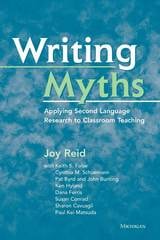
Writing Myths
Applying Second Language Research to Classroom TeachingJoy Reid with Keith S. Folse, Cynthia M. Schuemann, Pat Byrd and John Bunting, Ken Hyland, Dana Ferris, Susan Conrad, Sharon Cavusgil, Paul Kei Matsuda
University of Michigan Press, 2008
This volume was conceived as a "best practices" resource for writing teachers in the way that Vocabulary Myths by Keith S. Folse is one for reading and vocabulary teachers. It was written to help ensure that writing teachers are not perpetuating the myths of teaching writing.
Each author is a practicing teacher who selected his or her "myth" based on classroom experience and expertise. Both the research and pedagogy in this book are based on the newest research in, for example, teacher preparation, EAP and ESP, and corpus linguistics. The myths discussed in this book are:
§ Teaching vocabulary is not the writing teacher's job. (Keith S. Folse)
§ Teaching citation is someone else's job. (Cynthia M. Schuemann)
§ Where grammar is concerned, one size fits all. (Pat Byrd and John Bunting)
§ Academic writing should be assertive and certain. (Ken Hyland)
§ Students must learn to correct all their writing errors. (Dana Ferris)
§ Corpus-based research is too complicated to be useful for writing teachers. (Susan Conrad)
§ Academic writing courses should focus on paragraph and essay development. (Sharon Cavausgil)
§ International and U.S. resident ESL writers cannot be taught in the same class. (Paul Kei Matsuda)
The book concludes with a discussion of students' myths about academic writing and teaching written by Joy Reid.
Writing-Enriched Curricula
Models of Faculty-Driven and Departmental Transformationedited by Chris M. Anson, and Pamela Flash
University Press of Colorado, 2022