Results by title
5 books match the query 'Composition (Music)'
Band People
Life and Work in Popular MusicFranz Nicolay
University of Texas Press, 2024
A close look at the lives of working musicians who aren’t the center of their stage.
Secret (and not-so-secret) weapons, side-of-the-stagers, rhythm and horn sections, backup singers, accompanists—these and other “band people” are the anonymous but irreplaceable character actors of popular music. Through interviews and incisive cultural critique, writer and musician Franz Nicolay provides a portrait of the musical middle class. Artists talk frankly about their careers and attitudes toward their craft, work environment, and group dynamics, and shed light on how support musicians make sense of the weird combination of friend group, gang, small business consortium, long-term creative collaboration, and chosen family that constitutes a band. Is it more important to be a good hang or a virtuoso player? Do bands work best as democracies or autocracies? How do musicians with children balance their personal and professional lives? How much money is too little? And how does it feel to play on hundreds of records, with none released under your name? In exploring these and other questions, Band People gives voice to those who collaborate to create and dissects what it means to be a laborer in the culture industry.
Composing Music
A New ApproachWilliam Russo
University of Chicago Press, 1988
Composing Music is the perfect introduction to writing music of all sorts for engaged beginners.
Composing for the Jazz Orchestra
William Russo
University of Chicago Press, 1961
Gallus Dressler's Praecepta musicae poeticae
Gallus Dressler, New Critical Text, Translation, Annotations, and Indices by Robert Forgács
University of Illinois Press, 2007
Now available for the first time in English translation, this new edition of Gallus Dressler's Praecepta musicae poeticae corrects and expands upon earlier editions of one of the most important sixteenth-century treatments of musical theory and rhetoric. Robert Forgács’ detailed study of the Latin text reveals significant and original insights into the invention of fugues and the composition of opening, middle, and concluding sections. Forgács introduces the reader to Dressler's life and work and the design and sources of Praecepta musicae poeticae, places the treatise more fully in its humanist environment, presents additional classical sources for the text, and relates it to the work of Dressler’s contemporary music theorists. Copious annotations and indexes of words, names, and subjects place the treatise within the broader context of German theoretical discussion, the teaching and practice of music in the sixteenth century, and the musical life of the Lutheran Church.
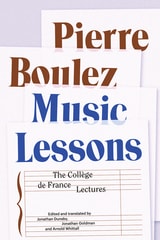
Music Lessons
The Collège de France LecturesPierre Boulez
University of Chicago Press, 2018
Music Lessons marks the first publication in English of Pierre Boulez’s Collège de France lectures, written while he held the chair of Invention, Technique and Language in Music at the Collège between 1976 and 1995. Representing Boulez’s most significant writings from the period, the lectures offer a sustained intellectual engagement with one of the dominant figures of twentieth-century music, a consummate composer-conductor who remained central to the conversation around contemporary music until his death in 2016. Boulez explores, among other topics, the process through which a musical idea is realized in a full-fledged composition, the complementary roles of craft and inspiration and the degree to which the memory of other musical works can influence and change the act of creation. Boulez also gives a penetrating account of problems in classical music that are still present today, such as the conservatism of a musical community fixated on the repertory of the past. Woven into the discussion are stories of his own compositions and those of fellow composers whose work he engaged with in his many roles as teacher, thinker, and conductor: from Stravinsky to Stockhausen and Varèse, from Bartók to Berg, Debussy to Mahler and Wagner, and all the way back to his beloved J. S. Bach.
Including a foreword by semiologist Jean-Jacques Nattiez, who was for years close to the composer, this edition is also enriched by an illuminating preface by Jonathan Goldman. With an authoritative translation retaining Boulez’s fierce convictions, cutting opinions and signature wit, Music Lessons is an essential and entertaining volume.