Results by title
2 books match the query 'Composition Rhetoric'
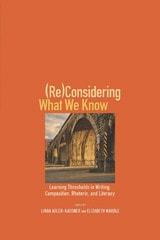
(Re)Considering What We Know
Learning Thresholds in Writing, Composition, Rhetoric, and LiteracyLinda Adler-Kassner
Utah State University Press, 2019
Part 1 raises questions about the ideologies of consensus that are associated with naming threshold concepts of a discipline. Contributions challenge the idea of consensus and seek to expand both the threshold concepts framework and the concepts themselves. Part 2 focuses on threshold concepts in action and practice, demonstrating the innovative ways threshold concepts and a threshold concepts framework have been used in writing courses and programs. Part 3 shows how a threshold concepts framework can help us engage in conversations beyond writing studies.
(Re)Considering What We Know raises new questions and offers new ideas that can help to advance the discussion and use of threshold concepts in the field of writing studies. It will be of great interest to scholars and graduate students in writing studies, especially those who have previously engaged with Naming What We Know.
Contributors:
Marianne Ahokas, Jonathan Alexander, Chris M. Anson, Ian G. Anson, Sarah Ben-Zvi, Jami Blaauw-Hara, Mark Blaauw-Hara, Maggie Black, Dominic Borowiak, Chris Castillo, Chen Chen, Sandra Descourtis, Norbert Elliot, Heidi Estrem, Alison Farrell, Matthew Fogarty, Joanne Baird Giordano, James Hammond, Holly Hassel, Lauren Heap, Jennifer Heinert, Doug Hesse, Jonathan Isaac, Katie Kalish, Páraic Kerrigan, Ann Meejung Kim, Kassia Krzus-Shaw, Saul Lopez, Jennifer Helane Maher, Aishah Mahmood, Aimee Mapes, Kerry Marsden, Susan Miller-Cochran, Deborah Mutnick, Rebecca Nowacek, Sarah O’Brien, Ọlá Ọládipọ̀, Peggy O’Neill, Cassandra Phillips, Mya Poe, Patricia Ratanapraphart, Jacqueline Rhodes, Samitha Senanayake, Susan E. Shadle, Dawn Shepherd, Katherine Stein, Patrick Sullivan, Brenna Swift, Carrie Strand Tebeau, Matt Thul, Nikhil Tiwari, Lisa Tremain, Lisa Velarde, Kate Vieira, Gordon Blaine West, Anne-Marie Womack, Kathleen Blake Yancey, Xiaopei Yang, Madylan Yarc
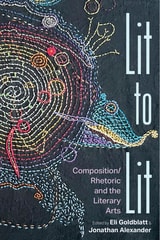
Lit to Lit
Composition/Rhetoric and the Literary ArtsEli Goldblatt
Utah State University Press, 2026
Lit to Lit examines the traditional split between the study of literature and composition and rhetoric programs, asking writing studies scholars to think critically and creatively about the role literature can play in the teaching of writing and the field’s conceptions of its own relation to writing. Grounded in diverse experiences and practices, contributors offer provocative but thoughtful analyses of how composition and literature can be brought together in the study and teaching of writing.
Complex forms of writing should not be the sole territory of one subfield or discipline but rather should benefit from multiple perspectives generated by those with keen and abiding interests in writing writ large. Many in the field of composition and rhetoric also have an active engagement in the literary arts, particularly the flowering of literature from diverse cultural experiences in the last decades. What new teaching and learning approaches could emerge from a synthesis of theoretical, literary, rhetorical, poetic, and compositional methods? This question becomes even more compelling when considering how English departments often house programs in journalism and creative writing, allowing robust opportunities for multiple ways of thinking about and studying complex texts.
Lit to Lit makes visible the generative overlap between subfields already present in the broad field of English, pointing to new ways forward that value each area’s separate endeavors while highlighting the possibilities for what could be built together.