Results by title
5 books match the query 'Computer art'
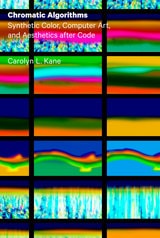
Chromatic Algorithms
Synthetic Color, Computer Art, and Aesthetics after CodeCarolyn L. Kane
University of Chicago Press, 2014
These days, we take for granted that our computer screens—and even our phones—will show us images in vibrant full color. Digital color is a fundamental part of how we use our devices, but we never give a thought to how it is produced or how it came about.
Chromatic Algorithms reveals the fascinating history behind digital color, tracing it from the work of a few brilliant computer scientists and experimentally minded artists in the late 1960s and early ‘70s through to its appearance in commercial software in the early 1990s. Mixing philosophy of technology, aesthetics, and media analysis, Carolyn Kane shows how revolutionary the earliest computer-generated colors were—built with the massive postwar number-crunching machines, these first examples of “computer art” were so fantastic that artists and computer scientists regarded them as psychedelic, even revolutionary, harbingers of a better future for humans and machines. But, Kane shows, the explosive growth of personal computing and its accompanying need for off-the-shelf software led to standardization and the gradual closing of the experimental field in which computer artists had thrived.
Even so, the gap between the bright, bold presence of color onscreen and the increasing abstraction of its underlying code continues to lure artists and designers from a wide range of fields, and Kane draws on their work to pose fascinating questions about the relationships among art, code, science, and media in the twenty-first century.
[more]

Computers and Art
Second EditionEdited by Stuart Mealing
Intellect Books, 2002
Computers and Art provides insightful perspectives on the use of the computer as a tool for artists. The approaches taken vary from its historical, philosophical and practical implications to the use of computer technology in art practice. The contributors include an art critic, an educator, a practising artist and a researcher. Mealing looks at the potential for future developments in the field, looking at both the artistic and the computational aspects of the field.
[more]
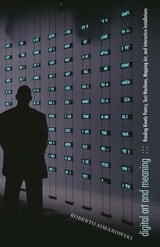
Digital Art and Meaning
Reading Kinetic Poetry, Text Machines, Mapping Art, and Interactive InstallationsRoberto Simanowski
University of Minnesota Press, 2010
In a world increasingly dominated by the digital, the critical response to digital art generally ranges from hype to counterhype. Popular writing about specific artworks seldom goes beyond promoting a given piece and explaining how it operates, while scholars and critics remain unsure about how to interpret and evaluate them. This is where Roberto Simanowski intervenes, demonstrating how such critical work can be done.
Digital Art and Meaning offers close readings of varied examples from genres of digital art such as kinetic concrete poetry, computer-generated text, interactive installation, mapping art, and information sculpture. For instance, Simanowski deciphers the complex meaning of words that not only form an image on a screen but also react to the viewer’s behavior; images that are progressively destroyed by the human gaze; text machines generating nonsense sentences out of a Kafka story; and a light show above Mexico City’s historic square, created by Internet users all over the world.
Simanowski combines these illuminating explanations with a theoretical discussion that employs art philosophy and history to achieve a deeper understanding of each particular example of digital art and, ultimately, of the genre as a whole.
[more]
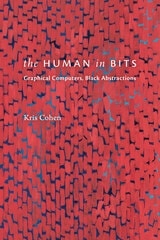
The Human in Bits
Graphical Computers, Black AbstractionsKris Cohen
Duke University Press, 2025
In The Human in Bits, Kris Cohen examines black abstractionist painting to demonstrate how race and computation are intimately entangled with the personal computer’s graphic user interface. He shows how the personal computer and the graphical field of its screen meant to transform the human by transforming what environments humans were to labor in. It also provided the means for whiteness to tie itself to notions of colorblind meritocracy. Cohen focuses on the post-1960s experiments of black abstractionists Alma Thomas, Jack Whitten, Charles Gaines, and Julie Mehretu, who developed a nonrepresentational approach to blackness that was oriented more toward constraint than human expression. From Gaines’s use of grids to Mehretu’s layering of paint, these artists—in their knowledge that black life had always been conflated with numbers and bits of information—flirted with repetition, systems, and formulas to test other ways of being human. By demonstrating how these artists bypassed the white fear that the human would become interchangeable with data, Cohen reframes modernism and modernist art to account for racialization in computational cultures.
[more]
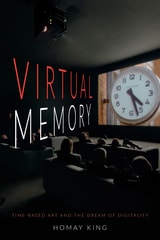
Virtual Memory
Time-Based Art and the Dream of DigitalityHomay King
Duke University Press, 2015
In Virtual Memory, Homay King traces the concept of the virtual through the philosophical works of Henri Bergson, Gilles Deleuze, and Giorgio Agamben to offer a new framework for thinking about film, video, and time-based contemporary art. Detaching the virtual from its contemporary associations with digitality, technology, simulation, and speed, King shows that using its original meaning—which denotes a potential on the cusp of becoming—provides the means to reveal the "analog" elements in contemporary digital art. Through a queer reading of the life and work of mathematician Alan Turing, and analyses of artists who use digital technologies such as Christian Marclay, Agnès Varda, and Victor Burgin, King destabilizes the analog/digital binary. By treating the virtual as the expression of powers of potential and change and of historical contingency, King explains how these artists transcend distinctions between disembodiment and materiality, abstraction and tangibility, and the unworldly and the earth-bound. In so doing, she shows how their art speaks to durational and limit-bound experience more than contemporary understandings of the virtual and digital would suggest.
[more]