Results by title
6 books match the query 'Computer programming'

60 Ready-to-Use Coding Projects
Ellyssa Kroski
American Library Association, 2020
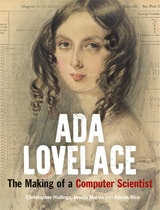
Ada Lovelace
The Making of a Computer ScientistChristopher Hollings, Ursula Martin and Adrian Rice
Bodleian Library Publishing, 2018
Although it was an unusual pursuit for women at the time, Ada Lovelace studied science and mathematics from a young age. This book uses previously unpublished archival material to explore her precocious childhood—from her curiosity about the science of rainbows to her design for a steam-powered flying horse—as well as her ambitious young adulthood. Active in Victorian London’s social and scientific elite alongside Mary Somerville, Michael Faraday, and Charles Dickens, Ada Lovelace became fascinated by the computing machines of Charles Babbage, whose ambitious, unbuilt invention known as the “Analytical Engine” inspired Lovelace to devise a table of mathematical formulae which many now refer to as the “first program.”
Ada Lovelace died at just thirty-six, but her work strikes a chord to this day, offering clear explanations of the principles of computing, and exploring ideas about computer music and artificial intelligence that have been realized in modern digital computers. Featuring detailed illustrations of the “first program” alongside mathematical models, correspondence, and contemporary images, this book shows how Ada Lovelace, with astonishing prescience, first investigated the key mathematical questions behind the principles of modern computing.
Language and the Rise of the Algorithm
Jeffrey M. Binder
University of Chicago Press, 2022
A wide-ranging history of the algorithm.
Bringing together the histories of mathematics, computer science, and linguistic thought, Language and the Rise of the Algorithm reveals how recent developments in artificial intelligence are reopening an issue that troubled mathematicians well before the computer age: How do you draw the line between computational rules and the complexities of making systems comprehensible to people? By attending to this question, we come to see that the modern idea of the algorithm is implicated in a long history of attempts to maintain a disciplinary boundary separating technical knowledge from the languages people speak day to day.
Here, Jeffrey M. Binder offers a compelling tour of four visions of universal computation that addressed this issue in very different ways: G. W. Leibniz’s calculus ratiocinator; a universal algebra scheme Nicolas de Condorcet designed during the French Revolution; George Boole’s nineteenth-century logic system; and the early programming language ALGOL, short for algorithmic language. These episodes show that symbolic computation has repeatedly become entangled in debates about the nature of communication. Machine learning, in its increasing dependence on words, erodes the line between technical and everyday language, revealing the urgent stakes underlying this boundary.
The idea of the algorithm is a levee holding back the social complexity of language, and it is about to break. This book is about the flood that inspired its construction.
Literate Programming
Donald E. Knuth
CSLI, 1992
This volume is first in a series of Knuth's collected works.

Managing Complexity in Software Engineering
R.J. Mitchell
The Institution of Engineering and Technology, 1990
Éléments pour une histoire de l'informatique
Donald E. Knuth
CSLI, 2011
This translation focuses on publications by Donald E. Knuth, one of the world’s leading computer programmers, that were addressed primarily to a general audience rather than to specialists. These fifteen papers discuss the history of computer science from ancient Babylon to modern times and survey the field of computer science and the nature of algorithms.