Results by title
5 books match the query 'Computer software'
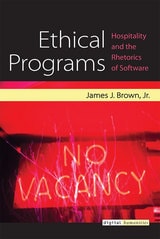
Ethical Programs
Hospitality and the Rhetorics of SoftwareJames J. Brown, Jr.
University of Michigan Press, 2015
Living in a networked world means never really getting to decide in any thoroughgoing way who or what enters your “space” (your laptop, your iPhone, your thermostat . . . your home). With this as a basic frame-of-reference, James J. Brown’s Ethical Programs examines and explores the rhetorical potential and problems of a hospitality ethos suited to a new era of hosts and guests. Brown reads a range of computational strategies and actors including the general principles underwriting the Transmission Control Protocol (TCP), which determines how packets of information can travel through the internet, to the Obama election campaign’s use of the power of protocols to reach voters, harvest their data, incentivize and, ultimately, shape their participation in the campaign. In demonstrating the kind of rhetorical spaces networked software establishes and the access it permits, prevents, and molds, Brown makes a major contribution to the emergent discourse of software studies as a major component of efforts in broad fields including media studies, rhetorical studies, and cultural studies.
[more]
From Russia with Code
Programming Migrations in Post-Soviet TimesMario Biagioli and Vincent Antonin Lepinay, editors
Duke University Press, 2019
While Russian computer scientists are notorious for their interference in the 2016 US presidential election, they are ubiquitous on Wall Street and coveted by international IT firms and often perceive themselves as the present manifestation of the past glory of Soviet scientific prowess. Drawing on over three hundred in-depth interviews, the contributors to From Russia with Code trace the practices, education, careers, networks, migrations, and lives of Russian IT professionals at home and abroad, showing how they function as key figures in the tense political and ideological environment of technological innovation in post-Soviet Russia. Among other topics, they analyze coders' creation of both transnational communities and local networks of political activists; Moscow's use of IT funding to control peripheral regions; brain drain and the experiences of coders living abroad in the United Kingdom, United States, Israel, and Finland; and the possible meanings of Russian computing systems in a heterogeneous nation and industry. Highlighting the centrality of computer scientists to post-Soviet economic mobilization in Russia, the contributors offer new insights into the difficulties through which a new entrepreneurial culture emerges in a rapidly changing world.
Contributors. Irina Antoschyuk, Mario Biagioli, Ksenia Ermoshina, Marina Fedorova, Andrey Indukaev, Alina Kontareva, Diana Kurkovsky, Vincent Lépinay, Alexandra Masalskaya, Daria Savchenko, Liubava Shatokhina, Alexandra Simonova, Ksenia Tatarchenko, Zinaida Vasilyeva, Dimitrii Zhikharevich
Contributors. Irina Antoschyuk, Mario Biagioli, Ksenia Ermoshina, Marina Fedorova, Andrey Indukaev, Alina Kontareva, Diana Kurkovsky, Vincent Lépinay, Alexandra Masalskaya, Daria Savchenko, Liubava Shatokhina, Alexandra Simonova, Ksenia Tatarchenko, Zinaida Vasilyeva, Dimitrii Zhikharevich
[more]

Industrial Software Technology
R.J. Mitchell
The Institution of Engineering and Technology, 1987
A number of interrelated developments are changing the nature of software technology. Developments in hardware are putting greatly increased power at the disposal of the software technologist. Advances in formal methods are providing the means to bring greater precision into the early stages of system development. Techniques such as expert systems are being brought into the domain of software technology as a result of advances in the application of artificial intelligence research. Developments in paradigms of system development are giving the software technologist better models of system structure and better tools and techniques for creating large systems, and greater political recognition of the importance of information technology is resulting in increased funding for research and development in software technology.
[more]
Managing Complexity in Software Engineering
R.J. Mitchell
The Institution of Engineering and Technology, 1990
Software engineering products are becoming ever more complex, because software is being used in the solution of more technically difficult problems and because the size of software projects continues to grow. A key question for software engineers is how to cope with this complexity. There is no single answer, and software engineers must attack the problem from a number of perspectives. A technical perspective reveals new paradigms for system development, including two paradigms that show particular promise: object-oriented design and formal methods. A management perspective recognises that good project management is vital to the success of a complex project. The scale of modern projects makes it essential to use automated support, so software engineers must also look at how to manage complexity from an automation perspective. Automated support can come in the form of discrete tools for particular tasks, or a packaged set of tools in a support environment.
[more]
Model-Based Requirements Engineering
Jon Holt
The Institution of Engineering and Technology, 2011
This book provides a hands-on introduction to model-based requirements engineering and management by describing a set of views that form the basis for the approach. These views take into account each individual requirement in terms of its description, but then also provide each requirement with meaning by putting it into the correct 'context'. A requirement that has been put into a context is known as a 'use case' and may be based upon either stakeholders or levels of hierarchy in a system. Each use case must then be analysed and validated by defining a combination of scenarios and formal mathematical and logic-based proofs that provide the rigour required for safety-critical and mission-critical systems.
[more]