Results by title
8 books match the query 'Computer vision'
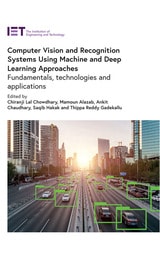
Computer Vision and Recognition Systems Using Machine and Deep Learning Approaches
Fundamentals, technologies and applicationsChiranji Lal Chowdhary
The Institution of Engineering and Technology, 2021

Ground Truth
Art History and the Invention of Computer VisionElizabeth C. Mansfield
University of Minnesota Press, 2027
An in-depth examination of how computer vision in AI is indebted to artistic ideals from the Enlightenment
When Dutch megabank ING launched a 2016 advertising campaign spearheaded by an AI-generated “next Rembrandt,” it demonstrated just how deeply Western assumptions about the history of art had infiltrated fledgling artificial intelligence technologies. Working backward from this computer-generated Old Master painting, Elizabeth C. Mansfield traces the history of computer vision (the branch of AI research concerned with visual perception, recognition, and design) back to Enlightenment fantasies of intelligent machines and artistic automata.
Through her inquiry in eighteenth-century European fascination with art-making machines, Mansfield connects centuries-old automata to contemporary AI systems like DALL-E and Midjourney, showing how the history of art abides as a ghost in the machine of computer vision. She documents the artistic ambitions, aesthetic experiments, commercial pressures, and crises of authenticity that occur during the development of a technology designed to emulate aspects of human visual perception.
An innovative art historical response to computer vision, Ground Truth offers important new directions for a renewed engagement with art’s humanist and digital generation history. At a time when the humanist enterprise is being questioned, Mansfield makes the different worlds of art history and computer vision mutually intelligible in this compelling account of both.
Retail e-book files for this title are screen-reader friendly with images accompanied by short alt text and/or extended descriptions.

Intelligent Distributed Video Surveillance Systems
Sergio A. Velastin
The Institution of Engineering and Technology, 2006

Intelligent Multimedia Processing and Computer Vision
Techniques and applicationsShyam Singh Rajput
The Institution of Engineering and Technology, 2023

Machine Learning in Medical Imaging and Computer Vision
Amita Nandal
The Institution of Engineering and Technology, 2024
Seeing the Past with Computers
Experiments with Augmented Reality and Computer Vision for HistoryKevin Kee and Timothy Compeau, Editors
University of Michigan Press, 2019
Seeing the Past with Computers is a collection of twelve thought-pieces on the current and potential uses of augmented reality and computer vision in historical research, teaching, and presentation. The experts gathered here reflect upon their experiences working with new technologies, share their ideas for best practices, and assess the implications of—and imagine future possibilities for—new methods of historical study. Among the experimental topics they explore are the use of augmented reality that empowers students to challenge the presentation of historical material in their textbooks; the application of seeing computers to unlock unusual cultural knowledge, such as the secrets of vaudevillian stage magic; hacking facial recognition technology to reveal victims of racism in a century-old Australian archive; and rebuilding the soundscape of an Iron Age village with aural augmented reality.
This volume is a valuable resource for scholars and students of history and the digital humanities more broadly. It will inspire them to apply innovative methods to open new paths for conducting and sharing their own research.
The Birth of Computer Vision
James E. Dobson
University of Minnesota Press, 2023
A revealing genealogy of image-recognition techniques and technologies
Today’s most advanced neural networks and sophisticated image-analysis methods come from 1950s and ’60s Cold War culture—and many biases and ways of understanding the world from that era persist along with them. Aerial surveillance and reconnaissance shaped all of the technologies that we now refer to as computer vision, including facial recognition. The Birth of Computer Vision uncovers these histories and finds connections between the algorithms, people, and politics at the core of automating perception today.
James E. Dobson reveals how new forms of computerized surveillance systems, high-tech policing, and automated decision-making systems have become entangled, functioning together as a new technological apparatus of social control. Tracing the development of a series of important computer-vision algorithms, he uncovers the ideas, worrisome military origins, and lingering goals reproduced within the code and the products based on it, examining how they became linked to one another and repurposed for domestic and commercial uses. Dobson includes analysis of the Shakey Project, which produced the first semi-autonomous robot, and the impact of student protest in the early 1970s at Stanford University, as well as recovering the computer vision–related aspects of Frank Rosenblatt’s Perceptron as the crucial link between machine learning and computer vision.
Motivated by the ongoing use of these major algorithms and methods, The Birth of Computer Vision chronicles the foundations of computer vision and artificial intelligence, its major transformations, and the questionable legacy of its origins.
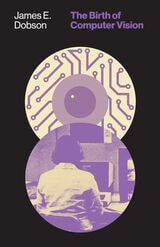
Cover alt text: Two overlapping circles in cream and violet, with black background. Top is a printed circuit with camera eye; below a person at a 1977 computer.
Vector Media
Leonardo Impett
University of Minnesota Press, 2026
Dispelling the notion of “generative” AI
Neural networks are designed to dissolve all media into the vector space—a universal space of commensurability. In Vector Media, Leonardo Impett and Fabian Offert parse theories of automatic vision to trace contemporary artificial intelligence’s technical ideology of epistemic reduction, where sensory data is turned into abstracted forms of meaning. Under this regime, bias is not just a question of what is represented but of the logic of representation itself. Drawing on Phil Agre’s notion of a critical technical practice, Vector Media reveals how artificial intelligence systems embed new epistemologies of media beneath the surface of their architectures.
Analyzing the techniques underpinning large multimodal artificial intelligence models like DALL-E, Midjourney, Flux, or Stable Diffusion, Impett and Offert offer the concept of neural exchange value: the value cultural artifacts acquire not through meaning or context but through their capacity to function as vectors. In such a system, commensurability becomes a condition of existence: what matters is not what something is but that it can be embedded. Rather than focusing solely on datasets, Vector Media proposes a critical study of vector spaces—and the machine cultures they produce—as a necessary complement to prevailing approaches in AI critique.
Retail e-book files for this title are screen-reader friendly with images accompanied by short alt text and/or extended descriptions.