Results by title
11 books match the query 'Computers and civilization'

Computers, Surveillance, and Privacy
David Lyon and Elia Zureik, Editors
University of Minnesota Press, 1996
Computers, Surveillance, and Privacy was first published in 1996. Minnesota Archive Editions uses digital technology to make long-unavailable books once again accessible, and are published unaltered from the original University of Minnesota Press editions.
From computer networks to grocery store checkout scanners, it is easier and easier for governments, employers, advertisers, and individuals to gather detailed and sophisticated information about each of us. In this important new collection, the authors question the impact of these new technologies of surveillance on our privacy and our culture.
Although surveillance-literally some people "watching over" others-is as old as social relationships themselves, with the advent of the computer age this phenomenon has acquired new and distinctive meanings. Technological advances have made it possible for surveillance to become increasingly global and integrated-both commercial and government-related personal data flows more frequently across national boundaries, and the flow between private and public sectors has increased as well.
Addressing issues of the global integration of surveillance, social control, new information technologies, privacy violation and protection, and workplace surveillance, the contributors to Computers, Surveillance, and Privacy grapple with the ramifications of these concerns for society today. Timely and provocative, this collection will be of vital interest to anyone concerned with resistance to social control and incursions into privacy.
Contributors: Jonathan P. Allen, Colin J. Bennett, Simon G. Davies, Oscar H. Gandy Jr., Calvin C. Gotlieb, Rob Kling, Gary T. Marx, Abbe Mowshowitz, Judith A. Perrolle, Mark Poster, Priscilla M. Regan, James B. Rule.
David Lyon is professor of sociology at Queen's University, Canada. His previous books include The Electronic Eye: The Rise of Surveillance Society (Minnesota, 1994). Elia Zureik is also professor of sociology at Queen's University, Canada, and coedited (with Dianne Hartling) The Social Context of the New Information and Communication Technologies (1987).
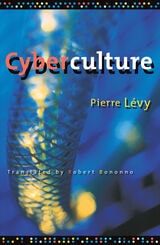
Cyberculture
Pierre Levy
University of Minnesota Press, 2001
A clear explanation and provocative look at the impact of new technologies on world society.
Needing guidance and seeking insight, the Council of Europe approached Pierre Lévy, one of the world’s most important and well-respected theorists of digital culture, for a report on the state (and, frankly, the nature) of cyberspace. The result is this extraordinary document, a perfectly lucid and accessible description of cyberspace—from infrastructure to practical applications-along with an inspired, far-reaching exploration of its ramifications. A window on the digital world for the technologically timid, the book also offers a brilliant vision of the philosophical and social realities and possibilities of cyberspace for the adept and novice alike.
In an overview, Lévy discusses the distinguishing features of cyberspace and cyberculture from anthropological, philosophical, cultural, and sociological points of view. An optimist about the future potential of cyberspace, he eloquently argues that technology—and specifically the infrastructure of cyberspace, the Internet—can have a transformative effect on global society. Some of the issues he takes up are new art forms; changes in relationships to knowledge, education, and training; the preservation of linguistic and cultural differences; the emergence and implications of collective intelligence; the problems of social exclusion; and the impact of new technology on the city and democracy in general. In considerable detail, Lévy describes the ways in which cyberspace will help promote the growth of democracy, primarily through the participation of individuals or groups. His analysis is enlivened by his own personal impressions of cyberculture—garnered from bulletin boards, mailing lists, virtual reality demonstrations, and simulations. Immediate in its details, visionary in its scope, deeply informed yet free of unnecessary technical language, Cyberculture is the book we require in our digital age.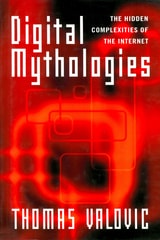
Digital Mythologies
The Hidden Complexities of the InternetValovic, Thomas
Rutgers University Press, 1999
Surf the web. Ride the information highway. Log on to the future. Corporate ad campaigns like these have become pervasive in the 1990s. You're either online, or you're falling behind the times-at least, that's what the media tells us.
Ever since the 1990s, when the Internet gained widespread popularity, it has been heralded as one of the best things ever to happen to technology and communications. Commentators expected it to revolutionize how we communicate, do business, and educate our children. Conversely, other pundits have vehemently attacked this technology. Naysayers of "cyberlife" emerged with their warnings of how the Net provides an uncensored, round-the-clock venue for pornography, for inaccurate, simplified information, and is rife with opportunities to violate our right to privacy. In Digital Mythologies, Thomas Valovic hopes to raise the level of discussion by giving a full and balanced picture of how the Net affects our lives.
Digital Mythologies, a collection of Valovic's essays, asks hard questions about where computer and communications technology is taking us. Through anecdotes drawn from his experiences as former editor-in-chief of Telecommunications magazine, the author gives readers an insider's peek behind the scenes of the Internet industry. He explores the underlying social and political implications of the Internet and its associated technologies, based on his contention that the cyberspace experience is far more complex than is commonly assumed. Valovic explores these hidden complexities, and points to fascinating connections between the Internet and our contemporary culture.
Flame Wars
The Discourse of CybercultureMark Dery
Duke University Press, 1994
The subcultural practices of the "incurably informed," to borrow the cyberpunk novelist Pat Cadigan’s coinage, offer a precognitive glimpse of mainstream culture in the near future, when many of us will be part-time residents in virtual communities. Yet, as the essays in this expanded edition of a special issue of the South Atlantic Quarterly confirm, there is more to fringe computer culture than cyberspace. Within these pages, readers will encounter flame warriors; new age mutant ninja hackers; technopagans for whom the computer is an occult engine; and William Gibson’s "Agrippa," a short story on software that can only be read once because it gobbles itself up as soon as the last page is reached. Here, too, is Lady El, an African American cleaning woman reincarnated as an all-powerful cyborg; devotees of on-line swinging, or "compu-sex"; the teleoperated weaponry and amok robots of the mechanical performance art group, Survival Research Laboratories; an interview with Samuel Delany, and more.
Rallying around Fredric Jameson’s call for a cognitive cartography that "seeks to endow the individual subject with some new heightened sense of place in the global system," the contributors to Flame Wars have sketched a corner of that map, an outline for a wiring diagram of a terminally wired world.
Contributors. Anne Balsamo, Gareth Branwyn, Scott Bukatman, Pat Cadigan, Gary Chapman, Erik Davis, Manuel De Landa, Mark Dery, Julian Dibbell, Marc Laidlaw, Mark Pauline, Peter Schwenger, Vivian Sobchack, Claudia Springer
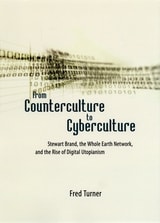
From Counterculture to Cyberculture
Stewart Brand, the Whole Earth Network, and the Rise of Digital UtopianismFred Turner
University of Chicago Press, 2006
In the early 1960s, computers haunted the American popular imagination. Bleak tools of the cold war, they embodied the rigid organization and mechanical conformity that made the military-industrial complex possible. But by the 1990s—and the dawn of the Internet—computers started to represent a very different kind of world: a collaborative and digital utopia modeled on the communal ideals of the hippies who so vehemently rebelled against the cold war establishment in the first place.
From Counterculture to Cyberculture is the first book to explore this extraordinary and ironic transformation. Fred Turner here traces the previously untold story of a highly influential group of San Francisco Bay–area entrepreneurs: Stewart Brand and the Whole Earth network. Between 1968 and 1998, via such familiar venues as the National Book Award–winning Whole Earth Catalog, the computer conferencing system known as WELL, and, ultimately, the launch of the wildly successful Wired magazine, Brand and his colleagues brokered a long-running collaboration between San Francisco flower power and the emerging technological hub of Silicon Valley. Thanks to their vision, counterculturalists and technologists alike joined together to reimagine computers as tools for personal liberation, the building of virtual and decidedly alternative communities, and the exploration of bold new social frontiers.
Shedding new light on how our networked culture came to be, this fascinating book reminds us that the distance between the Grateful Dead and Google, between Ken Kesey and the computer itself, is not as great as we might think.
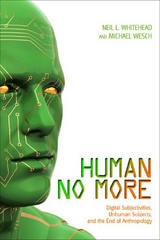
Human No More
Digital Subjectivities, Unhuman Subjects, and the End of AnthropologyNeil L. Whitehead
University Press of Colorado, 2012
Online worlds have recently thrown into question the traditional anthropological conception of place-based ethnography. They break definitions, blur distinctions, and force us to rethink the notion of the "subject." Human No More asks how digital cultures can be integrated and how the ethnography of both the "unhuman" and the "digital" could lead to possible reconfiguring the notion of the "human."
This provocative and groundbreaking work challenges fundamental assumptions about the entire field of anthropology. Cross-disciplinary research from well-respected contributors makes this volume vital to the understanding of contemporary human interaction. It will be of interest not only to anthropologists but also to students and scholars of media, communication, popular culture, identity, and technology.
Materializing New Media
Embodiment in Information AestheticsAnna Munster
Dartmouth College Press, 2006
The Electronic Word
Democracy, Technology, and the ArtsRichard A. Lanham
University of Chicago Press, 1993
This highly acclaimed collection of Richard Lanham's witty, provocative, and engaging essays surveys the effects of electronic text on the arts and letters. Lanham explores how electronic text fulfills the expressive agenda of twentieth-century visual art and music, revolutionizes the curriculum, democratizes the instruments of art, and poses anew the cultural accountability of humanism itself.
Persuading us with uncommon grace and power that the move from book to screen gives cause for optimism, not despair, Lanham proclaims that "electronic expression has come not to destroy the Western arts but to fulfill them."
The Electronic Word is also available as a Chicago Expanded Book for your Macintosh®. This hypertext edition allows readers to move freely through the text, marking "pages," annotating passages, searching words and phrases, and immediately accessing annotations, which have been enhanced for this edition. In a special prefatory essay, Lanham introduces the features of this electronic edition and gives a vividly applied critique of this dynamic new edition.
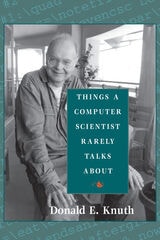
Things a Computer Scientist Rarely Talks About
Donald E. Knuth
CSLI, 2003
Perhaps no one is more qualified to address these questions than Donald E. Knuth, whose massive contributions to computing have led others to nickname him "The Father of Computer Science"—and whose religious faith led him to understand a fascinating analysis of the Bible called the 3:16 project. In this series of six spirited, informal lectures, Knuth explores the relationships between his vocation and his faith, revealing the unique perspective that his work with computing has lent to his understanding of God.
His starting point is the 3:16 project, an application of mathematical "random sampling" to the books of the Bible. The first lectures tell the story of the project's conception and execution, exploring its many dimensions of language translation, aesthetics, and theological history. Along the way, Knuth explains the many insights he gained from such interdisciplinary work. These theological musings culminate in a surprising final lecture tackling the ideas of infinity, free will, and some of the other big questions that lie at the juncture of theology and computation.
Things a Computer Scientist Rarely Talks About, with its charming and user-friendly format—each lecture ends with a question and answer exchange, and the book itself contains more than 100 illustrations—is a readable and intriguing approach to a crucial topic, certain to edify both those who are serious and curious about their faiths and those who look at the science of computation and wonder what it might teach them about their spiritual world.
Includes "Creativity, Spirituality, and Computer Science," a panel discussion featuring Harry Lewis, Guy L. Steele, Jr., Manuela Veloso, Donald E. Knuth, and Mitch Kapor.

Tyranny of the Moment
Fast and Slow Time in the Information AgeThomas Hylland Eriksen
Pluto Press, 2001
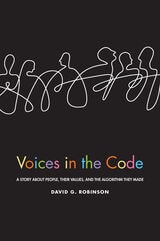
Voices in the Code
A Story about People, Their Values, and the Algorithm They MadeDavid G. Robinson
Russell Sage Foundation, 2022
In Voices in the Code, scholar David G. Robinson tells the story of how one community built a life-and-death algorithm in an inclusive, accountable way. Between 2004 and 2014, a diverse group of patients, surgeons, clinicians, data scientists, public officials and advocates collaborated and compromised to build a new kidney transplant matching algorithm—a system to offer donated kidneys to particular patients from the U.S. national waiting list. Drawing on interviews with key stakeholders, unpublished archives, and a wide scholarly literature, Robinson shows how this new Kidney Allocation System emerged and evolved over time, as participants gradually built a shared understanding both of what was possible, and of what would be fair. Robinson finds much to criticize, but also much to admire, in this story. It ultimately illustrates both the promise and the limits of participation, transparency, forecasting and auditing of high stakes software. The book’s final chapter draws out lessons for the broader struggle to build technology in a democratic and accountable way.