Results by title
30 books match the query 'Conceptual'
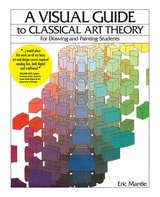
A Visual Guide to Classical Art Theory for Drawing and Painting Students
Mantle, Eric
Parkhurst Brothers, Inc., 2009
Eric Mantle presents the basics of classical theory in a clear and concise manner for all beginning drawing and painting students. His book features diagrams that illustrate every concept. Students will see the complexities of color theory and understand how to create the illusion of volume and depth on a 2-dimensional surface. “As an art student,” Professor Mantle recalls, “I was frequently frustrated by instructional books that gave lengthy verbal descriptions of visual concepts and then showed small and/or unclear diagrams of those concepts. As an art teacher, I found that my students would gain a clearer understanding of a visual concept if my verbal explanation was combined with a diagram of that concept.”
A Visual Guide to Classical Art Theory is great for both traditional and non-traditional media. Each page, theory and diagram represents a different tool for the artist to use. Through their use, the artist will find an infinite number of solutions. Artists also may use the book to create a trompe-l’oeil effect in graffiti art or the illusion of volume and depth on the computer. A Visual Guide to Art Theory is presented in a unique, non-verbal format that clearly illustrates the effect of perspective on color, light and shade.
Art & Language International
Conceptual Art between Art WorldsRobert Bailey
Duke University Press, 2016
Chinese Surplus
Biopolitical Aesthetics and the Medically Commodified BodyAri Larissa Heinrich
Duke University Press, 2018
Clairvoyance (For Those In The Desert)
Performance Pieces, 1979–2004Joanna Frueh
Duke University Press, 2008
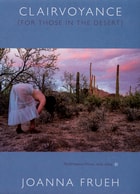
Frueh’s performances are unabashedly autobiographical, as likely to reflect her scholarship as a feminist art historian as her love affairs or childhood memories. For Frueh, eros and self-love are part of a revolutionary feminist strategy; her work exemplifies the physicality and embrace of pleasure that she finds wanting in contemporary feminist theory. Scholarly and rigorous yet playful in tone, her performances are joyful, filled with eroticism, flowers, sexy costumes, and beautiful colors, textures, and scents. Recurring themes include Frueh’s passionate attachment to the desert landscape and the idea of transformation: a continual reaching for clarity of thought and feeling.
In an afterword as lyrical and breathless as her performance pieces, Frueh explores her identification with the desert and its influence on her art. Clairvoyance (For Those In The Desert) includes a detailed chronology of Frueh’s performances.
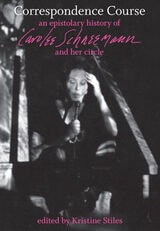
Correspondence Course
An Epistolary History of Carolee Schneemann and Her CircleKristine Stiles, ed.
Duke University Press, 2010
Kristine Stiles selected, edited, annotated, and wrote the introduction to the letters, assembling them so that readers can follow the development of Schneemann’s art, thought, and private and public relationships. The correspondence chronicles a history of energy and invention, joy and sorrow, and charged personal and artistic struggles. It sheds light on the internecine aesthetic politics and mundane activities that constitute the exasperating vicissitudes of making art, building an artistic reputation, and negotiating an industry as unpredictable and demanding as the art world in the mid- to late twentieth century.
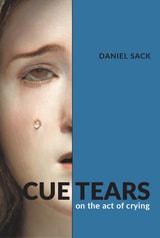
Cue Tears
On the Act of CryingDaniel Sack
University of Michigan Press, 2024
Across seven semi-autonomous essays, Cue Tears looks at the mechanisms of tear production, internal and external techniques that actors use to weep, and the effects of tears in performance situations on the stage, in the gallery, and in the classroom. The writing moves with a light touch between theory and criticism of a broad range of instances from literature, theater, performance art, visual art, and cinema, while also embracing a strong autobiographical and personal slant. Author Daniel Sack’s father was a biochemist who studied tears and collected his son’s tears for research during his childhood. These “reflex tears” were produced as a physical response to irritation—an eye stretched past the point of blinking, a cotton swab up the nose. This childhood occupation coincided with his first years taking acting classes, trying to learn how to cry “emotional tears” onstage through psychological stimulation and the recollection of memory. Cue Tears investigates these memories and methods, finding that tears both shore up and dissolve distinctions between truth and artifice, emotional and physical, private and public, sad and humorous.
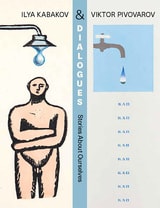
Dialogues
Ilya Kabakov and Viktor Pivovarov, Stories about OurselvesKsenia Nouril
Rutgers University Press, 2020
This exhibition catalog brings together Kabakov and Pivovarov’s key works for the first time, putting the two artists in dialogue and recreating their artistic community. It not only includes nearly hundred pages of full-color illustrations, but also provides complete English translations of the Russian texts that appear in the volume, plus new interviews with each artist. Taken together, they give viewers a new appreciation of the different aesthetic strategies each artist used to depict the absurdities of everyday life in the Soviet era. Published in partnership with the Zimmerli Museum.
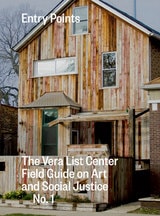
Entry Points
The Vera List Center Field Guide on Art and Social Justice No. 1Carin Kuoni and Chelsea Haines, editors
Duke University Press, 2016
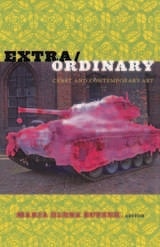
Extra/Ordinary
Craft and Contemporary ArtMaria Elena Buszek, ed.
Duke University Press, 2011
Contributors. Elissa Auther, Anthea Black, Betty Bright, Nicole Burisch, Maria Elena Buszek, Jo Dahn, M. Anna Fariello, Betsy Greer, Andrew Jackson, Janis Jefferies, Louise Mazanti, Paula Owen, Karin E. Peterson, Lacey Jane Roberts, Kirsty Robertson, Dennis Stevens, Margaret Wertheim
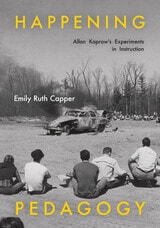
Happening Pedagogy
Allan Kaprow's Experiments in InstructionEmily Ruth Capper
University of Chicago Press, 2026
How Allan Kaprow’s happenings fused modernist pedagogy with an emerging college culture.
In Happening Pedagogy, art historian Emily Ruth Capper argues that Allan Kaprow’s famed invention of the happening brought together experimental traditions of modernist pedagogy with emerging forms of American undergraduate student culture—from hazing rituals to campus protests. Capper traces Kaprow’s trajectory from 1947 to 1968, following him through the classrooms of three of his instructors who were prominent figures in postwar American art—painter Hans Hofmann, art historian Meyer Schapiro, and composer John Cage—and across his own classrooms at institutions including Rutgers and Stony Brook University. Although Kaprow’s teachers were educated in the distinct disciplines of studio art, art history, and music, all three designed their classrooms to cultivate student creativity and critical reflection through forms of social exchange.
Capper shows that Kaprow transformed these modernist classrooms into new pedagogical environments that he developed within the novel context of the suburban state university. Drawing on archival sources, she describes how Kaprow engaged the culture and creative work of middle-class college students, whose rituals he took seriously as an avant-garde vernacular. In this way, Kaprow’s happenings represent a critical extension of modernism as a social practice of sensory attunement, experimentation, and philosophical critique. Through Kaprow’s work, modernist pedagogy became an artistic medium in itself, and his participation-based creative practices helped define the broad resurgence of the American neo-avant-garde after 1960.
Irina Nakhova
Museum on the EdgeJane A. Sharp
Rutgers University Press, 2019
Released in conjunction with Nakhova’s first museum retrospective exhibition in the United States, this book includes many full-color illustrations of her work, spanning the entirety of her forty-year career and demonstrating her facility with a variety of media. It also includes essays by a variety of world-renowned curators and art historians, each cataloging Nakhova’s artistic innovations and exploring how she deals with themes of everyday life, memory, viewer engagement, and moral responsibility. It concludes with a new interview with Nakhova herself, giving new insight into her creative process and artistic goals. Irina Nakhova: Museum on the Edge provides a vivid look at the work of a visionary artist. Published in partnership with the Zimmerli Museum.
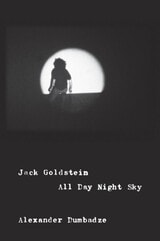
Jack Goldstein
All Day Night SkyAlexander Dumbadze
University of Chicago Press, 2025
A defining figure of the 1970s–80s New York art world, Jack Goldstein’s wide-ranging body of work, which included immaculate color films and radiant paintings of appropriated images composed by assistants, is both seductive and interpretively elusive. Goldstein’s legacy has been complicated by the mythology of his later years. Consumed by drug addiction, he dropped out of the art world in the 1990s, lived alone in an East Los Angeles trailer park, and resurfaced in a wave of critical fanfare at the turn of the millennium, before taking his own life in 2003.
Employing his signature blend of biography, theoretical reflection, and archival research, Alexander Dumbadze examines Goldstein’s life and career, homing in on the artist’s refusal to distinguish between mental and actual images. Progressing chronologically through key moments in Goldstein’s artistic and intellectual formation, the book offers a deeply complex portrait of this significant artist, along with a nuanced meditation on the nature of images, the meaning of artistic subjectivity, and the consequences of holding unwavering faith in art.
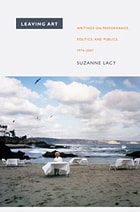
Leaving Art
Writings on Performance, Politics, and Publics, 1974-2007Suzanne Lacy
Duke University Press, 2010
Liquor Store Theatre
Maya Stovall
Duke University Press, 2020
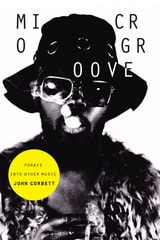
Microgroove
Forays into Other MusicJohn Corbett
Duke University Press, 2015
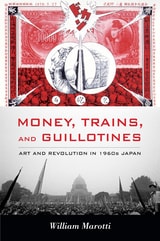
Money, Trains, and Guillotines
Art and Revolution in 1960s JapanWilliam Marotti
Duke University Press, 2013
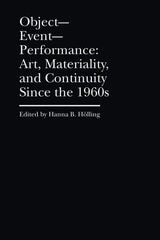
Object—Event— Performance
Art, Materiality, and Continuity Since the 1960sEdited by Hanna B. Hölling
Bard Graduate Center, 2021
Much of the artwork that rose to prominence in the second half of the twentieth century took on novel forms—such as installation, performance, event, video, film, earthwork, and intermedia works with interactive and networked components—that pose a new set of questions about what art actually is, both physically and conceptually. For conservators, this raises an existential challenge when considering what elements of these artworks can and should be preserved.
This provocative volume revisits the traditional notions of conservation and museum collecting that developed over the centuries to suit a conception of art as static, fixed, and permanent objects. Conservators and museums increasingly struggle with issues of conservation for works created from the mid-twentieth to the twenty-first century that are unstable over time. The contributors ask what it means to conserve artworks that fundamentally address and embody the notion of change and, through this questioning, guide us to reevaluate the meaning of art, of objects, and of materiality itself. Object—Event—Performance considers a selection of post-1960s artworks that have all been chosen for their instability, changeability, performance elements, and processes that pose questions about their relationship to conservation practices. This volume will be a welcome resource on contemporary conservation for art historians, scholars of dance and theater studies, curators, and conservators.
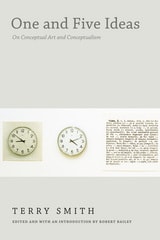
One and Five Ideas
On Conceptual Art and ConceptualismTerry Smith
Duke University Press, 2017
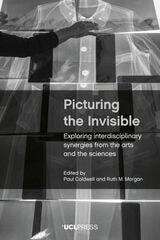
Picturing the Invisible
Exploring Interdisciplinary Synergies from the Arts and the SciencesEdited by Paul Coldwell and Ruth M. Morgan
University College London, 2022
Picturing the Invisible presents different disciplinary approaches to articulating the invisible, that which is not known or not provable. The challenge is how to articulate these concepts, not only to those within a particular academic field but beyond, to other disciplines and society at large. As our understanding of the complexity of the world grows incrementally, so does our realization that issues and problems can rarely be resolved within neat demarcations. Therefore, the authors argue, the importance of finding means of communicating across disciplines and fields must become a priority. This book brings together insights from leading academics from a wide range of disciplines, including art and design, curatorial practice, literature, forensic science, medical science, psychoanalysis and psychotherapy, philosophy, astrophysics, and architecture, who share an interest in exploring how in each discipline we strive to find expression for the invisible or unknown and to draw out and articulate some of the explicit and tacit ways of communicating those concepts that transcend traditional disciplinary boundaries.
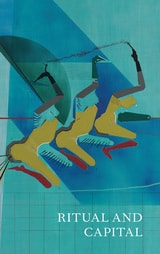
Ritual and Capital
Edited by Bard Graduate Center and Wendy's Subway
Bard Graduate Center, 2020
The publication of Ritual and Capital is the culmination of a series of public readings organized by Wendy’s Subway, a nonprofit organization in Brooklyn, as part of their Spring 2017 Reading Room residency at the Bard Graduate Center. Copublished by the Bard Graduate Center and Wendy’s Subway, Ritual and Capital is the first title in the BGCX series, a publication series designed to expand time-based programming after the events themselves have ended. Springing from the generative spontaneity of conversation, performance, and hands-on engagement as their starting points, these experimental publishing projects will provide space for continued reflection and research in a form that is inclusive of a variety of artists and makers.
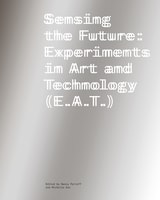
Sensing the Future
Experiments in Art and Technology (E.A.T.)Nancy Perloff
J. Paul Getty Trust, The, 2024
In 1966, Billy Klüver and Fred Waldhauer, engineers at Bell Labs in Murray Hill, New Jersey, teamed up with artists Robert Rauschenberg and Robert Whitman to form a nonprofit organization, Experiments in Art and Technology (E.A.T.). E.A.T.’s debut event, 9 Evenings: Theatre & Engineering, integrated art, theater, and groundbreaking technology in a series of performances at the 69th Regiment Armory in Manhattan. Its second major event, the Pepsi Pavilion at Expo ’70 in Osaka, Japan, presented a multisensory environment for the first world exposition held in Asia. At these events, and in the hundreds of collaborations E.A.T. facilitated in between, the participants—including John Cage, Lucinda Childs, Deborah Hay, Steve Paxton, Yvonne Rainer, and David Tudor—imagined innovative ways for art and science to intersect and enrich society.
Sensing the Future tells the story of these collaborations between artists and engineers and how they led to new installations and technology-based artworks. Through the examination of films, photographs, diagrams, and artists’ records from the E.A.T. archive at the Getty Research Institute, this volume provides a new perspective on multimedia art in the 1960s and ’70s and highlights the ways E.A.T. pushed the role of the artist beyond the traditional art world.
This volume is published to accompany an exhibition on view at the Getty Research Institute at the Getty Center from September 10, 2024, to February 23, 2025.
Speculation, Now
Essays and ArtworkVyjayanthi Venuturupalli Rao, with Prem Krishnamurty and Carin Kuoni, eds.
Duke University Press, 2014
Artists and essayists include William Darity Jr., Filip De Boeck, Boris Groys, Hans Haacke, Darrick Hamilton, Laura Kurgan, Lin + Lam, Gary Lincoff, Lize Mogel, Christina Moon, Stefania Pandolfo, Satya Pemmaraju, Mary Poovey, Walid Raad, Sherene Schostak, Robert Sember, and Srdjan Jovanović Weiss.
Published by Duke University Press and the Vera List Center for Art and Politics at The New School
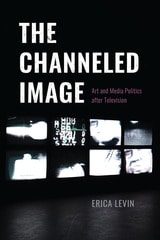
The Channeled Image
Art and Media Politics after TelevisionErica Levin
University of Chicago Press, 2022
Following the integration of television into the fabric of American life in the 1950s, experimental artists of the 1960s began to appropriate this novel medium toward new aesthetic and political ends. As Erica Levin details in The Channeled Image, groundbreaking artists like Carolee Schneemann, Bruce Conner, Stan VanDerBeek, and Aldo Tambellini developed a new formal language that foregrounded television’s mediation of a social order defined by the interests of the state, capital, and cultural elites. The resulting works introduced immersive projection environments, live screening events, videographic distortion, and televised happenings, among other forms. For Levin, “the channeled image” names a constellation of practices that mimic, simulate, or disrupt the appearance of televised images. This formal experimentation influenced new modes of installation, which took shape as multi-channel displays and mobile or split-screen projections, or in some cases, experimental work produced for broadcast. Above all, this book asks how artistic experimentation with televisual forms was shaped by events that challenged television broadcasters’ claims to authority, events that set the stage for struggles over how access to the airwaves would be negotiated in the future.
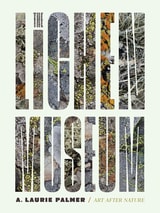
The Lichen Museum
Laurie A. Palmer
University of Minnesota Press, 2023
A radical proposal for how a tiny organism can transform our understanding of human relations
Serving as both a guide and companion publication to the conceptual art project of the same name, The Lichen Museum explores how the physiological characteristics of lichens provide a valuable template for reimagining human relations in an age of ecological and social precarity. Channeling between the personal, the scientific, the philosophical, and the poetic, A. Laurie Palmer employs a cross-disciplinary framework that artfully mirrors the collective relations of lichens, imploring us to envision alternative ways of living based on interdependence rather than individualism and competition.
Lichens are composite organisms made up of a fungus and an alga or cyanobacteria thriving in a mutually beneficial relationship. The Lichen Museum looks to these complex organisms, remarkable for their symbiosis, diversity, longevity, and adaptability, as models for relations rooted in collaboration and nonhierarchical structures. In their resistance to fast-paced growth and commodification, lichens also offer possibilities for humans to reconfigure their relationship to time and attention outside of the accelerated pace of capitalist accumulation.
Drawing together a diverse set of voices, including personal encounters with lichenologists and lichens themselves, Palmer both imagines and embodies a radical new approach to human interconnection. Using this tiny organism as an emblem through which to navigate environmental and social concerns, this work narrows the gap between the human and natural worlds, emphasizing the notion of mutual dependence as a necessary means of survival and prosperity.
The Multispecies Salon
Eben Kirksey
Duke University Press, 2014
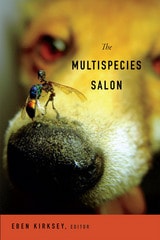
Delectable mushrooms flourishing in the aftermath of ecological disaster, microbial cultures enlivening the politics and value of food, and nascent life forms running wild in the age of biotechnology all figure in this curated collection of essays and artifacts. Recipes provide instructions on how to cook acorn mush, make cheese out of human milk, and enliven forests after they have been clear-cut. The Multispecies Salon investigates messianic dreams, environmental nightmares, and modest sites of biocultural hope.
For additional materials see the companion website: www.multispecies-salon.org/
Contributors. Karen Barad, Caitlin Berrigan, Karin Bolender, Maria Brodine, Brandon Costelloe-Kuehn, David S. Edmunds, Christine Hamilton, Donna J. Haraway, Stefan Helmreich, Angela James, Lindsay Kelley, Eben Kirksey, Linda Noel, Heather Paxson, Nathan Rich, Anna Rodriguez, Dorion Sagan, Craig Schuetze, Nicholas Shapiro, Miriam Simun, Kim TallBear, Anna Lowenhaupt Tsing
The Scores Project
Essays on Experimental Notation in Music, Art, Poetry, and Dance, 1950–1975Michael Gallope
J. Paul Getty Trust, The, 2025
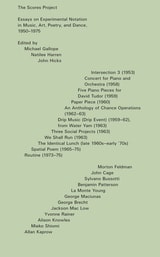
Individuals working in and across the fields of visual art, music, poetry, theater, and dance in the mid–twentieth century began to use experimental scores in ways that revolutionized artistic practice and opened up new forms of interdisciplinary collaboration. Their experimental methods—associated with the neo-avant-garde, neo-Dadaism, intermedia, Fluxus, and postmodernism—exploded in notoriety during the 1960s in locales from New York to Europe, East Asia, and Latin America, becoming foundational to global trends in contemporary art and performance.
The Scores Project provides an in-depth view of this historical moment. Through expert commentaries from an interdisciplinary team of scholars with accompanying illustrations, this publication examines a series of experimental scores by John Cage, George Brecht, Sylvano Bussotti, Morton Feldman, Allan Kaprow, Alison Knowles, Jackson Mac Low, Benjamin Patterson, Yvonne Rainer, Mieko Shiomi, David Tudor, and La Monte Young. Ambitious, provocative, and playful, The Scores Project is an illuminating resource to scholars and students who seek to understand this innovative and historically complex moment in the history of art.
An expanded edition of this open-access publication is available for free online at www.getty.edu/publications/scores/. It includes more than 2,800 images, audio/video files, and interactive features. Also available are free PDF and EPUB downloads of the book.
Transit
Serpent Mound Crossing Space, Time, DiscourseChadwick Allen
University of Chicago Press, 2026
In Transit, Chadwick Allen chronicles the surprising history of how the ancient snake effigy known as Serpent Mound, located in what is now southern Ohio, traveled to Seattle, Washington in the 1970s, at the height of American Indian activism associated with the Red Power movement. Allen considers Indigenous earthworks built for thousands of years across the eastern half of the North American continent, questioning what it would mean if they were understood not as static entities fixed in space and time, but as animate forces with the ability to travel. Allen also looks at the origins of the “modern” effigy in the nineteenth century, when archaeologists reconstructed Serpent Mound’s deteriorating form to create a static icon suitable for touristic display within the confines of a settler state memorial.
Drawing from archival research, interviews, and site-specific encounters, Transit meditates on the significance of building an earthen effigy in the Pacific Northwest, as part of what became the Daybreak Star Indian Cultural Center, and on the complexity of the mound’s generative contexts. Allen’s research intersects the mid-twentieth century, when artist Robert Smithson created his iconic Spiral Jetty earth sculpture and when the Muscogee (Creek) Nation designed its innovative Mound Building. The story remains ongoing in the twenty-first century, as new mounds are rising in Oklahoma and artists, activists, and intellectuals are again asserting the power of Indigenous design.
Transition in Post-Soviet Art
The Collective Actions Group Before and After 1989Octavian Esanu
Central European University Press, 2013
What We Made
Conversations on Art and Social CooperationTom Finkelpearl
Duke University Press, 2013
Interviewees. Naomi Beckwith, Claire Bishop, Tania Bruguera, Brett Cook, Teddy Cruz, Jay Dykeman, Wendy Ewald, Sondra Farganis, Harrell Fletcher, David Henry, Gregg Horowitz, Grant Kester, Mierle Laderman Ukeles, Pedro Lasch, Rick Lowe, Daniel Martinez, Lee Mingwei, Jonah Peretti, Ernesto Pujol, Evan Roth, Ethan Seltzer, and Mark Stern
Writing in Space, 1973–2019
Lorraine O'Grady
Duke University Press, 2020