Results by title
2 books match the query 'Conceptual Framework'
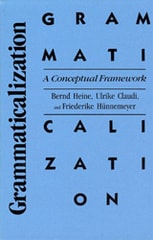
Grammaticalization
A Conceptual FrameworkBernd Heine, Ulrike Claudi, and Friederike Hünnemeyer
University of Chicago Press, 1991
This volume challenges theories which describe language as a static system, as well as those which assume that linguistic categorization is based on discrete morpheme types, word classes, or sentence constituents. In contrast, the book's central argument is that both language structure and language use are dynamic phenomena and that linguistic behavior is essentially a creative activity. That creativity manifests itself, for example, in conceptual transfer leading to the encoding of more abstract concepts and of grammatical categories. Another key element of this theory is captured in the term "grammaticalization chain," which refers to a specific kind of linguistic category which cuts across morpheme types and word classes and has both a synchronic and diachronic dimension.
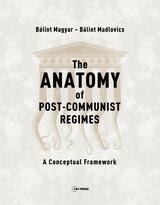
The Anatomy of Post-Communist Regimes
A Conceptual FrameworkBálint Magyar
Central European University Press, 2021
Offering a single, coherent framework of the political, economic, and social phenomena that characterize post-communist regimes, this is the most comprehensive work on the subject to date. Focusing on Central Europe, the post-Soviet countries and China, the study provides a systematic mapping of possible post-communist trajectories.
At exploring the structural foundations of post-communist regime development, the work discusses the types of state, with an emphasis on informality and patronalism; the variety of actors in the political, economic, and communal spheres; the ways autocrats neutralize media, elections, etc. The analysis embraces the color revolutions of civil resistance (as in Georgia and in Ukraine) and the defensive mechanisms of democracy and autocracy; the evolution of corruption and the workings of “relational economy”; an analysis of China as “market-exploiting dictatorship”; the sociology of “clientage society”; and the instrumental use of ideology, with an emphasis on populism. Beyond a cataloguing of phenomena—actors, institutions, and dynamics of post-communist democracies, autocracies, and dictatorships—Magyar and Madlovics also conceptualize everything as building blocks to a larger, coherent structure: a new language for post-communist regimes.
While being the most definitive book on the topic, the book is nevertheless written in an accessible style suitable for both beginners who wish to understand the logic of post-communism and scholars who are interested in original contributions to comparative regime theory. The book is equipped with QR codes that link to www.postcommunistregimes.com, which contains interactive, 3D supplementary material for teaching.