Results by title
6 books match the query 'Concerts'
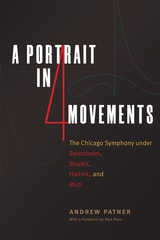
A Portrait in Four Movements
The Chicago Symphony under Barenboim, Boulez, Haitink, and MutiAndrew Patner
University of Chicago Press, 2019
The Chicago Symphony Orchestra has been led by a storied group of conductors. And from 1994 to 2015, through the best work of Daniel Barenboim, Pierre Boulez, Bernard Haitink, and Riccardo Muti, Andrew Patner was right there. As a classical music critic for the Chicago Sun-Times and WFMT radio, Patner was able to trace the arc of the CSO’s changing repertories, all while cultivating a deep rapport with its four principal conductors.
This book assembles Patner’s reviews of the concerts given by the CSO during this time, as well as transcripts of his remarkable radio interviews with these colossal figures. These pages hold tidbits for the curious, such as Patner’s “driving survey” that playfully ranks the Maestri he knew on a scale of “total comfort” to “fright level five,” and the observation that Muti appears to be a southpaw on the baseball field. Moving easily between registers, they also open revealing windows onto the sometimes difficult pasts that brought these conductors to music in the first place, including Boulez’s and Haitink’s heartbreaking experiences of Nazi occupation in their native countries as children. Throughout, these reviews and interviews are threaded together with insights about the power of music and the techniques behind it—from the conductors’ varied approaches to research, preparing scores, and interacting with other musicians, to how the sound and personality of the orchestra evolved over time, to the ways that we can all learn to listen better and hear more in the music we love. Featuring a foreword by fellow critic Alex Ross on the ethos and humor that informed Patner’s writing, as well as an introduction and extensive historical commentary by musicologist Douglas W. Shadle, this book offers a rich portrait of the musical life of Chicago through the eyes and ears of one of its most beloved critics.
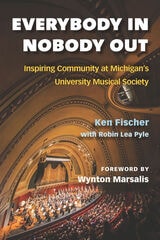
Everybody In, Nobody Out
Inspiring Community at Michigan's University Musical SocietyKen Fischer with Robin Lea Pyle
University of Michigan Press, 2020
The approach not only deepened UMS’s engagement with the university and southeast Michigan communities, it led to exemplary partnerships with distinguished artists across the world. Under Fischer’s leadership, UMS hosted numerous breakthrough performances, including the Vienna Philharmonic’s final tour with Leonard Bernstein, appearances by then relatively unknown opera singer Cecilia Bartoli, a multiyear partnership with the Royal Shakespeare Company, and artists as diverse as Yo-Yo Ma, Jawole Willa Jo Zollar, Elizabeth Streb, and Nusrat Fateh Ali Khan.
Though peppered with colorful anecdotes of how these successes came to be, this book is neither a history of UMS nor a memoir of Fischer’s significant accomplishments with the organization. Rather it is a reflection on the power of the performing arts to engage and enrich communities—not by handing down cultural enrichment from on high, but by meeting communities where they live and helping them preserve cultural heritage, incubate talent, and find ways to make community voices heard.
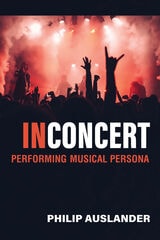
In Concert
Performing Musical PersonaPhillip Auslander
University of Michigan Press, 2021
The conventional way of understanding what musicians do as performers is to treat them as producers of sound; some even argue that it is unnecessary to see musicians in performance as long as one can hear them. But musical performance, counters Philip Auslander, is also a social interaction between musicians and their audiences, appealing as much to the eye as to the ear. In Concert: Performing Musical Persona he addresses not only the visual means by which musicians engage their audiences through costume and physical gesture, but also spectacular aspects of performance such as light shows.
Although musicians do not usually enact fictional characters on stage, they nevertheless present themselves to audiences in ways specific to the performance situation. Auslander’s term to denote the musician’s presence before the audience is musical persona. While presence of a musical persona may be most obvious within rock and pop music, the book’s analysis extends to classical music, jazz, blues, country, electronic music, laptop performance, and music made with experimental digital interfaces. The eclectic group of performers discussed include the Beatles, Miles Davis, Keith Urban, Lady Gaga, Nicki Minaj, Frank Zappa, B. B. King, Jefferson Airplane, Virgil Fox, Keith Jarrett, Glenn Gould, and Laurie Anderson.
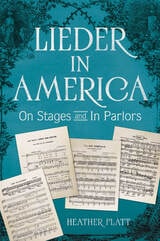
Lieder in America
On Stages and In ParlorsHeather Platt
University of Illinois Press, 2023
Though viewed as quintessentially German, lieder became a centerpiece of nineteenth century song recitals in the United States. By the 1890s, these songs, which were often sung in English, were a sensation among tutored and untutored music lovers alike. Heather Platt examines the varied supporters and singers who both established the lied as a concert repertoire and shaped a new kind of recital dedicated to art songs. Lieder were embraced and spread by performers like Max Heinrich and advocates like John Sullivan Dwight, as well as by the women’s clubs that flourished nationwide. At the same time as examining the critical reception of the artists and songs, Platt reveals ways in which US recital programs anticipated trends in European recitals. She also places lieder against the backdrop of the time, when factors like the growth in the sheet music industry, the evolution of American art song, and emerging anti-German feeling had a profound impact on the genre’s popularity.
The Symphony Concert in Nazi Germany
Neil Gregor
University of Chicago Press, 2025
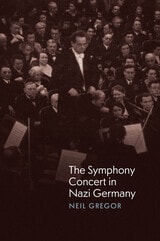
In the years after the Nazis came to power in January 1933 and throughout the Second World War, all aspects of life in Germany changed. Despite the social and political upheaval, gentile citizens continued to attend concerts. In this book, historian Neil Gregor surveys how the classical concert scene was impacted in Nazi Germany. Taking the perspective of the audience, rather than institutions or performers, Gregor delves into the cultural lives of ordinary Germans under conditions of dictatorship. Did the ways in which Germans heard music in the period change? Did a Nazi way of listening emerge?
For audiences, Gregor shows, changes to the concert experience were small and often took place around the edges. This, combined with the preserved idea of the concert hall as a space of imagined civility and cultivation, led many concertgoers and music lovers to claim after the war that their field and their practice had been innocent—a place to retreat from the vicious violence and racism of the Nazi regime. Drawing on untapped archival sources, The Symphony Concert in Nazi Germany reveals that the true history was one of disruption but also of near seamless adaptation. Through countless small acts, the symphony concert was reframed within the languages of strident nationalism, racism, and militarism to ensure its place inside the cultural cosmos of National Socialist Germany.
We Had Fun and Nobody Died
Adventures of a Milwaukee Music PromoterAmy T. Waldman
Wisconsin Historical Society Press, 2024
The entertaining and inspiring story of a stubbornly independent promoter and club owner
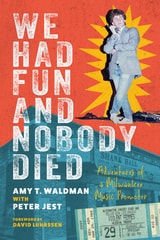
This irreverent biography provides a rare window into the music industry from a promoter’s perspective. From a young age, Peter Jest was determined to make a career in live music, and despite naysayers and obstacles, he did just that, bringing national acts to his college campus at UW–Milwaukee, booking thousands of concerts across Wisconsin and the Midwest, and opening Shank Hall, the beloved Milwaukee venue named after a club in the cult film This Is Spinal Tap.
This funny, nostalgia-inducing book details the lasting friendships Jest established over the years with John Prine, Arlo Guthrie, and Milwaukee’s own Violent Femmes, among others. It also shines a light into the seldom-seen world of music promotion, as Jest attempts to manage a turbulent band on the road, negotiates with agents, deals with fires (both real and metaphorical), struggles through a pandemic, and takes pleasure in presenting music of all kinds—from world-famous acts to up-and-coming local bands. In addition to photos of celebrated musicians, the book includes concert posters, tickets, and backstage passes documenting decades of rock, folk, and alternative shows that helped put Milwaukee on the live music map.
As the music industry has become dominated by profit-driven corporations, We Had Fun and Nobody Died chronicles the career of a one-of-a-kind independent promoter whose hardheadedness and love of music have helped him keep it real and make it in the music business for more than forty years.
"[An] adventure-filled biography of music promoter Peter Jest. . . . Reflecting decades of changes to the music business, We Had Fun and Nobody Died is a fascinating biography of a passionate promoter’s work to transform Milwaukee’s music scene."
—Foreword Reviews
“Amy Waldman and Peter Jest weave a thrilling tale of fanhood gone pro. Dreams followed, dragons slain, and the roof of a venerable venue repeatedly blown sky-high. We’re proud to have provided the name [for Shank Hall]; it took men and women of sterner stuff to do the heavy lifting.”
—Michael McKean, actor and comedian, This Is Spinal Tap
“We Had Fun and Nobody Died is a fantastic journey of a Midwest boy, his love of music, and his excitement to be part of it all.”
—Kevn Kinney, lead singer and guitarist of Drivin N Cryin
“Peter Jest’s story is one that conveys a winning combination of friendship, determination, and entrepreneurial insights that led him to a lifelong career in support of the live music industry and the community that comes together in common appreciation of it.”
—Shana Morrison, singer-songwriter