Results by title
6 books match the query 'Concise History'

Arkansas
A Concise HistoryJeannie M. Whayne
University of Arkansas Press, 2019
Distilled from Arkansas: A Narrative History, the definitive work on the subject since its original publication in 2002, Arkansas: A Concise History is a succinct one-volume history of the state from the prehistory period to the present. Featuring four historians, each bringing his or her expertise to a range of topics, this volume introduces readers to the major issues that have confronted the state and traces the evolution of those issues across time.
After a brief review of Arkansas’s natural history, readers will learn about the state’s native populations before exploring the colonial and plantation eras, early statehood, Arkansas’s entry into and role in the Civil War, and significant moments in national and global history, including Reconstruction, the Gilded Age, the Progressive Era, the Elaine race massacre, the Great Depression, both world wars, and the Civil Rights Movement. Linking these events together, Arkansas: A Concise History offers both an understanding of the state’s history and a perspective on that history’s implications for the political, economic, and social realities of today.
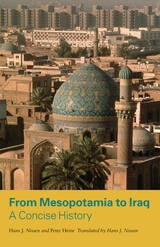
From Mesopotamia to Iraq
A Concise HistoryHans J. Nissen and Peter Heine
University of Chicago Press, 2009
The recent reopening of Iraq’s National Museum attracted worldwide attention, underscoring the country’s dual image as both the cradle of civilization and a contemporary geopolitical battleground. A sweeping account of the rich history that has played out between these chronological poles, From Mesopotamia to Iraq looks back through 10,000 years of the region’s deeply significant yet increasingly overshadowed past.
Hans J. Nissen and Peter Heine begin by explaining how ancient Mesopotamian inventions—including urban society, a system of writing, and mathematical texts that anticipated Pythagoras—profoundly influenced the course of human history. These towering innovations, they go on to reveal, have sometimes obscured the major role Mesopotamia continued to play on the world stage. Alexander the Great, for example, was fascinated by Babylon and eventually died there. Seventh-century Muslim armies made the region one of their first conquests outside the Arabian peninsula. And the Arab caliphs who ruled for centuries after the invasion built the magnificent city of Baghdad, attracting legions of artists and scientists. Tracing the evolution of this vibrant country into a contested part of the Ottoman Empire, a twentieth-century British colony, a republic ruled by Saddam Hussein, and the democracy it has become, Nissen and Heine repair the fragmented image of Iraq that has come to dominate our collective imagination.
In hardly any other continuously inhabited part of the globe can we chart such developments in politics, economy, and culture across so extended a period of time. By doing just that, the authors illuminate nothing less than the forces that have made the world what it is today.
Mao Zedong and China in the Twentieth-Century World
A Concise HistoryRebecca E. Karl
Duke University Press, 2010
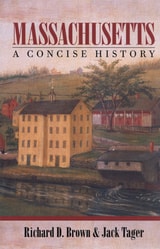
Massachusetts
A Concise HistoryRichard D. Brown
University of Massachusetts Press, 2000
From the moment the first English colonists landed on the shores of Plymouth Bay, the experiences of the people of Massachusetts have been emblematic of larger themes in American history. The story of the first Pilgrim thanksgiving is commemorated as a national holiday, while the Boston Tea Party and Paul Revere's ride have passed into the national mythology. Even the grimmer aspects of the American experience—Indian warfare and the conquest of an ever expanding frontier—were part of the early history of Massachusetts. In this book, Richard D. Brown and Jack Tager survey the rich heritage of this distinctive, and distinctly American, place, showing how it has long exerted an influence disproportionate to its size.
A seedbed of revolt against British colonial rule, Massachusetts has supplied the nation with a long line of political leaders—from Samuel and John Adams to William Lloyd Garrison and Lucy Stone to John, Robert, and Edward Kennedy. Its early textile mills helped shape the industrial revolution, while its experiences with urbanization, immigration, ethnic conflict, and labor strife reflected the growth of the national economy. In the twentieth century, the state continued to lead the country through a series of wrenching economic changes as it moved from the production of goods to the provision of services, eventually becoming a center of the high-tech revolution in telecommunications. If there is one common theme in the Bay State's history, Brown and Tager make clear, it is the capacity to adapt to change. In part this trait can be attributed to the state's unique blend of resources, including its many distinguished colleges and universities. But it can also be credited to the people themselves, who have created a singular sense of place by reconciling claims of tradition with the possibilities of innovation. This book tells their story.
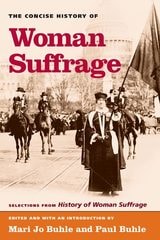
The Concise History of Woman Suffrage
Selections from History of Woman Suffrage, by Elizabeth Cady Stanton, Susan B. Anthony, Matilda Joslyn Gage, and the National American Woman Suffrage AssociationEdited and with an Introduction by Mari Jo Buhle and Paul Buhle
University of Illinois Press, 2005
In their Concise History of Woman Suffrage, Mari Jo Buhle and Paul Buhle have revitalized this classic text by carefully selecting from among its best material. The eighty-two chosen documents, now including interpretative introductory material by the editors, give researchers easy access to material that the original work's arrangement often caused readers to ignore or to overlook.
The volume contains the work of many reform agitators, among them Angelina Grimké, Lucy Stone, Carrie Chapman Catt, Charlotte Perkins Gilman, Anna Howard Shaw, Jane Addams, Sojourner Truth, and Victoria Woodhull, as well as Elizabeth Cady Stanton, Susan B. Anthony, Matilda Joslyn Gage, and Ida Husted Harper.
Women Have Always Worked
A Concise HistoryAlice Kessler-Harris
University of Illinois Press, 2018