Results by title

4 books match the query 'Concordances'
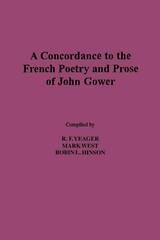
cover of Concordance to the French Poetry and Prose of John Gower

Concordance to the French Poetry and Prose of John Gower

R. F. Yeager

Michigan State University Press, 1997

That the poet John Gower was a major literary figure in England at the close of the fourteenth century is no longer in question. Scholarly attention paid to him and to his work over the past twenty- five years has redeemed him from an undeserved obscurity imposed by the preceding two hundred. The facts of his life and career are now documented, and recent critical assessment has placed his achievement most accurately alongside Chaucer's, Langland's, and the Gawain- poet's.
Unique among his contemporaries, all of whom undoubtedly read and used French in some measure, Gower alone has left us a significant body of verse and prose in Anglo-Norman; chiefly, the twelve-stanza poem Mirour de l-Omme, the Cinkante Balades, and the Traitié pour les amantz marietz. We are offered in this concordance of his Anglo- Norman work a unique opportunity to view a poetic language as it was written and read in England until Gower's death in 1408 and beyond.
[more]
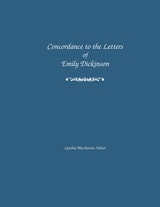
cover of Concordance to the Letters of Emily Dickinson

Concordance to the Letters of Emily Dickinson

Cynthia MacKenzie

University Press of Colorado, 2000

This valuable resource for Dickinson scholars is based on the Thomas H. Johnson three-volume edition of the letters (published in 1958 and 1965) as well as the 1998 one-volume paperback edition. The primary importance of the concordance pertains to the poetic quality of the letters themselves. As editor of both the poems and the letters, T.H. Johnson recognizes this link when he writes: "the letters both in style and rhythm begin to take on qualities that are so nearly the quality of her poems as on occasion to leave the reader in doubt where the letter leaves off and the poem begins."

 The similarities between the letters and the poems makes the typical concordance search for the poet's thematically significant words and biographical references particularly relevant. Tracing Dickinson's thoughts through her correspondence complements the ideas within her poetry and thus provides a more comprehensive insight into the poet's personal and artistic development. The concordance will facilitate an understanding of words or concepts that may be obscure in the poetry by itself. Research into Dickinson's problematic style, characterized by gaps, disjunctions, and ellipses, will be greatly enhanced.

 By listing Dickinson's words together with their contexts and frequencies, the concordance provides the scholar with the ability to answer confidently questions of a statistical or stylistic nature. Finally, one of the most important functions of this concordance is to provide scholar, student, and general reader alike with endless opportunities to make exciting and unexpected discoveries by way of browsing.
[more]
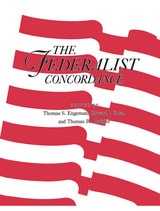
cover of The Federalist Concordance

The Federalist Concordance

Edited by Thomas Engeman, Edward J. Erler, and Thomas B. Hofeller

University of Chicago Press, 1988
The "Federalist" Concordance is an alphabetical index of all but the most common words contained in the Federalist Papers, locating each occurrence of a word by paper number, author, page, and line in the definitive Cooke edition. It also indicates whether each word appears in the text or in a footnote, in italic or boldface type, or within a quotation or parentheses, and it provides information on the number of occurrences of each word and the relative frequency of those occurrences. This edition carries a new table correlating the pages in Cooke with those in other, often used editions of the Federalist—the Rossiter, Wills, Kramnick, Earle, and Great Books editions.
[more]
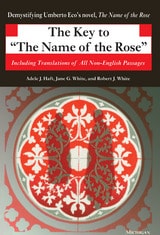
cover of The Key to The Name of the Rose: Including Translations of All Non-English Passages

The Key to The Name of the Rose

Including Translations of All Non-English Passages

Adele J. Haft, Jane G. White, and Robert J. White

University of Michigan Press, 1999

Umberto Eco's The Name of the Rose is a brilliant mystery set in a fictitious medieval monastery. The text is rich with literary, historical, and theoretical references that make it eminently re-readable. The Key makes each reading fuller and more meaningful by helping the interested reader not merely to read but also to understand Eco's masterful work. Inspired by pleas from friends and strangers, the authors, each trained in Classics, undertook to translate and explain the Latin phrases that pepper the story. They have produced an approachable, informative guide to the book and its setting--the middle ages. The Key includes an introduction to the book, the middle ages, Umberto Eco, and philosophical and literary theories; a useful chronology; and reference notes to historical people and events.
The clear explanations of the historical setting and players will be useful to anyone interested in a general introduction to medieval history.
Adele J. Haft is Associate Professor of Classics, Hunter College, City University of New York. Jane G. White is chair of the Department of Languages, Dwight Englewood School. Robert J. White is Professor of Classics and Oriental Studies, Hunter College, City University of New York.
[more]