Results by title
7 books match the query 'Conditions'
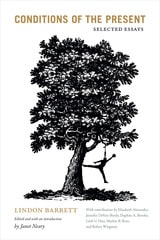
Conditions of the Present
Selected EssaysLindon Barrett
Duke University Press, 2018
Contributors. Elizabeth Alexander, Jennifer DeVere Brody, Daphne A. Brooks, Linh U. Hua, Janet Neary, Marlon B. Ross, Robyn Wiegman

Context Providers
Conditions of Meaning in Media ArtsMargot Lovejoy, Christiane Paul, Victoria Vesna
Intellect Books, 2011
Context Providers explores the ways in which digital art and culture are challenging and changing the creative process and our ways of constructing meaning. The authors introduce the concept of artists as context providers—people who establish networks of information in a highly collaborative creative process, blurring boundaries between disciplines. Technological change has affected the function of art, the role of the artist, and the way artistic productions are shared, creating a need for flexible information filters as a framework for establishing meaning and identity. Context Providers considers the work of media artists today who are directly engaging the scientific community through collaboration, active dialogue, and creative work that challenges the scientific.
Law and the Conditions of Freedom in the Nineteenth-Century United States
James Willard Hurst
University of Wisconsin Press, 1964
In these essays J. Willard Hurst shows the correlation between the conception of individual freedom and the application of law in the nineteenth-century United States—how individuals sought to use law to increase both their personal freedom and their opportunities for personal growth. These essays in jurisprudence and legal history are also a contribution to the study of social and intellectual history in the United States, to political science, and to economics as it concerns the role of public policy in our economy. The nonlawyer will find in them demonstration of how "technicalities" express deep issues of social values.

Law and the Conditions of Freedom in the Nineteenth-Century United States
J. Willard Hurst
University of Wisconsin Press, 1956
In these essays J. Willard Hurst shows the correlation between the conception of individual freedom and the application of law in the nineteenth-century United States—how individuals sought to use law to increase both their personal freedom and their opportunities for personal growth. These essays in jurisprudence and legal history are also a contribution to the study of social and intellectual history in the United States, to political science, and to economics as it concerns the role of public policy in our economy. The nonlawyer will find in them demonstration of how "technicalities" express deep issues of social values.
Minority Parties in U.S. Legislatures
Conditions of InfluenceJennifer Hayes Clark
University of Michigan Press, 2015
Challenging conventional assumptions that the majority party dominates the legislature, Jennifer Hayes Clark investigates precisely the ways in which—and under what conditions—members of the minority party successfully pursue their interests. For this study, Clark collects fine-grained data from both the U.S. Congress and state legislatures to get a close look at three key points in the legislative process: committee assignments, bill cosponsorship, and roll-call votes. She finds that minority party members are not systematically excluded throughout the policymaking process. Indeed, their capacity to shape legislative decision-making is enhanced when party polarization is low, when institutional prerogatives are broadly dispersed rather than centralized, and when staff resources are limited. Under these conditions, bipartisanship bill cosponsorship and voting coalitions are also more prevalent.
With the sharp increase of partisan polarization in state legislatures and in Congress, it is essential to understand how and when a minority party can effectively represent constituents.
The Conditions of Discretion
Joel Handler
Russell Sage Foundation, 1986
The Cultural Practice of Immigrant Filmmaking
The Conditions and Practices of Migrant Minor Cinemas in Sweden 1950-1990John Sundholm and Lars Gustaf Andersson
Intellect Books, 2019
Based on a research project funded by the Swedish Research Council, this book examines 40 years of post-war independent immigrant filmmaking in Sweden. John Sundholm and Lars Gustaf Andersson consider the creativity that lies in the state of exile, offering analyses of over 50 rarely seen immigrant films that would otherwise remain invisible and unarchived. They shed light on the complex web of personal, economic, and cultural circumstances that surround migrant filmmaking, discuss associations that became important sites of self-organization for exiled filmmakers, and explore the cultural practice of minor immigrant cinema archiving. The Cultural Practice of Immigrant Filmmaking applies film theory to immigrant filmmaking in a transnational context, exploring how immigrant filmmakers use film to find a place in a new cultural situation.