Results by title
6 books match the query 'Conflict of generations'
An Uncertain Age
The Politics of Manhood in KenyaPaul Ocobock
Ohio University Press, 2017
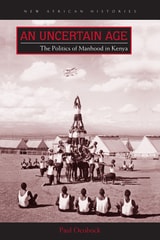
In twentieth-century Kenya, age and gender were powerful cultural and political forces that animated household and generational relationships. They also shaped East Africans’ contact with and influence on emergent colonial and global ideas about age and masculinity. Kenyan men and boys came of age achieving their manhood through changing rites of passage and access to new outlets such as town life, crime, anticolonial violence, and nationalism. And as they did, the colonial government appropriated masculinity and maturity as means of statecraft and control.
In An Uncertain Age, Paul Ocobock positions age and gender at the heart of everyday life and state building in Kenya. He excavates in unprecedented ways how the evolving concept of “youth” motivated and energized colonial power and the movements against it, exploring the masculinities boys and young men debated and performed as they crisscrossed the colony in search of wages or took the Mau Mau oath. Yet he also considers how British officials’ own ideas about masculinity shaped not only young African men’s ideas about manhood but the very nature of colonial rule.
An Uncertain Age joins a growing number of histories that have begun to break down monolithic male identities to push the historiographies of Kenya and empire into new territory.
Inventing Modern Adolescence
The Children of Immigrants in Turn-of-the-Century AmericaSarah E. Chinn
Rutgers University Press, 2008
Mildred Pierce
Edited by Albert J. La Valley; Tino T. Balio, Series Editor
University of Wisconsin Press, 1980
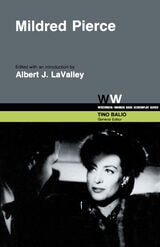
Joan Crawford forged a new and successful screen image in this powerful women's noir film; winning her an Academy Award for best actress.
Albert J. LaValley's through and insightful guide to Mildred Pierce at once tells us much about the making of this complex film, the problems and process of transferring the story to the screen, the specific and important roles of the producer, director, and set designer, and how the film relates to broad trends within the industry. It is without a doubt the most thorough treatment of this important American motion picture.
Romeo and Juliet
William Shakespeare
Arizona Center for Medieval and Renaissance Studies, 2022
“For never was a story of more woe / Than this of Juliet and her Romeo.” In this new version of Romeo and Juliet, written in accessible modern English, Hansol Jung breathes new life into Shakespeare’s famous tragedy. By closely examining the familiar language and focusing on the subtleties of the text, Jung illuminates a surprising and more nuanced world than many of us have come to expect from the well-known tale of star-crossed lovers.
This translation of Romeo and Juliet was written as part of the Oregon Shakespeare Festival’s Play On! project, which commissioned new translations of thirty-nine Shakespeare plays. These translations present work from “The Bard” in language accessible to modern audiences while never losing the beauty of Shakespeare’s verse. Enlisting the talents of a diverse group of contemporary playwrights, screenwriters, and dramaturges from diverse backgrounds, this project reenvisions Shakespeare for the twenty-first century. These volumes make these works available for the first time in print—a new First Folio for a new era.

Tokyo Boogie-woogie and D.T. Suzuki
Shoji Yamada
University of Michigan Press, 2022
Against this famous figure, however, is a largely unknown or forgotten shape: Suzuki Alan Masaru. Alan was D.T. Suzuki’s adopted son and, though he remained within his father’s shadow, is mostly known as the lyricist of the iconic pop hit “Tokyo Boogie-woogie.” Perhaps due to his frequent scandals and the fraught nature of the relationship, Alan remains unmentioned and unstudied by scholars and historians. Yet by exploring the nature of the relationship between these two, Shoji Yamada digs into the conflicting memories and experiences of these generations in Japan.

Two Kinds of Rationality
Kibbutz Democracy and Generational ConflictT.M.S. Evens
University of Minnesota Press, 1995
Two Kinds of Rationality was first published in 1995. Minnesota Archive Editions uses digital technology to make long-unavailable books once again accessible, and are published unaltered from the original University of Minnesota Press editions.
Beginning with a discussion of mind-body dualism in social anthropology, Evens presents a profound theory of human conduct that deploys notions of hierarchy and practice. He uses the case study of an Israeli kibbutz to address the central anthropological problem of rationality.
Of particular interest is Evens's interpretation of the Genesis myth, as well as his reading of Rousseau's revision of this myth, as paradigms of generational conflict and the kibbutz's logic of moral order. These interpretations are tied to Evens's detailed discussion of a controversial attempt to introduce secret balloting into a particular kibbutz's directly democratic process.
Two Kinds of Rationality distinguishes between instrumental and mythic rationality, picturing the latter as a value rationality. Projecting reality as basically ambiguous, Evens offers a critique of theoretical approaches to social action and a rethinking of contemporary notions of human agency. This revolutionary theoretical work will appeal to social and political theorists, anthropologists, and students of cultural studies, social movements, and Jewish studies.
T. M. S. Evens is professor of anthropology at the University of North Carolina, Chapel Hill. He is the author of numerous articles and coeditor of Transcendence in Society: Case Studies (1990), a comparative study of social movements.