Results by title
6 books match the query 'Confrontation'
Being and God
A Systematic Approach in Confrontation with Martin Heidegger, Emmanuel Levinas, and Jean-Luc MarionLorenz B. Puntel and Alan White
Northwestern University Press, 2011
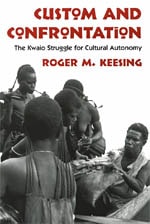
Custom and Confrontation
The Kwaio Struggle for Cultural AutonomyRoger M. Keesing
University of Chicago Press, 1992
"A major contribution to the ethnography and history of Malaita and Melanesia, and to the growing literature on cultural resistance. But above all, his humane and painful analysis of the meeting of peoples living in different worlds and constructing their agendas and moralities on incommensurate—and apparently equally arbitrary—principles, represents a major contribution and challenge to anthropological thought, addressing the basic issue of what it is to be human."—Fredrik Barth
Disability Rights Movement
From Charity to ConfrontationDoris Fleischer
Temple University Press, 2000
Referring to the Americans with Disabilities Act as "every American's insurance policy," the authors recount the genesis of this civil rights approach to disability, from the almost forgotten disability activism of the 1930s to the independent living movement of the 1970s to the call for disability pride of the 1990s. Like other civil rights struggles, the disability rights movement took place in the streets and in the courts as activists fought for change in the schools, the workplace, and in the legal system. They continue to fight for effective access to the necessities of everyday life -- to telephones, buses, planes, public buildings, restaurants, and toilets.
The history of disability rights mirrors the history of the country. Both World Wars sparked changes in disability policy and changes in medical technology as veterans without without limbs and with other disabilities return home. The empowerment of people with disabilities has become another chapter in the struggles over identity politics that began in the 1960s. Today, with the expanding ability of people with disabilities to enter the workforce, and a growing elderly population increasingly significant at a time when HMOs are trying to contain healthcare expenditures.
Engagement, Enlargement, and Confrontation
A Political History of the European Union’s Eastern Policies after the Cold WarGraham Timmins
Central European University Press, 0
Engagement, Enlargement, and Confrontation provides a holistic view of the European Union’s eastern relations explored in an historical context following the end of the Cold War. The author draws out the key achievements and failures of this strategic exercise.
The focus is on the institutional adaptation of the European Union as well as on the dynamics of its policies towards the East. Graham Timmins identifies four interconnected factors which have shaped the development of the EU’s policies towards its eastern neighbours; the projection of the EU’s identity as an agent of peace and stability, the maintenance of internal stability within the Union, the coordination of Member State foreign policies, and the EU’s relations with Russia.
The book explores the key challenges faced by the European Union in terms of the EU’s eastern policies. These include capacity building, the management of expectations in the eastern neighbourhood, the reconciliation of national perspectives and agendas with wider EU strategic thinking, and last but not least the handling of the relationship with Russia. The general conclusion of the study is that the EU’s internal development in respect to its relationship with its eastern members and neighbours is likely to remain complex and unpredictable.
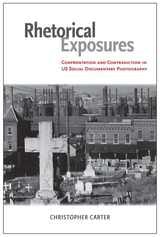
Rhetorical Exposures
Confrontation and Contradiction in US Social Documentary PhotographyChristopher Carter
University of Alabama Press, 2015
Exposing the politics of seeing: how documentary photographs confront inequality and reshape public understanding.
In Rhetorical Exposures, Christopher Carter explores social documentary photography from the nineteenth century to the present in order to illuminate the political dimensions and consequences of photographs taken and selected to highlight social injustice. Documentary photography aims to capture the material reality of life. Carter demonstrates how the creation and display of documentary photographs—often now called “imagetexts”—both invite analysis and raise persistent questions about the political and social causes for the bleak scenes of poverty and distress captured on film.
Carter’s carefully reasoned monograph examines both formal qualities of composition and the historical contexts of the production and display of documentary photographs. In Rhetorical Exposures, Carter explores Jacob Riis’s heartrending photos of Manhattan’s poor in late nineteenth-century New York, Walker Evans’s iconic images of tenant farmers in west Alabama, Ted Streshinsky’s images of 1960s social movements, Camilo José Vergara’s photographic landscapes of urban dereliction in the 1970s, and Chandra McCormick’s portraits of New Orleans’s Ninth Ward scarred by Hurricane Katrina.
While not ascribing specifically political or Marxist intentions to the photographers discussed, Carter frames his arguments in a class-based dialectic that addresses material want as an ineluctable result of social inequality. Carter argues that social documentary photography has the powerful capacity to disrupt complacent habits of viewing and to prompt viewers to confront injustice. Though photography may induce socially disruptive experiences, it remains vulnerable to the same power dynamics it subverts. Therefore, Carter offers a “rhetoric of exposure” that outlines how such social documentary images can be treated as highly tensioned rhetorical objects. His framework enables the analysis of photographs as heterogeneous records of the interaction of social classes and expressions of specific built environments. Rhetorical Exposures also discusses how photographs interact with oral and print media and relate to creations as diverse as public memorials, murals, and graphic novels.
As the creation and dissemination of new media continues to evolve in an environment of increasing anxiety about growing financial inequality, Rhetorical Exposures offers a very apt and timely discussion of the ways social documentary photography is created, employed, and understood.
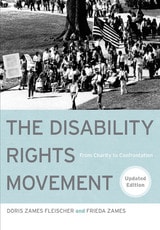
The Disability Rights Movement
From Charity to ConfrontationDoris Fleischer
Temple University Press, 2011
In this updated edition, Doris Zames Fleischer and Frieda Zames expand their encyclopedic history of the struggle for disability rights in the United States, to include the past ten years of disability rights activism.The book includes a new chapter on the evolving impact of the Americans with Disabilities Act, the continuing struggle for cross-disability civil and human rights, and the changing perceptions of disability.
The authors provide a probing analysis of such topics as deinstitutionalization, housing, health care, assisted suicide, employment, education, new technologies, disabled veterans, and disability culture.
Based on interviews with over one hundred activists, The Disability Rights Movement tells a complex and compelling story of an ongoing movement that seeks to create an equitable and diverse society, inclusive of people with disabilities.