Results by title
2 books match the query 'Congo (Brazzaville)'
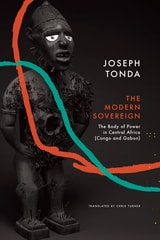
Modern Sovereign
The Body of Power in Central Africa (Congo and Gabon)Joseph Tonda
Seagull Books, 2020
The “Modern Sovereign,” a notion indebted both to Hobbes’s Leviathan and Marx’s conception of capital, refers to the power that governed the African multitudes from the earliest colonial days to the post-colonial era. It is an internalized power, responsible for the multiform violence exerted on bodies and imaginations. Joseph Tonda contends that in Central Africa—and particularly in Gabon and the Congo—the body is at the heart of political, religious, sexual, economic, and ritual power. This, he argues, is confirmed by the strong link between corporeal and political matters, and by the ostentatious display of bodies in African life. The body of power asserts itself as both matter and spirit, and it incorporates the seductive force of money, commodities, sex, and knowledge. Tonda’s incisive analysis reveals how this sovereign power is a social relation, historically constituted by the violence of the African cultural Imaginary and the realities of State, Market, and Church. It is to be understood, he asserts, through a generalized theory economic, political, and religious fetishism. By introducing this crucial critical voice from contemporary Africa into the English language, The Modern Sovereign makes a significant contribution to field of anthropology, political science, and African studies.
[more]
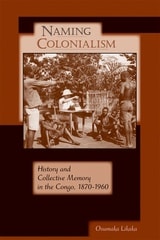
Naming Colonialism
History and Collective Memory in the Congo, 1870–1960Osumaka Likaka
University of Wisconsin Press, 2009
What’s in a name? As Osumaka Likaka argues in this illuminating study, the names that Congolese villagers gave to European colonizers reveal much about how Africans experienced and reacted to colonialism. The arrival of explorers, missionaries, administrators, and company agents allowed Africans to observe Westerners’ physical appearances, behavior, and cultural practices at close range—often resulting in subtle yet trenchant critiques. By naming Europeans, Africans turned a universal practice into a local mnemonic system, recording and preserving the village’s understanding of colonialism in the form of pithy verbal expressions that were easy to remember and transmit across localities, regions, and generations.
Methodologically innovative, Naming Colonialism advances a new approach that shows how a cultural process—the naming of Europeans—can provide a point of entry into economic and social histories. Drawing on archival documents and oral interviews, Likaka encounters and analyzes a welter of coded fragments. The vivid epithets Congolese gave to rubber company agents—“the home burner,” “Leopard,” “Beat, beat,” “The hippopotamus-hide whip”—clearly conveyed the violence that underpinned colonial extractive economies. Other names were subtler, hinting at derogatory meaning by way of riddles, metaphors, or symbols to which the Europeans were oblivious. Africans thus emerge from this study as autonomous actors whose capacity to observe, categorize, and evaluate reverses our usual optic, providing a critical window on Central African colonialism in its local and regional dimensions.
Methodologically innovative, Naming Colonialism advances a new approach that shows how a cultural process—the naming of Europeans—can provide a point of entry into economic and social histories. Drawing on archival documents and oral interviews, Likaka encounters and analyzes a welter of coded fragments. The vivid epithets Congolese gave to rubber company agents—“the home burner,” “Leopard,” “Beat, beat,” “The hippopotamus-hide whip”—clearly conveyed the violence that underpinned colonial extractive economies. Other names were subtler, hinting at derogatory meaning by way of riddles, metaphors, or symbols to which the Europeans were oblivious. Africans thus emerge from this study as autonomous actors whose capacity to observe, categorize, and evaluate reverses our usual optic, providing a critical window on Central African colonialism in its local and regional dimensions.
[more]