Results by title
3 books match the query 'Conjuring'
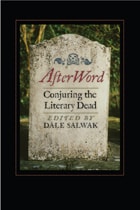
AfterWord
Conjuring the Literary DeadDale Salwak
University of Iowa Press, 2011
If you could meet one deceased literary figure, who would that be? What would you ask? What would you say, and why? In AfterWord: Conjuring the Literary Dead, eighteen distinguished authors respond to this challenge by creating imagined conversations with a constellation of British and American authors, from Samuel Johnson to Jane Austen to Samuel Beckett to Edith Wharton.
Each chapter embarks on an intellectual, emotional, and often humorous voyage as the layers of time are peeled away, letting readers experience authors as they really were in their own era or, on occasion, transported to the present. As eccentric as it is eclectic, this collection takes the audience on a dizzying descent into a literary Inferno where biographers, novelists, and critics eat the food of the dead and return to tell the tale. Readers will take great pleasure in seeing what happens when scholars are loosed from the chains of fact and conduct imaginary interviews with deceased authors.
Covering 200 years of literary history, the essays in AfterWord draw upon the lifelong, consuming interest of the contributors, each fashioning a vivid, credible portrait of a vulnerable, driven, fully human character. As contributors appeal to what Margaret Atwood calls the deep human desire to “go to the land of the dead, to bring back to the living someone who has gone there,” readers are privy to questions that have seldom been asked, to incidents that have been suppressed, to some of the secrets that have puzzled readers for years, and to novel literary truths about the essential nature of each author.
Contributors to AfterWord are: Catherine Aird (on Rudyard Kipling), Brian Aldiss (on Thomas Hardy), Margaret Atwood (on negotiating with the dead), William M. Chace (on Ezra Pound), Nora Crook (on the Shelleys), Paul Delany (on George Gissing), Colin Dexter (on Alfred Edward Housman), Margaret Drabble (on Arnold Bennett), Peter Firchow (on George Orwell), Alan W. Friedman (on Samuel Beckett), Eugene Goodheart (on Jane Austen), John Halperin (on Edith Wharton), Francis King (on Oscar Wilde), Jeffrey Meyers (on Samuel Johnson), Cynthia Ozick (on Henry James), Jay Parini (on Robert Frost), Carl Rollyson (on William Faulkner), Dale Salwak and Laura Nagy (on literary imagination), Alan Sillitoe (on Joseph Conrad), and Ann Thwaite (on Frances Hodgson Burnett, Edmund Gosse, A. A. Milne, and Emily Tennyson).
[more]
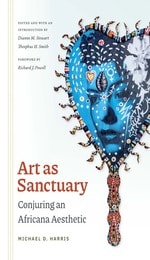
Art as Sanctuary
Conjuring an Africana AestheticMichael D. Harris. Edited and with an introduction by Dianne M. Stewart and Theophus H. Smith. Foreword by Richard J. Powell.
Duke University Press, 2026
In Art as Sanctuary, Michael D. Harris considers literal and metaphorical uses of sanctuary in the black experience and African diaspora art, including locales of spiritual expression, self-renewal, and cultural celebration. Harris offers an alternative framework to the Duboisian philosophy of double consciousness, pushing the boundaries of Africana aesthetic analysis by exploring the cultural signifiers embedded consciously or unconsciously in African diaspora art. Within these works, he reveals how these cultural cues speak to the vibrancy of African American life. While acknowledging the presence of the white observer’s gaze, Harris wishes to relieve the black interior from the panoptic assumptions of that gaze and its disciplines. Art as Sanctuary provides innovative pathways to understand African American visual culture and music as autobiographies of cultural identity and experience.
[more]
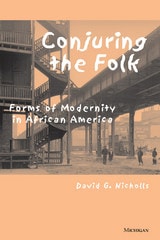
Conjuring the Folk
Forms of Modernity in African AmericaDavid G. Nicholls
University of Michigan Press, 2000
Conjuring the Folk addresses the dynamic relation between metropolitan artistic culture and its popular referents during the Harlem Renaissance period. From Jean Toomer's conclusion that "the Negro of the folk-song has all but passed away" to Zora Neale Hurston's discovery of "a rich field for folk-lore" in a Florida lumber camp, Harlem Renaissance writers made competing claims about the vitality of the African-American "folk." These competing claims, David Nicholls explains, form the basis of a discordant conversation on the question of modernity in African America.
In a series of revisionary readings, Nicholls studies how the "folk" is shaped by the ideology of form. He examines the presence of a spectral "folk" in Toomer's modernist pastiche, Cane. He explores how Hurston presents folklore as a contemporary language of resistance in her ethnography, Mules and Men. In Claude McKay's naturalistic romance, Banana Bottom, Nicholls discovers the figuration of an alternative modernity in the heroine's recovery of her lost "folk" identity. He unearths the individualist ethos of Booker T. Washington in two novels by George Wylie Henderson. And he reveals how Richard Wright's photo-documentary history, 12 Million BlackVoices, places the "folk" in a Marxian narrative of modernization toward class-consciousness.
A provocative rereading of the cultural politics of the Harlem Renaissance, Conjuring the Folk offers a new way of understanding literary responses to migration, modernization, and the concept of the "folk" itself.
David G. Nicholls is a post-doctoral fellow in the Center for the Study of Race, Politics, and Culture, University of Chicago.
[more]